
Vitamin K Intake Calculator for Warfarin Users
How This Works
This tool helps you calculate your daily vitamin K intake to maintain consistent levels. The goal is to consume 90-120 micrograms of vitamin K per day. Consistency matters more than avoiding greens completely.
Select Your Foods
Your Daily Intake
Your Result
When you're on warfarin, your blood thinner isn't just reacting to your pills-it's reacting to your spinach. A single cup of cooked spinach can pack over 800 micrograms of vitamin K. That’s more than eight times your daily need. And if you eat that one day, then skip greens the next, your INR can swing dangerously low-or spike too high. It’s not about avoiding vitamin K. It’s about keeping it steady.
Why Vitamin K Matters on Warfarin
Warfarin works by blocking vitamin K from helping your blood clot. That’s why it prevents dangerous clots in people with atrial fibrillation, deep vein thrombosis, or mechanical heart valves. But vitamin K doesn’t just disappear when you take warfarin. It’s still in your food, your gut, even your body’s own cells. And every time you eat a high-vitamin K food, it fights back against the drug’s effect.Here’s the math: if your INR is 2.5 and you suddenly eat three cups of kale, your INR could drop to 1.8 in 48 hours. That’s not just a number-it’s a risk. An INR below 2.0 means your blood is clotting too fast. You’re vulnerable to stroke or pulmonary embolism. On the flip side, if you cut out vitamin K for days and then eat a big bowl of broccoli, your INR might jump to 5.0. That’s bleeding territory-nosebleeds, bruising, even internal bleeding.
The old advice-"avoid all greens"-is outdated and dangerous. Studies show patients who restrict vitamin K end up with worse INR control because they’re not prepared for the occasional salad. The real key? Consistency.
What Counts as High-Vitamin K Food?
Not all vegetables are equal. Some barely move the needle. Others? They’re game-changers.- Very High (500+ µg per cup cooked): Cooked spinach (889 µg), kale (547 µg), collard greens (772 µg), Swiss chard (585 µg)
- High (200-500 µg): Broccoli (220 µg), Brussels sprouts (219 µg), asparagus (70 µg per half-cup)
- Moderate (50-200 µg): Green beans (14 µg per half-cup), cabbage (80 µg), lettuce (40 µg per cup)
- Low (under 50 µg): Carrots, tomatoes, onions, potatoes, apples, rice, chicken, eggs
Raw vs. cooked matters too. One cup of raw spinach has 145 µg. Cook it down, and you’re looking at nearly 900 µg because the volume shrinks. Same with broccoli. Raw? 80 µg. Cooked? 220 µg. If you’re not tracking portion size and preparation, you’re guessing-and guessing wrong.
The Consistency Rule: 90-120 µg Per Day, Every Day
The American Heart Association, the American College of Cardiology, and the American Society of Hematology all agree: don’t cut vitamin K. Stabilize it.Target: 90 to 120 micrograms of vitamin K per day. That’s not a lot. One cup of raw spinach (145 µg) is already near the top. Or two cups of raw kale (100 µg). Or half a cup of cooked broccoli (110 µg). You don’t need to eat all of them. Just pick one or two consistent sources and stick to them.
Here’s what works for real people:
- Every morning: one cup of raw baby spinach in a smoothie (90 µg)
- Every other day: half a cup of cooked broccoli (110 µg)
- Never: three-day streak of kale salads followed by zero greens
People who do this see their Time in Therapeutic Range (TTR)-the percentage of time their INR stays between 2.0 and 3.0-jump from 55% to over 80%. That’s the difference between frequent INR checks and long stretches of stability.
What You Should Avoid
Some foods and habits sabotage consistency without you even realizing it.- Supplements: Many multivitamins, protein shakes (Ensure®, Boost®), and green powders contain 50-100 µg of vitamin K. Read labels. If it’s not listed, don’t take it.
- Antibiotics: They kill gut bacteria that make vitamin K2. If you’re on antibiotics, your vitamin K levels drop. Your INR might rise unexpectedly. Tell your anticoagulation clinic.
- Illness: If you’re sick and not eating, your vitamin K intake drops. Your INR can climb. Keep eating-even if it’s just toast and yogurt. Don’t fast.
- Alcohol: Heavy drinking (more than 2 drinks/day) can raise INR. Keep it steady, not bingey.
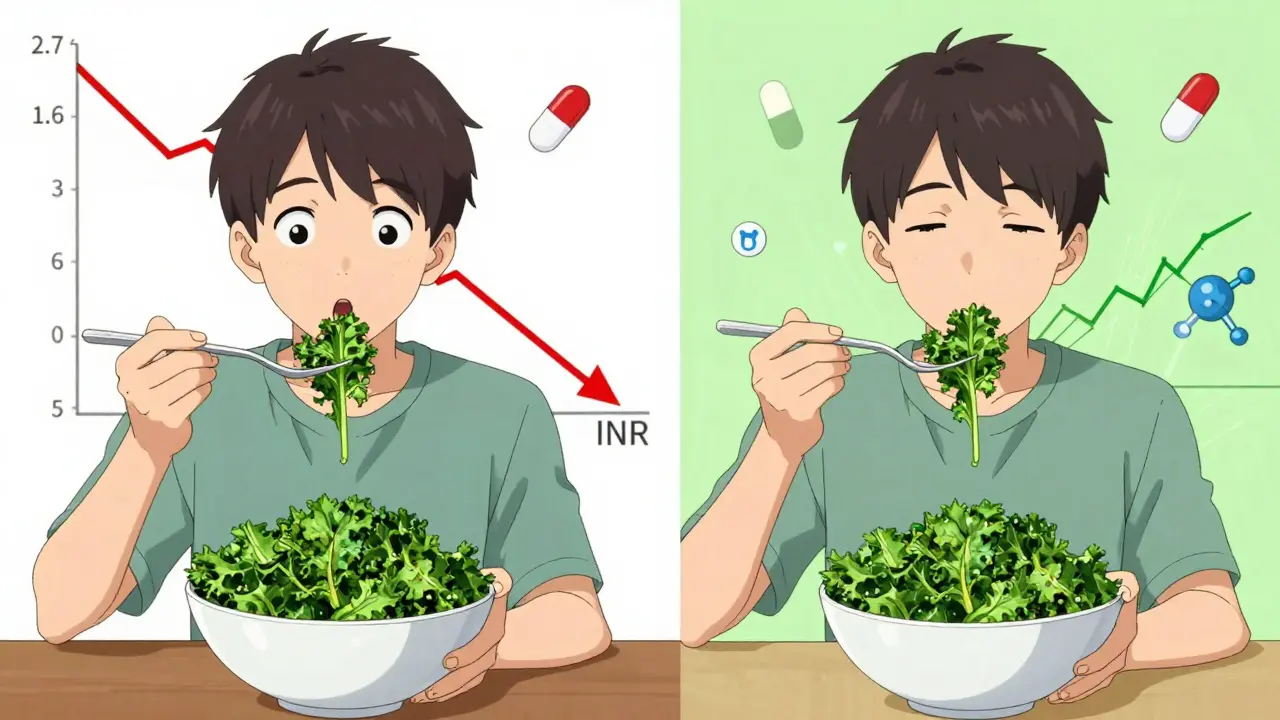
One patient in a 2022 study drank a daily green juice with kale, spinach, and parsley. His INR was rock-stable. Then he switched to a different brand with more kale. His INR crashed from 2.7 to 1.6 in three days. He needed a hospital visit. The change? Just one ingredient.
Tools That Actually Help
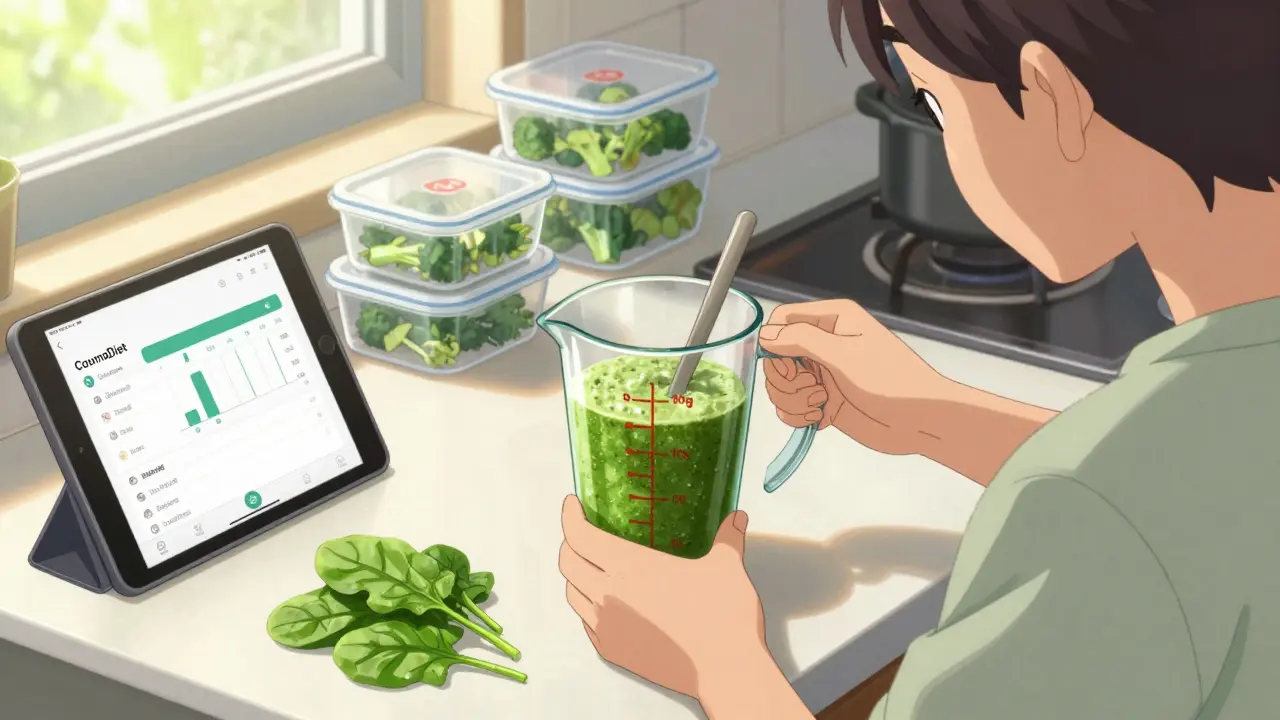
You don’t need to memorize every food’s vitamin K content. You need a system.- MyFitnessPal: Use the USDA database. Search "kale, cooked"-not just "kale." Portion size matters. Log everything.
- CoumaDiet app: Designed for warfarin users. Tracks daily K intake, predicts INR trends, and alerts you if you’ve deviated too far from your baseline.
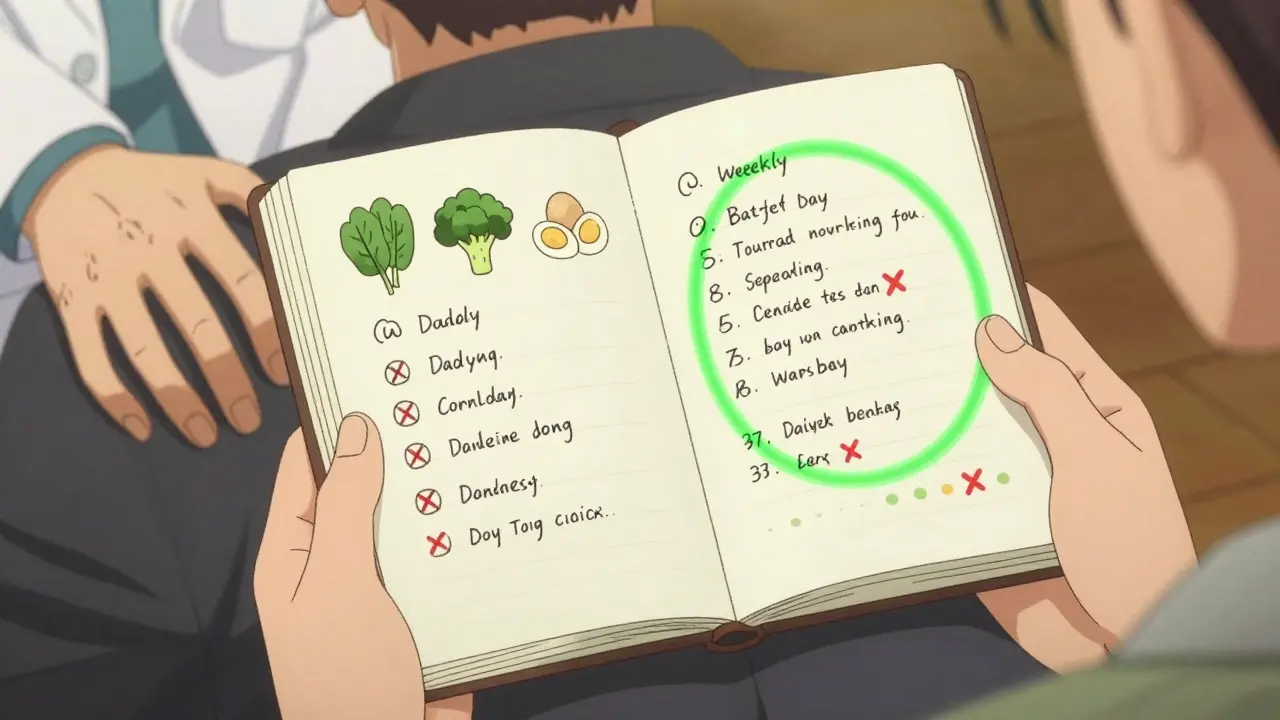
- Food diary: Pen and paper still works. Write down what you ate, when, and how much. Bring it to every INR check.
- Weekly meal prep: Cook your high-K foods on Sunday. Portion them out. Eat the same amount every day. No surprises.
Patients who use apps or diaries are 37% more likely to maintain stable INR levels than those who don’t. It’s not about being perfect. It’s about being predictable.
What About DOACs? Are They Better?
Newer blood thinners like apixaban (Eliquis) or rivaroxaban (Xarelto) don’t care about vitamin K. You can eat kale, skip it, or binge it-they won’t budge. And they don’t need weekly blood tests.So why is warfarin still prescribed to 35% of new atrial fibrillation patients in 2026? Cost. Warfarin costs $4-$10 a month. DOACs cost $300-$400. For many, especially older adults on fixed incomes, warfarin is the only option.
And here’s the twist: even if you’re on a DOAC, you still need to watch vitamin K. Why? Because if you ever need surgery, or if your kidney function drops, your doctor might switch you back to warfarin. Knowing how to manage vitamin K now means you won’t be caught off guard later.
What to Do If Your INR Fluctuates
If your INR drops below 2.0 or rises above 4.0, don’t panic-but don’t ignore it either.- Check your food log: Did you eat something new? A restaurant salad? A supplement? A different brand of protein bar?
- Review medications: Did you start or stop an antibiotic? A painkiller? A cold medicine? Many interact with warfarin.
- Call your clinic: Don’t wait for your next appointment. Most clinics have a 24/7 line for INR emergencies.
- Don’t adjust your dose yourself: Even 0.5 mg too much or too little can be risky. Let your anticoagulation team guide you.
One man in Perth adjusted his warfarin dose after eating a large spinach salad. He thought he was "fixing" a low INR. He ended up with a dangerous bleed. He didn’t know that vitamin K takes 3-5 days to affect INR. His body was still reacting to the salad when he changed his pill.
Final Rule: No Surprises
Warfarin isn’t about perfection. It’s about rhythm. Think of it like insulin for diabetics-you don’t avoid carbs. You eat the same amount every day. Same here.Choose one or two vitamin K sources. Stick to the same portion. Log it. Don’t skip. Don’t binge. And if you’re unsure? Ask your anticoagulation clinic. They’ve seen it all.
The goal isn’t to eat less vitamin K. It’s to eat the same amount, every single day. That’s how you stay out of the hospital, avoid strokes, and live without fear.
Can I eat spinach on warfarin?
Yes, but only if you eat the same amount every day. One cup of raw spinach (about 90 µg) is safe and stable. Three cups? Not unless you do it every day. Consistency matters more than avoidance.
Should I stop eating green vegetables on warfarin?
No. Cutting out greens leads to more INR swings because you’re unprepared for accidental intake. The guidelines say to maintain consistent intake, not avoid vitamin K. Restriction increases risk-not reduces it.
Why does my INR change even when I eat the same food?
Several factors: antibiotics can reduce gut vitamin K, illness can lower food intake, alcohol can affect liver metabolism, and even changes in your body weight or hydration can shift INR. Food isn’t the only variable. Track everything.
Is vitamin K2 different from K1 on warfarin?
Yes, but not enough to matter. K1 from plants (spinach, kale) has a stronger effect on warfarin than K2 from cheese or natto. But both interfere. Don’t assume fermented foods are "safe." Stick to consistency across all sources.
How long does it take to stabilize vitamin K intake?
Most people need 8 to 12 weeks to build a routine. INR stability improves by about 5% per month. Be patient. Use an app or diary. Don’t give up after one bad INR.
Can I take vitamin K supplements to help stabilize my INR?
Yes-under medical supervision. Studies show 100-150 µg/day of supplemental vitamin K can actually improve INR stability in people with erratic intake. But never start a supplement without telling your anticoagulation clinic first.
William Minks
March 4, 2026 AT 14:57Just wanted to say this post saved my life 🙏 I was eating spinach every other day and wondering why my INR was all over the place. Started doing the same cup of raw spinach every morning like clockwork. No more panic calls to the clinic. My TTR went from 48% to 83% in 3 months. Consistency > perfection. Also, MyFitnessPal is a game changer if you use the USDA database right. 🥬💪
Susan Purney Mark
March 5, 2026 AT 12:32Thank you for this. I’ve been on warfarin for 7 years and this is the first time someone explained it in a way that actually stuck. I used to avoid greens completely out of fear. Now I have a weekly smoothie with spinach, kale, and flaxseed - same amount every Monday, Wednesday, Friday. No more INR rollercoaster. Also, side note: if you’re on antibiotics, tell your anticoagulation team. Mine didn’t warn me and I ended up in the ER. 😅
Amina Aminkhuslen
March 6, 2026 AT 01:57Ugh. People still on warfarin in 2026? Bro. DOACs exist. They don’t care if you eat a whole damn kale farm. If you’re too broke to afford Eliquis, maybe you shouldn’t be on a blood thinner at all. Or better yet - get a job that pays more than minimum wage. This whole ‘consistency’ thing is just a band-aid on a bullet wound.
Roland Silber
March 7, 2026 AT 22:41This is actually one of the most thoughtful, well-researched posts I’ve seen on this topic. I work as a clinical pharmacist and I’ve seen too many patients get confused because they were told to "avoid greens" - then they panic eat a salad after 3 weeks of nothing and their INR spikes. The key is predictable intake, not elimination. Also - vitamin K2 from natto? Yeah, it’s different chemically, but in practice? It still flips your INR. Don’t get cute with fermented soy. Stick to the plan. And yes, supplements can help - under supervision. I’ve had patients stabilize with 100mcg daily K1. It’s counterintuitive but it works. 📊
Patrick Jackson
March 8, 2026 AT 07:08I cried reading this. Not because I’m dramatic (okay maybe I am) but because I’ve been fighting this for 5 years. One day I ate a huge bowl of broccoli soup. Next day, INR 5.2. I thought I was being healthy. Turns out I was almost bleeding out. Now I prep my greens every Sunday. Same cup. Same time. Same bowl. I even have a little sticker on my fridge that says "K is my king." It sounds weird but it works. My doctor says I’m the most stable patient she’s ever had. I’m not perfect. But I’m predictable. And that’s everything. 🙌
Bridget Verwey
March 10, 2026 AT 02:31Oh honey. You’re telling me to eat the same amount of spinach every day? Like, as if I’m a robot with a vitamin K meter? Newsflash: life happens. You get sick. You travel. You eat at your nephew’s wedding and there’s kale in the salad. Guess what? Your INR will wiggle. And that’s okay. You don’t need to log every single leaf. Just don’t go full kale monk for a week then vanish. Be kind to yourself. And if you’re using an app? Congrats. You’re the 37% who actually care. The rest of us are just trying not to die. 🤷♀️
Andrew Poulin
March 11, 2026 AT 03:50Stop overcomplicating. Same amount every day. No surprises. Log it. Call if it’s out of range. That’s it. No need for apps. No need for charts. Just be consistent. If you can’t do that, maybe you shouldn’t be on warfarin. Simple. Done. 💪
Weston Potgieter
March 12, 2026 AT 18:14Wow this is so detailed. Like… why? Who has time for this? I eat what I want. My INR goes up, they lower my dose. It goes down, they raise it. It’s a job. I’m not a lab rat. Why not just switch to Xarelto? Oh right. Money. Well then maybe the system should fix that instead of making me track my kale like it’s a cult ritual. Also I read somewhere that gut bacteria make K2 so maybe just don’t take antibiotics? Nah I’m not even gonna bother. 🤷