
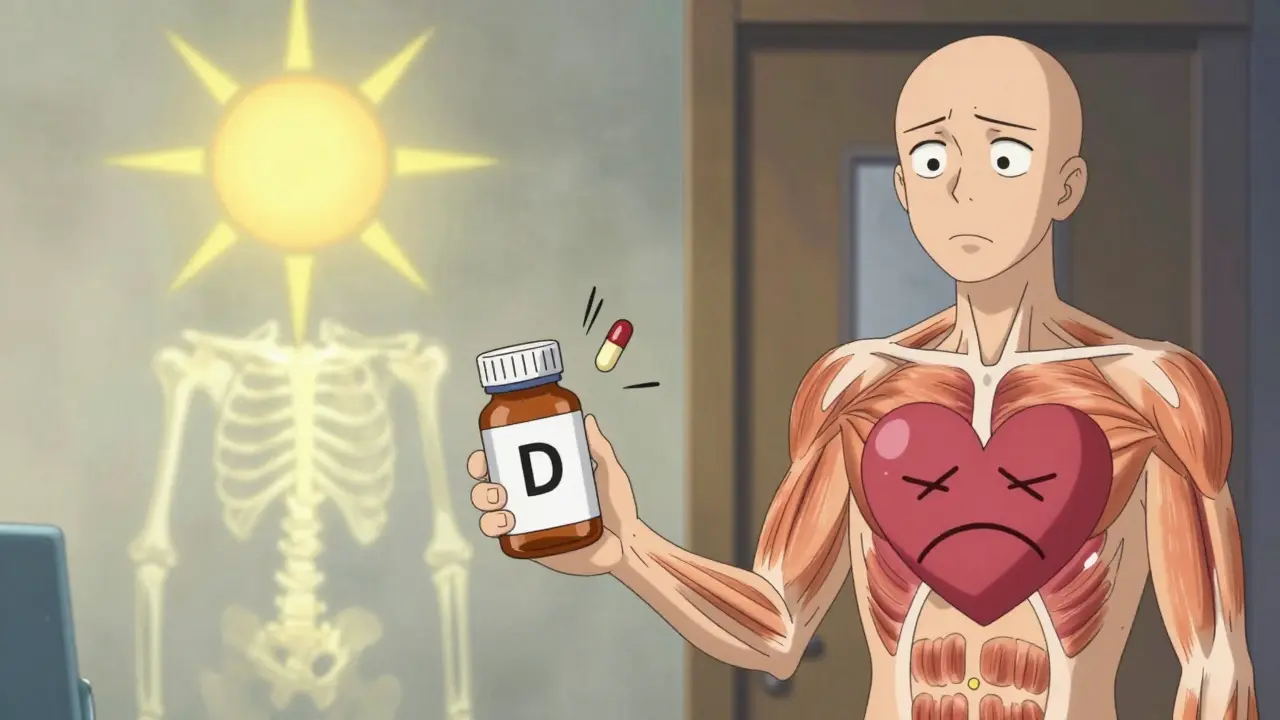
Millions of people take statins to lower cholesterol and protect their hearts. At the same time, nearly half of all Americans take vitamin D supplements - often because they’ve been told it’s good for bones, immunity, or even muscle pain. But what happens when you take both? Does vitamin D help with statin muscle aches? Do statins mess with your vitamin D levels? The answer isn’t simple, and the research tells a story that’s more confusing than most people realize.
Why People Think Vitamin D Helps with Statin Muscle Pain
It’s easy to see why so many people connect vitamin D with statin side effects. Statins can cause muscle soreness, weakness, or cramps - a problem called statin-associated muscle symptoms (SAMS). About 1 in 10 people on statins report these issues. When that happens, it’s common to hear advice like, “Try vitamin D. It helps with muscle function.” And it’s not just random internet advice. Many doctors still recommend it, even though the science doesn’t back it up.
On Reddit’s r/Statins community, over 60% of the 1,247 people surveyed said they tried vitamin D for muscle pain. More than half of them claimed it helped. On Drugs.com, 37% of users said vitamin D improved their symptoms. But here’s the catch: these are personal stories. They’re not proof. And when you look at real clinical trials - the kind that control for bias and placebo effects - the results tell a different story.
The VITAL Trial: The Most Reliable Evidence We Have
In 2022, the VITAL trial published a substudy that’s become the gold standard for answering this question. It tracked 2,083 people who just started taking statins. Half got 2,000 IU of vitamin D daily. The other half got a placebo. Neither group knew which they were taking. The trial lasted a year.
The result? No difference. Both groups had the same rate of muscle symptoms - 31%. Even among people with low vitamin D levels (under 20 ng/mL), the numbers were almost identical: 33% in the vitamin D group, 35% in the placebo group. That’s not a small difference. That’s no difference.
This wasn’t a fluke. The study was designed to catch even small effects. It was double-blind, randomized, and large enough to be statistically powerful. The researchers even checked if the effect changed based on how low someone’s vitamin D was to begin with. No matter the starting level, vitamin D didn’t reduce muscle pain.
The American College of Cardiology and the European Society of Cardiology both point to this trial as the reason they no longer recommend vitamin D for preventing statin muscle symptoms. Yet, 47% of primary care doctors still suggest it - mostly because patients ask for it.
Do Statins Affect Vitamin D Levels? The Evidence Is Mixed
It’s not just about whether vitamin D helps statin users - it’s also about whether statins change vitamin D levels in the body. And here, the data is all over the place.
Some studies show statins raise vitamin D. A 2012 study found that people taking rosuvastatin saw their vitamin D levels jump from 11.8 ng/mL to 35.2 ng/mL in just eight weeks. Another 2019 study found that statin users had higher vitamin D levels than non-users - especially those on atorvastatin. One theory is that statins might boost the activity of cholesterol transporters, helping the body absorb more vitamin D from food or supplements.
But other studies say the opposite. A 2018 study of 125 people found that those on statins had significantly lower vitamin D levels than those not taking them. In that group, 72% were deficient (under 20 ng/mL), compared to 49% in the control group. They also had more muscle pain.
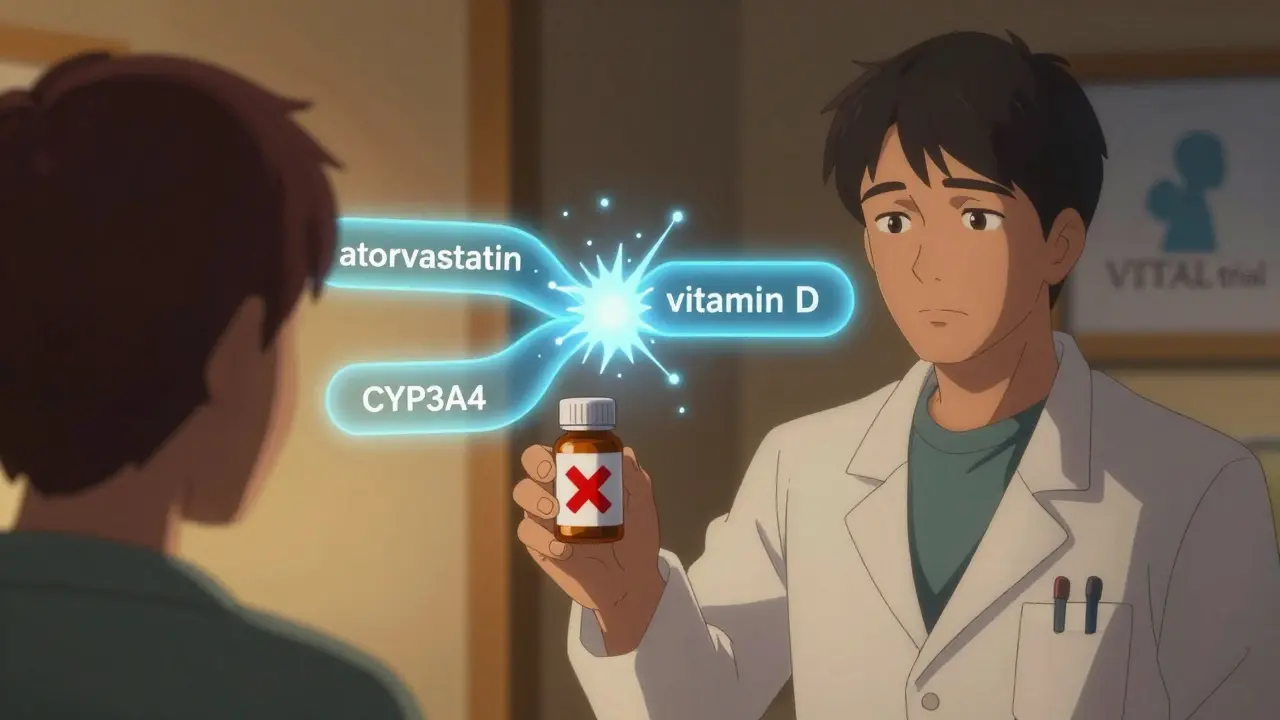
Why the contradiction? It might come down to the type of statin. Statins like atorvastatin, simvastatin, and lovastatin are broken down by the liver enzyme CYP3A4. Vitamin D is also processed through this pathway. That means they could compete - or maybe even help each other. Rosuvastatin and pravastatin, on the other hand, don’t rely on CYP3A4. They don’t seem to affect vitamin D levels much.
There’s also the issue of who’s taking them. People on statins are often older, less active, and may spend less time in the sun - all factors that lower vitamin D naturally. So when a study finds lower levels in statin users, is it the drug, or the lifestyle?
Could Vitamin D Lower Statin Effectiveness?
There’s another side to this. A 2015 study found that people taking 800 IU of vitamin D daily had lower levels of atorvastatin in their blood. That suggests vitamin D might interfere with how the body absorbs or breaks down the statin. If true, that could mean the statin isn’t working as well - which is a big deal if you’re taking it to prevent a heart attack.
This isn’t proven yet. But it’s a red flag. If you’re on a CYP3A4-metabolized statin like atorvastatin or simvastatin, and you’re taking high-dose vitamin D, it’s worth talking to your doctor. You might need your statin levels checked, especially if your cholesterol isn’t improving.
What Should You Do If You’re on Statins?
Let’s cut through the noise. Here’s what the evidence says you should actually do:
- Don’t take vitamin D to prevent muscle pain from statins. The best study we have says it doesn’t work.
- Do get your vitamin D level checked if you’re deficient. If your level is under 20 ng/mL, correcting that is important for your bones, immune system, and overall health - not because of statins, but because you need it.
- Don’t assume all statins act the same. If you’re on atorvastatin, simvastatin, or lovastatin, there’s a chance vitamin D could affect how your body processes it. Talk to your doctor about monitoring.
- Don’t take more than 2,000 IU daily unless your doctor says so. High doses can cause side effects, and there’s no proven benefit for statin users.
The European Atherosclerosis Society says it best: you don’t need vitamin D to prevent statin muscle pain - but you should still have enough for your general health. Aim for a level of at least 20 ng/mL. That’s not about statins. That’s about being healthy.
Why Does This Myth Keep Growing?
Even with solid evidence against it, the idea that vitamin D helps with statin muscle pain keeps spreading. Why?
First, people want control. Statin side effects feel random and scary. Taking a simple supplement feels like an easy fix. Second, there’s money behind it. The vitamin D supplement market is worth over $1.7 billion a year. The statin market is $14 billion. When those two overlap - and they do, in 30% of adults over 40 - there’s a lot of incentive to keep the myth alive.
Third, anecdotal wins stick. If someone takes vitamin D and their muscle pain goes away, they’ll remember it - even if it was just the placebo effect or a change in their diet, exercise, or sleep. The brain loves patterns, even when they’re not real.
The Bottom Line
Vitamin D doesn’t prevent statin muscle pain. That’s the clear takeaway from the best science we have. But that doesn’t mean you should stop taking it altogether. If you’re deficient, fix it. If you’re not, there’s no need to take extra just because you’re on a statin.
The real issue isn’t vitamin D. It’s the assumption that every health problem has a simple supplement fix. Statins work. They save lives. But they’re not perfect. Muscle pain is real. And if you’re having it, don’t blame your vitamin D level. Talk to your doctor about switching statins, lowering the dose, or trying coenzyme Q10 - which has slightly better evidence than vitamin D.
And if someone tells you vitamin D will solve your statin side effects? Ask them if they’ve read the VITAL trial. If they haven’t, they’re repeating a myth - not giving you medical advice.
Does vitamin D help with statin muscle pain?
No, according to the largest and most reliable study (the VITAL trial, 2022), vitamin D supplementation does not reduce muscle pain or prevent people from stopping their statins. This was true even in people with low vitamin D levels at the start. Personal stories may suggest otherwise, but clinical trials show no benefit.
Can statins lower vitamin D levels?
It depends on the statin and the person. Some studies show statins - especially atorvastatin and rosuvastatin - raise vitamin D levels, possibly by improving cholesterol transport. Other studies show lower levels in statin users, likely due to lifestyle factors like less sun exposure. The effect isn’t consistent, so it’s not something to assume or worry about without testing.
Should I take vitamin D if I’m on a statin?
Only if you’re deficient. If your blood test shows a level below 20 ng/mL, correcting that is important for bone and immune health. But don’t take extra vitamin D just because you’re on a statin. It won’t help with muscle pain, and high doses could interfere with how some statins work.
Which statins interact with vitamin D?
Statins metabolized by the CYP3A4 liver enzyme - atorvastatin, simvastatin, and lovastatin - may interact with vitamin D because both use this pathway. Rosuvastatin, pravastatin, and fluvastatin don’t rely on CYP3A4 and are less likely to interact. If you’re on one of the CYP3A4 statins and taking high-dose vitamin D, talk to your doctor about monitoring your statin levels.
Is it safe to take vitamin D and statins together?
Yes, it’s generally safe to take vitamin D and statins together, especially at standard doses (up to 2,000 IU per day). But safety doesn’t mean benefit. There’s no evidence that combining them improves outcomes. If you’re taking more than 4,000 IU daily or have kidney disease, check with your doctor - high doses can cause toxicity over time.
What’s the best way to manage statin muscle pain?
First, confirm it’s actually statin-related - other conditions like thyroid issues or arthritis can mimic it. Then, talk to your doctor about switching to a different statin (like pravastatin or rosuvastatin), lowering the dose, or trying coenzyme Q10, which has modest evidence for helping muscle symptoms. Vitamin D won’t help, but these other options might.
Usha Sundar
December 23, 2025 AT 23:50My doctor told me to take D3 for statin cramps. It did nothing. I stopped. My muscles didn’t care.
Still, I’m not mad at him. He’s just trying to help.
Wilton Holliday
December 24, 2025 AT 20:52This is the kind of post that makes me love Reddit. Clear, backed by data, and no fluff.
So many people think supplements are magic pills - but science doesn’t care about your hopes.
Keep sharing this stuff. We need more like you.
👍
Joseph Manuel
December 25, 2025 AT 08:21The VITAL trial is indeed the most robust evidence to date. However, one must consider the limitations of subgroup analyses in large RCTs. The power to detect small effect sizes in subpopulations (e.g., those with baseline vitamin D <15 ng/mL) may still be insufficient, despite the overall null result.
Furthermore, the dosage of 2000 IU/day may be suboptimal for individuals with severe deficiency or malabsorption syndromes. The absence of a dose-response curve in this study precludes definitive conclusions regarding higher-dose regimens.
While clinical guidelines rightly discourage routine supplementation for SAMS, individualized care remains imperative.
niharika hardikar
December 26, 2025 AT 23:05It is patently irresponsible to perpetuate the myth that vitamin D ameliorates statin-associated muscle symptoms, particularly when the evidence base is unequivocally negative.
The conflation of correlation with causation in anecdotal reports constitutes a form of epistemic negligence.
Furthermore, the commercialization of nutritional supplements as therapeutic agents, particularly within the context of chronic pharmaceutical regimens, reflects a systemic failure of medical education and public health literacy.
One must ask: Who benefits from this misinformation? The answer is not the patient.
EMMANUEL EMEKAOGBOR
December 28, 2025 AT 13:09Interesting read. I’ve been on atorvastatin for 5 years and take 1000 IU of D3 daily.
My levels are fine, no muscle pain, and my cholesterol is under control.
Maybe it’s the combo? Maybe it’s luck?
Either way, I’m not stopping either until my doctor says so.
Thanks for the clarity - I’ll share this with my uncle who’s convinced D3 is his miracle cure.
CHETAN MANDLECHA
December 29, 2025 AT 00:47So if I’m on simvastatin and taking 5000 IU of D3 every day… am I basically sabotaging my own heart meds?
Should I cut the D3? Or just lower it?
My doc never mentioned this. I’m kinda freaked out now.
Ajay Sangani
December 29, 2025 AT 19:46it’s funny how we all want a simple answer for complex things… like if only we took this vitamin, then the pill wouldn’t hurt…
but the body isn’t a machine you can tweak with a knob.
maybe the pain isn’t from the statin at all… maybe it’s from stress, or sitting too much, or just getting older…
we blame the drug because it’s easier than blaming ourselves.
or maybe we just want to believe in magic.
and that’s okay… as long as we know it’s not real.
Gray Dedoiko
December 30, 2025 AT 23:45Man, I’ve been taking D3 for years because my doc said I was low. Never thought it had anything to do with my statins.
But now that I think about it… I didn’t feel better until I started walking every morning.
Maybe it wasn’t the D3. Maybe it was just moving.
Thanks for making me rethink this.
Aurora Daisy
December 31, 2025 AT 09:05Of course vitamin D doesn’t help. But tell that to the 47% of American doctors still pushing it like it’s 2008.
Meanwhile, in the UK, we just tell people to get outside and stop buying snake oil.
It’s not rocket science. It’s basic hygiene.
And yet, here we are - spending billions on supplements while the NHS is broke.
Somehow, I’m not surprised.
Lu Jelonek
December 31, 2025 AT 18:41As someone who works in global health nutrition, I’ve seen this play out in rural India and urban Nigeria alike.
People take D3 because it’s cheap, accessible, and feels like agency.
But the real problem? No access to testing. No access to alternative statins.
So they take D3 - and if it doesn’t work, they quit the statin.
That’s the real danger.
We need better systems, not more supplements.
Ademola Madehin
January 1, 2026 AT 02:12Y’all are overthinking this.
I took D3, my legs stopped hurting, I felt like a new man.
Science can kiss my ass.
My body knows what it needs.
And I ain’t giving up my D3 for some 2022 trial.
Period.
Also, I’m 62 and still lifting 100lbs - so who’s the real expert here?