
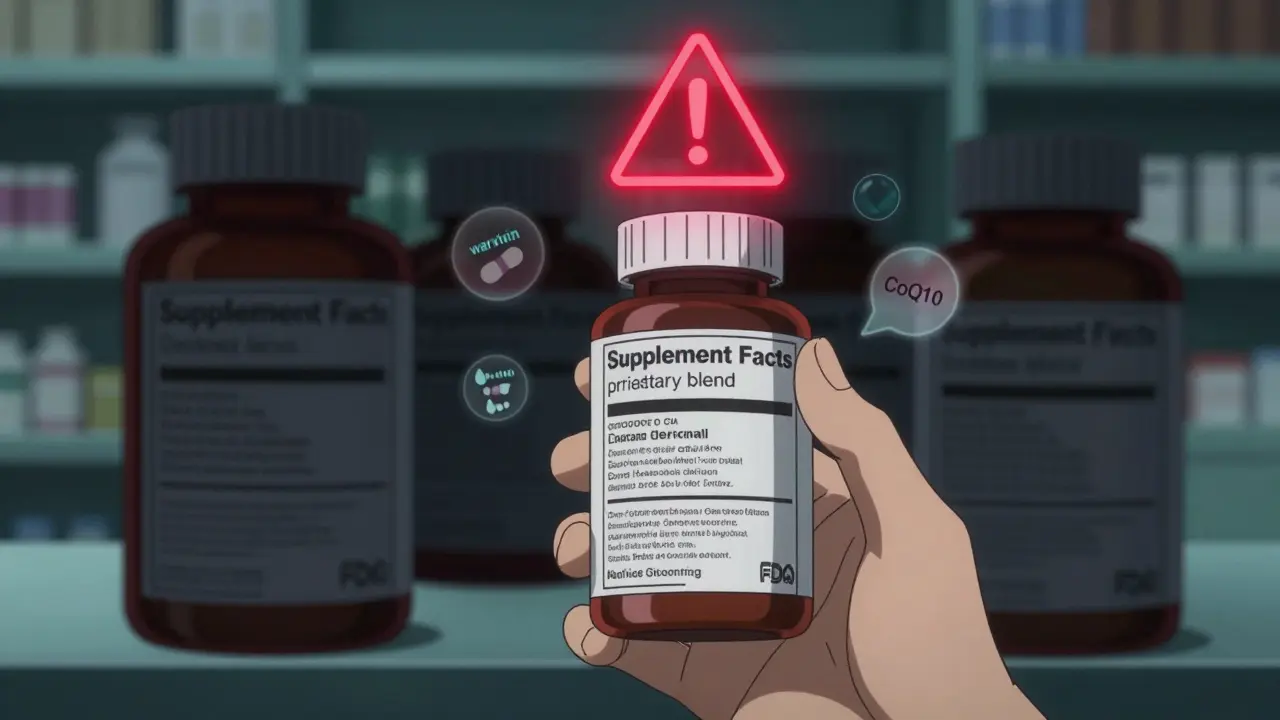
Every year, millions of people take supplements alongside prescription drugs - magnesium for sleep, vitamin D for immunity, fish oil for heart health. But here’s the problem: supplement labels rarely tell you if those pills might clash with your medication. Unlike your blood pressure pill or antibiotic, which clearly warn you about dangerous combos, most supplements don’t say a word. And that’s not an accident - it’s the law.
What’s on a supplement label - and what’s missing
Look at the back of your multivitamin or protein powder. You’ll see a box labeled Supplement Facts. It lists the serving size, how much of each ingredient is in one scoop or tablet, and sometimes a % Daily Value. That’s required. But here’s what’s not required: any warning about drug interactions.
Take a common example: you’re on warfarin, a blood thinner. You start taking CoQ10 because you heard it helps with energy. The label says nothing. But according to the FDA, CoQ10 can reduce warfarin’s effectiveness by 15-25%. That means your blood could start clotting when it shouldn’t. Or consider St. John’s wort - a popular herbal mood supplement. It cuts digoxin levels in your blood by 26%. If you’re taking it for heart failure, that drop could be life-threatening. Neither label says a thing.
Compare that to a prescription drug label. It has a dedicated Warnings section. It lists every known interaction - with other drugs, with food, even with grapefruit juice. The FDA requires this. Supplement makers? They don’t have to. In 2021, the FDA reviewed 500 popular supplements. Only 12.7% included any drug interaction warning. Meanwhile, 100% of prescription drugs and 94% of over-the-counter drugs do.
Why the gap exists - and why it’s dangerous
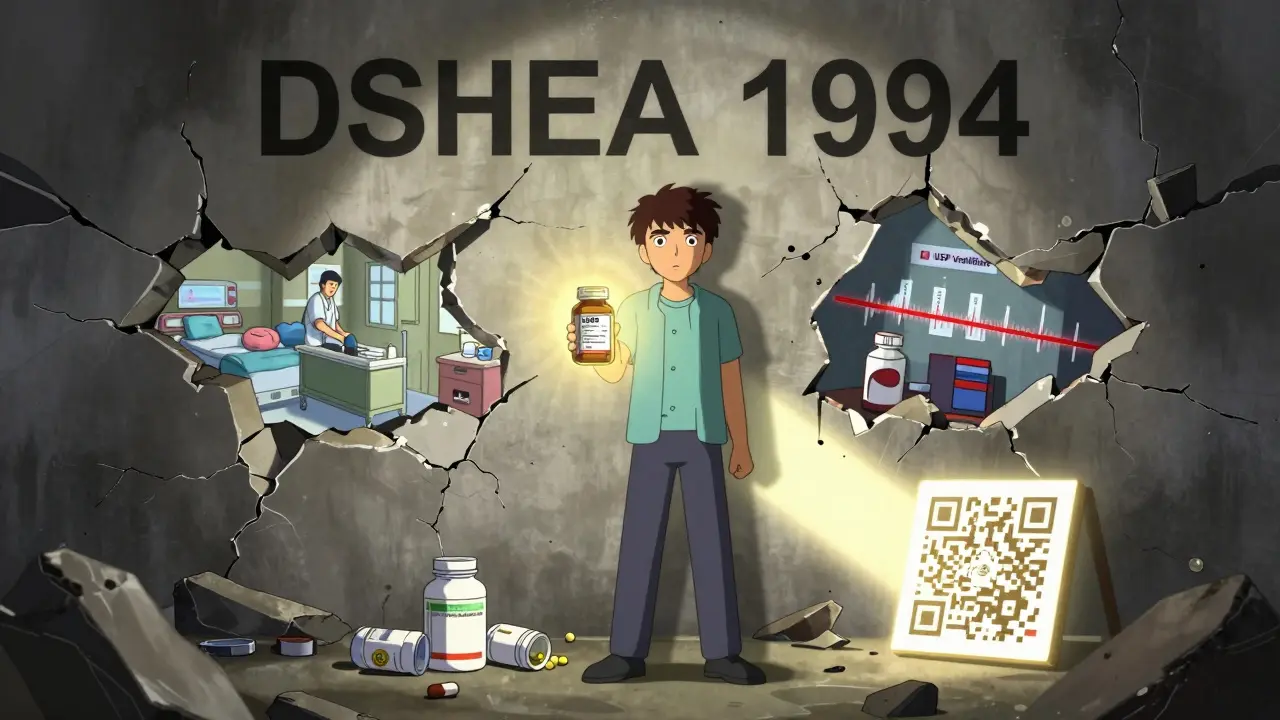
The reason? The Dietary Supplement Health and Education Act (DSHEA) of 1994. It treats supplements like food, not medicine. That means manufacturers don’t need FDA approval before selling. They don’t have to prove safety. They don’t have to prove effectiveness. And they definitely don’t have to test how their product interacts with your blood pressure meds, antidepressants, or diabetes drugs.
This isn’t theoretical. In 2022, the FDA recorded 1,960 adverse events linked to supplements. Nearly 28% involved drug interactions. One man took milk thistle with metformin for diabetes. His blood sugar crashed to 42 mg/dL - a level that can cause seizures. He didn’t know the supplement could boost metformin’s effect. Another woman took green tea extract while on warfarin. Her INR level spiked dangerously high. She didn’t realize vitamin K in the extract could interfere with her blood thinner.
And here’s the kicker: 62% of supplement users think the FDA reviews supplements before they hit shelves. That’s false. The FDA only steps in after someone gets hurt. By then, it’s too late.
How to read a supplement label - step by step
Don’t just glance. Spend 30 seconds. Here’s how to do it right:
- Find the Supplement Facts panel. It’s usually a box with borders. Look for serving size. Many people take 2 tablets thinking it’s one serving - but the label says one serving is 4. Double your dose? Double your risk.
- Check the ingredient list. Look for anything unfamiliar. If you see “proprietary blend,” stop. That’s a red flag. It means the company won’t tell you how much of each ingredient is in there. A 2023 ConsumerLab analysis found 38% of supplements use this to hide low doses of active ingredients.
- Search for known risky ingredients. Some supplements are notorious for interactions:
- Vitamin K - found in green tea extract, spirulina - reduces warfarin’s effect
- St. John’s wort - cuts levels of digoxin, birth control pills, antidepressants
- Milk thistle - can boost metformin, leading to low blood sugar
- Vitamin C (over 1,000 mg/day) - may reduce effectiveness of some HIV meds
- Red yeast rice - contains the same compound as lovastatin (a statin drug). Taking it with another statin can cause muscle damage
- Don’t trust “natural.” Just because it’s plant-based doesn’t mean it’s safe. Red yeast rice is natural. So is arsenic. Natural doesn’t equal harmless.
- Photograph the label. Bring it to your doctor or pharmacist. Don’t rely on memory. Show them the exact product.
What to do when the label says nothing
If the label doesn’t warn you - and most won’t - you need to take action:
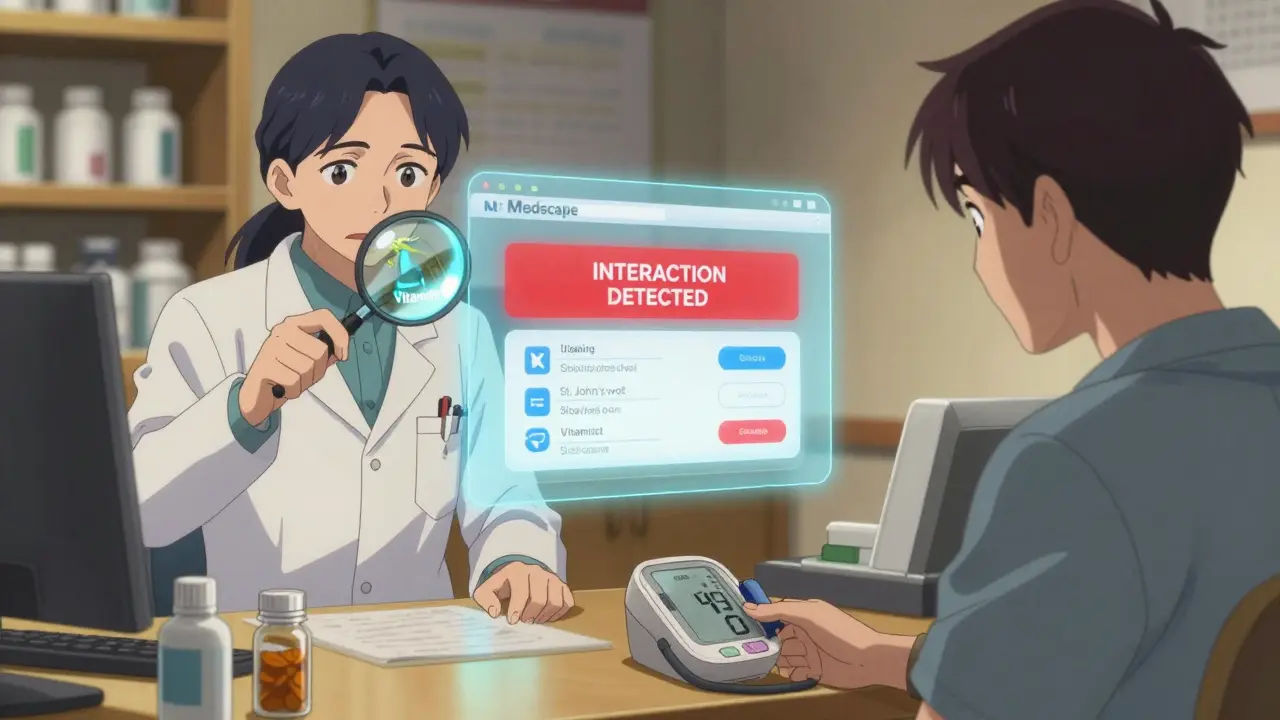
- Use the Medscape Drug Interaction Checker. It’s free. Type in your medication and the supplement. It checks over 24,000 drug pairs. For example: “warfarin + CoQ10” returns a clear warning.
- Ask your pharmacist. Pharmacists are trained to spot these conflicts. Many offer free interaction checks. Don’t wait until you’re in the ER.
- Check for USP verification. Look for the “USP Verified” mark on the bottle. It means an independent lab tested the product for purity, strength, and accurate labeling. Only 18% of supplements carry this. But those that do are 92% accurate - compared to 67% for non-certified ones.
- Wait before starting. If you’re unsure, don’t take it. Talk to your doctor first. Even if they’re not a supplement expert, they can help you find reliable sources.
The bigger picture: Why this system is broken
The supplement industry made $53.1 billion in 2023. Over 77% of Americans take at least one. But the FDA’s Office of Dietary Supplement Programs has a budget of just $4.7 million - 0.03% of the agency’s total funding. That’s not enough to inspect even 1% of products. In 2023, they found 1,247 supplements with false or misleading labels. Only 28% of those led to recalls.
And there’s no sign of change. The Dietary Supplement Listing Act of 2022 - which would have required manufacturers to register products with the FDA before selling - failed in Congress. Without that, the loophole stays open.
Meanwhile, the FDA is testing QR codes on labels that link to real-time interaction databases. It’s a step forward. But it’s voluntary. And until the law changes, the responsibility falls on you.
Bottom line: You’re the last line of defense
Supplements aren’t regulated like drugs. Labels aren’t required to warn you. And the consequences can be serious - even deadly. The good news? You don’t need to be a scientist to protect yourself. You just need to be curious.
Read the label. Question the vague terms. Use free tools like Medscape. Talk to your pharmacist. And never assume “natural” means safe. The safest supplement is the one you’ve checked - not the one you just grabbed off the shelf because it promised more energy or better sleep.
Do supplement labels have to list drug interactions?
No. Unlike prescription and over-the-counter drugs, supplement manufacturers are not required by law to include drug interaction warnings on their labels. The FDA only mandates that supplements list ingredients, serving size, and allergens. Any interaction warning you see is voluntary.
What should I do if my supplement doesn’t mention interactions?
Don’t assume it’s safe. Use the free Medscape Drug Interaction Checker or ask your pharmacist to check the combination. Bring the actual supplement bottle to your doctor - not just the name. Many interactions are only discovered after people get sick, so it’s better to be cautious.
Can I trust “natural” or “herbal” supplements?
Not necessarily. Many herbal supplements have powerful effects. St. John’s wort can interfere with birth control. Green tea extract can reduce the effectiveness of blood thinners. Red yeast rice contains the same active ingredient as the statin drug lovastatin. “Natural” doesn’t mean safe - especially when mixed with prescription drugs.
What’s a proprietary blend, and why should I avoid it?
A proprietary blend lists multiple ingredients together without showing how much of each one is in the product. For example: “Energy Blend (500 mg)” - but you don’t know if it’s mostly caffeine or just a trace of ginseng. This hides low doses and makes it impossible to assess risk. A 2023 ConsumerLab study found 38% of supplements use this to obscure ingredient amounts. Avoid them if you’re on medication.
Is there a way to know if a supplement is reliable?
Yes. Look for the “USP Verified” mark on the label. It means an independent lab tested the product for accurate ingredient amounts, purity, and whether it dissolves properly. USP-certified supplements are 92% accurate - compared to only 67% for non-certified ones. It’s not foolproof, but it’s the best sign you’ll find.
Can I stop my medication if I start taking a supplement?
Never stop a prescribed medication without talking to your doctor. Even if a supplement seems harmless, it can change how your medication works. For example, stopping your blood thinner because you think “it’s natural” could lead to a stroke. Always consult your healthcare provider before adding or removing anything.