

Pomegranate Interaction Risk Checker
Disclaimer: This tool is for educational purposes only and is based on the provided article data. It is not a substitute for professional medical advice. Always consult your doctor or pharmacist before changing your diet or starting supplements.
Risk Level: Evaluating...
Select your options and click "Check Potential Risk" to see the analysis.
You've probably heard the warnings about grapefruit juice. Your pharmacist might have told you to avoid it entirely while taking certain blood pressure meds or cholesterol pills because it can send drug levels in your blood skyrocketing. Naturally, when people see that Pomegranate Juice is packed with similar antioxidants, the question pops up: does it do the same thing? For a while, the scientific community thought the answer was a scary "yes," but the reality is much more reassuring for your breakfast routine.
The Great Lab vs. Life Debate
To understand why there's confusion, we have to look at how science is done. Back in 2005, researchers at Gifu Pharmaceutical University in Japan did some tests in petri dishes (what we call in vitro). They found that pomegranate juice seemed to shut down CYP3A4, a powerhouse enzyme in your liver and gut that breaks down about 50% of all common medications. In those lab tests, pomegranate juice looked just as potent as grapefruit juice at stopping these enzymes from working.
But here is the catch: a test tube is not a human body. While the juice can inhibit enzymes in a lab, the actual amount of the active compound that reaches your intestinal wall after you drink a glass of juice is far too low to cause a real-world problem. Later human trials, like those conducted by Hanley et al. in 2012 and Farkas et al. in 2013, proved that when people actually drank the juice, there was no significant change in how their bodies processed drugs like midazolam or flurbiprofen. In short, the "scare" was based on lab data that didn't translate to real people.
How CYP Enzymes Actually Work
Think of Cytochrome P450 (or CYP) enzymes as a disposal crew in your liver. Their job is to break down medications so your body can get rid of them. If something-like grapefruit juice-"fires" the disposal crew, the medication stays in your blood longer. This can lead to an overdose even if you took the correct dose.
Pomegranate juice targets two main crews: CYP3A4 and CYP2C9. The latter is responsible for about 15% of drug metabolism. If pomegranate juice actually blocked these, you'd see massive spikes in drug concentration. However, clinical evidence shows the effect is negligible. Dr. Stephen M. Stahl, a leading expert in psychopharmacology, has pointed out that clinicians should trust human data over lab data. If the humans are fine, the lab results are mostly just a curiosity.
| Feature | Grapefruit Juice | Pomegranate Juice |
|---|---|---|
| Clinical Effect | Strong and Significant | Negligible/None |
| FDA Warnings | Mandated for 85+ drugs | No specific mandates |
| University of Washington Rating | Rating A (Strong Evidence) | Rating B (Moderate Evidence Against) |
| Primary Target | CYP3A4 | CYP3A4 & CYP2C9 (theoretical) |

The Danger of "Extracts" vs. Juices
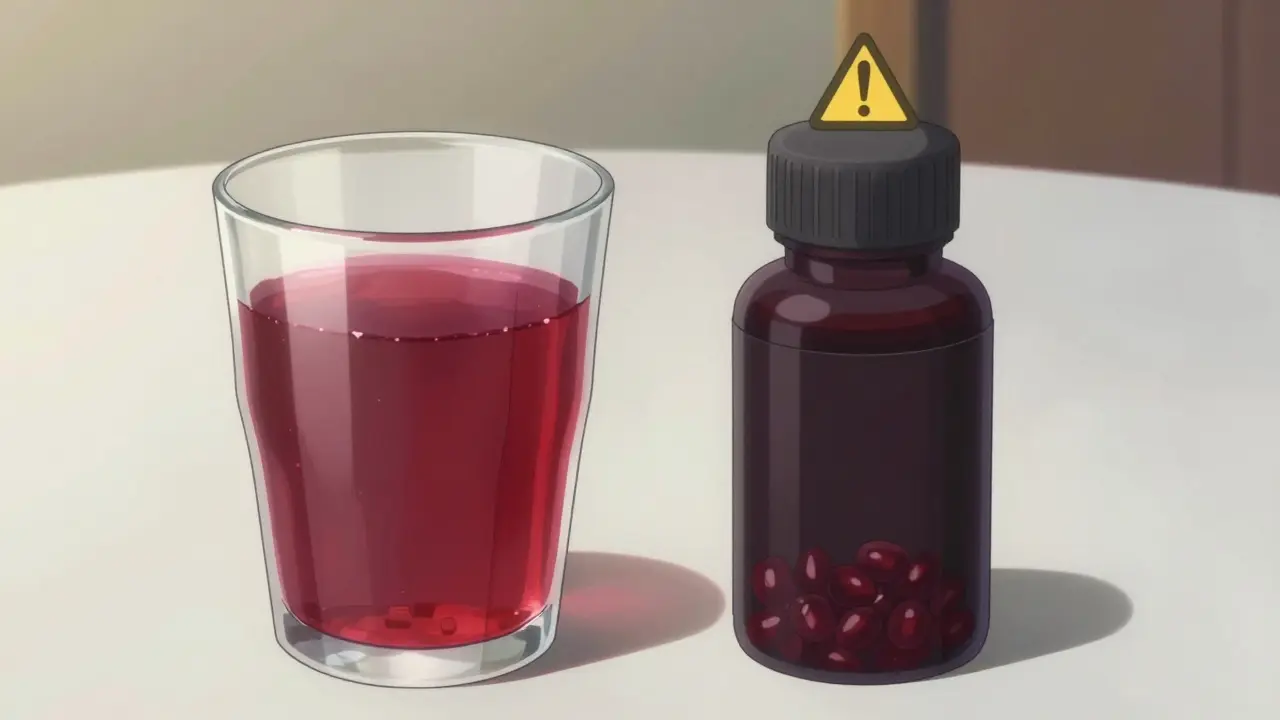
Here is where you need to be careful. Drinking a glass of juice is one thing; taking a highly concentrated Pomegranate Extract supplement is another. Supplements are often stripped of water and concentrated, meaning the active compounds are much more potent. There have been isolated case reports where patients taking concentrated extracts saw a spike in their INR (a measure of blood clotting) while using Warfarin.
Because 43% of patients struggle to tell the difference between a food-based juice and a pharmacy-grade extract, this is a common point of confusion. If you are taking a "narrow therapeutic index" drug-meaning a drug where a tiny change in dose can be dangerous-you should still treat supplements with more caution than a simple glass of juice. Always tell your doctor about any pill or powder you're taking, even if it's "natural."
What the Pros are Saying
If you ask a pharmacist today, they likely won't tell you to avoid pomegranate juice. On platforms like Reddit's r/Pharmacy, the vast majority of practicing pharmacists report that they don't counsel against pomegranate juice the way they do with grapefruit. One pharmacist with over a decade of experience noted that while they've seen many patients experience blood-thinning spikes from grapefruit, they've never seen a similar issue with pomegranate juice.
The FDA and the European Medicines Agency both omit pomegranate juice from their lists of clinically relevant inhibitors. The consensus is clear: the risk is low. The 2015 position statement from the American Society for Clinical Pharmacology and Therapeutics confirmed that avoidance isn't necessary for those on CYP3A4 or CYP2C9 substrate drugs.
Practical Tips for Staying Safe
So, should you worry? For most people, the answer is no. But if you want to be 100% sure, follow these rules of thumb:
- Stick to the juice: Whole food and standard juices are generally safe based on current human trials.
- Beware the bottle: Be cautious with high-potency extracts, capsules, or tinctures. These have a higher concentration of active compounds and less human data.
- Watch for narrow-index drugs: If you are on medications with a very tight safety margin (like certain anti-seizure meds or strong blood thinners), a quick check with your pharmacist is always a smart move.
- Don't swap warnings: Just because pomegranate is safe doesn't mean grapefruit is. Don't assume all "superfood" juices behave the same way.
Can I drink pomegranate juice if I'm taking Statins?
Generally, yes. Most statins are processed by CYP3A4. While grapefruit juice blocks this enzyme and can lead to muscle pain or toxicity, human studies show that pomegranate juice does not cause this same clinical effect.
Is pomegranate extract different from pomegranate juice?
Yes, significantly. Extracts are concentrated versions of the fruit's active components. Because they are much more potent, there is a higher theoretical risk of drug interactions compared to the diluted form found in juice.
Why did early studies say it was dangerous?
Early studies were in vitro, meaning they were done in lab dishes using liver cells. These tests showed that the juice could inhibit enzymes. However, when the juice is digested and absorbed by a human, the concentration isn't high enough to actually stop those enzymes in a living person.
Does pomegranate juice affect Warfarin?
Clinical evidence suggests that moderate consumption of pomegranate juice does not significantly alter the effects of Warfarin. However, some reports suggest that concentrated pomegranate extracts might increase the INR, so supplements should be used with caution.
Should I ask my doctor before drinking it?
While the evidence is very safe for most, it is always a good idea to mention your diet to your healthcare provider, especially if you are taking medications with a narrow therapeutic index or starting a new supplement regimen.