
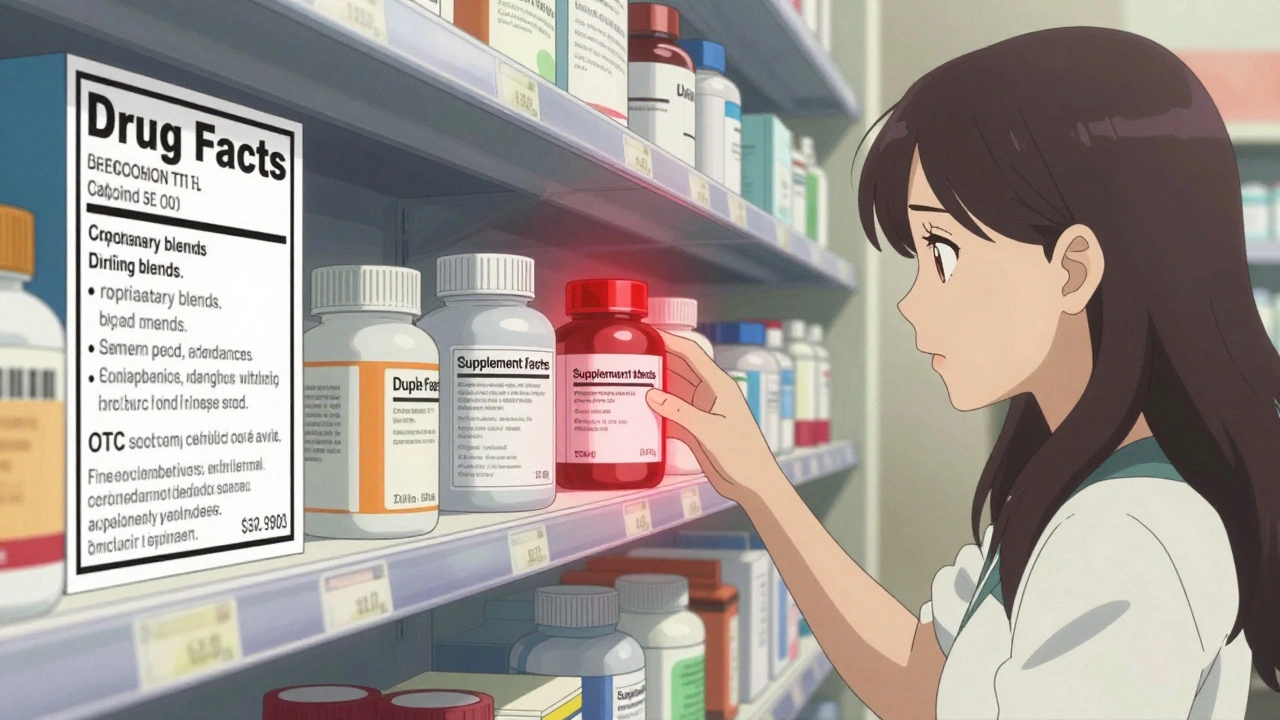
When you pick up a bottle of ibuprofen or a cold medicine from the shelf, you expect to see clear instructions: how much to take, when not to take it, what it might interact with, and what side effects to watch for. That’s because OTC medications have to follow the Drug Facts label rules - a standardized format the FDA has required since 1999. But if you grab a multivitamin, a magnesium pill, or a "immune support" supplement right next to it, you’re looking at something completely different. And that difference could be dangerous.
Supplement Facts vs. Drug Facts: Two Different Worlds
The label on your vitamin bottle is called a Supplement Facts panel. It looks similar to a Drug Facts label - same boxes, same layout - but it’s missing critical information. While OTC medications must list exact milligram amounts of active ingredients, supplements often hide those numbers behind vague terms like "proprietary blend." For example, a weight loss supplement might say it contains "200 mg of a proprietary blend" with five different ingredients. You won’t know how much of each one you’re actually getting. That’s not allowed on any OTC painkiller or allergy pill.OTC drugs must also list every single inactive ingredient - the fillers, dyes, and preservatives. That’s important if you’re allergic to gluten, soy, or red dye #40. Supplements? Not required. A 2023 ConsumerLab review found that 1 in 5 popular supplements contained undeclared allergens, including gluten and dairy, simply because manufacturers weren’t forced to disclose them.
No Warnings About Drug Interactions
If you’re taking blood pressure medication, your OTC pain reliever will warn you: "Do not use if you are on ACE inhibitors." But your vitamin D supplement? No warning. Your fish oil? Nothing. Your St. John’s wort? Still nothing.A 2021 study in JAMA Internal Medicine found that only 17% of supplement labels mention possible interactions with prescription drugs. Meanwhile, every single OTC medication label includes this information - because it’s the law. That’s a huge gap. People assume if it’s on the pharmacy shelf, it’s as safe as the aspirin next to it. But that’s not true. St. John’s wort can make birth control pills useless. Calcium supplements can block antibiotics. Vitamin K can interfere with blood thinners like warfarin. None of these risks are clearly labeled on the bottle.
Pregnancy Warnings? Barely There
Vitamin A is a perfect example. High doses of retinol - the active form of vitamin A - are known to cause severe birth defects. That’s why prescription acne drugs like Accutane come with pregnancy tests, counseling, and multiple warning labels. But a vitamin A supplement with 10,000 IU per serving - the same amount linked to birth defects - doesn’t need any of that. It might have a tiny disclaimer buried in the fine print: "Contains vitamin A. Consult your doctor if pregnant." That’s it.A 2021 advisory from the American College of Obstetricians and Gynecologists found that 40% of prenatal vitamins contain vitamin A levels above the recommended safety limit. Yet only 22% of them include a warning that’s as clear as what you’d see on a prescription drug. Many women take these daily without realizing the risk. And because the label doesn’t specify whether the vitamin A comes from retinol (dangerous) or beta-carotene (safe), you can’t even tell what you’re getting.

No Expiration Dates? No Problem?
OTC medications must have an expiration date printed on the package. That’s because potency and safety degrade over time. But supplements? Not required. Many vitamin bottles you buy have no expiration date at all. Some manufacturers put one in voluntarily, but it’s not the law. That means you could be taking a supplement that’s been sitting on a warehouse shelf for three years. The vitamin C might be half-dead. The probiotics might be dead. The melatonin? Maybe it’s still working, maybe it’s not. You won’t know.What About Sodium? Or Allergens? Or Dosage Timing?
OTC medications must list sodium content per dose. That’s critical for people with high blood pressure or heart failure. Supplements? No. A single serving of some multivitamins can contain over 100 mg of sodium - the same amount as a small bag of pretzels - and you’d never know unless you dug up the manufacturer’s website.OTC drugs also tell you exactly when to take them: "Take with food," "Do not take before bed," "Avoid alcohol." Supplements? Often nothing. A magnesium supplement might say "Take 1 tablet daily," but not whether it’s better in the morning or at night. Magnesium taken at night can help with sleep. Taken in the morning, it might cause loose stools. But you’re left guessing.
The FDA Doesn’t Approve Supplements Before They Hit the Shelf
This is the biggest myth of all. Most people think the FDA checks supplements for safety before they’re sold. They don’t. The FDA only steps in after someone gets hurt. Between 2008 and 2020, the agency found 776 dietary supplements that contained hidden pharmaceutical drugs - like erectile dysfunction meds, weight loss chemicals, and steroids - that were never approved for sale. But because the label didn’t list them, consumers had no way to know they were taking something dangerous.That’s why the FDA takes an average of 427 days to act on a dangerous supplement report. For OTC drugs? 45 days. The system is set up to protect companies, not consumers.
Why Does This Keep Happening?
The supplement industry is worth over $54 billion in the U.S. alone. That kind of money means powerful lobbying. In 2022, supplement companies spent $8.2 million pushing back against stricter labeling rules. The Dietary Supplement Health and Education Act of 1994 - the law that lets supplements bypass drug regulations - was written by industry lobbyists. It’s not outdated. It was designed this way from the start.There’s no incentive for companies to be more transparent. If your label says "supports immune health" and adds the tiny disclaimer "This statement has not been evaluated by the FDA," you’re legally protected. You don’t need to prove it works. You don’t need to warn about risks. You don’t even need to know what’s in your own product.
What Can You Do?
You can’t rely on the label. But you can take control.- Look for third-party certification. Brands with NSF, USP, or ConsumerLab seals have been tested for ingredients and contaminants. Not perfect, but better than nothing.
- Check Examine.com. It’s a free, science-based database that breaks down every supplement, its dosage, safety, and interactions. Over 4.7 million people use it every month.
- Ask your pharmacist. Pharmacists see more supplement questions than you think. Walgreens reported over 14,000 questions in just one quarter about supplement interactions. They know what to look for.
- When in doubt, skip it. If a supplement doesn’t list exact amounts, doesn’t warn about interactions, and has no expiration date - it’s not worth the risk.
The truth is, supplements aren’t medicine. They’re food. And food doesn’t come with safety warnings. But when you put them on the same shelf as aspirin, people assume they’re just as safe. That’s the trap. The label doesn’t tell you the full story - because the law doesn’t require it.
Why don’t supplement labels warn about drug interactions like OTC medications do?
Because dietary supplements are regulated as food, not drugs. The FDA doesn’t require supplement manufacturers to test for or disclose interactions with prescription medications. OTC medications must include this information by law. Supplements only need to list ingredients and serving size. That’s why you’ll see interaction warnings on ibuprofen but not on your vitamin D bottle - even if both can affect the same liver enzymes.
Can I trust the ingredient amounts listed on supplement labels?
Not always. Many supplements use "proprietary blends" that hide the exact amount of each ingredient. A 2022 NSF International analysis found that 63% of weight loss supplements and 41% of protein powders use this trick. Independent testing by ConsumerLab.com found that 20% of supplements contain less of the active ingredient than advertised - and some contain more, which can be dangerous. Look for products with NSF, USP, or ConsumerLab certification for more reliable labeling.
Are there any supplements that are actually dangerous even if they’re legal?
Yes. High-dose vitamin A (over 10,000 IU) can cause birth defects and liver damage. Vitamin K can interfere with blood thinners like warfarin. St. John’s wort can make birth control, antidepressants, and HIV meds ineffective. Iron supplements can be deadly in children if taken in excess. And some supplements - especially weight loss or muscle-building ones - contain hidden pharmaceutical drugs like sildenafil (Viagra) or steroids. These aren’t listed on the label, so you have no idea you’re taking them.
Do supplements expire? Should I care?
Legally, no - supplement labels don’t need expiration dates. But yes, you should care. Vitamins degrade over time. Probiotics die. Melatonin loses potency. Taking an old supplement might mean you’re getting nothing at all - or worse, a degraded compound that could irritate your stomach. If there’s no date on the bottle, assume it’s expired after two years. Store supplements in a cool, dry place to slow degradation.
Is the FDA going to change supplement labeling rules soon?
There are signs of change. In June 2023, the FDA proposed new guidelines requiring clearer warnings for high-dose vitamin A and better labeling of retinol forms. The NIH also launched a public Supplement Label Database with over 65,000 products. But these are still voluntary. Until Congress amends the 1994 law, manufacturers aren’t forced to make these changes. Consumer pressure and independent testing sites like Examine.com are currently doing more to protect people than federal regulations are.
Joel Deang
December 3, 2025 AT 02:34Roger Leiton
December 4, 2025 AT 22:19Laura Baur
December 6, 2025 AT 11:30मनोज कुमार
December 6, 2025 AT 22:02Steve World Shopping
December 8, 2025 AT 12:52ATUL BHARDWAJ
December 9, 2025 AT 08:25dave nevogt
December 10, 2025 AT 19:34Rebecca M.
December 12, 2025 AT 16:59Steve Enck
December 14, 2025 AT 14:15Jay Everett
December 15, 2025 AT 18:45Arun kumar
December 17, 2025 AT 12:01Zed theMartian
December 19, 2025 AT 02:54Ella van Rij
December 20, 2025 AT 11:54Jack Dao
December 21, 2025 AT 06:04