

Most people reach for an OTC nasal spray when their nose is clogged-whether from a cold, allergies, or sinus pressure. It feels like magic: one spray, and suddenly you can breathe again. But what if that relief is setting you up for something worse? If you’ve used a decongestant spray for more than three days, you might already be caught in a cycle you didn’t even know existed.
Why Your Nose Gets Worse After Using Nasal Spray
Those fast-acting sprays-like Afrin, Neo-Synephrine, or store brands-contain chemicals like oxymetazoline or phenylephrine. They work by shrinking swollen blood vessels in your nose. That’s why you feel instant relief. But here’s the catch: your body doesn’t like being told to constrict blood vessels for days on end. After about 72 hours, your nasal tissues start fighting back. The blood vessels dilate even more than before, causing worse congestion than you had originally. This isn’t your cold coming back-it’s called rebound congestion, or rhinitis medicamentosa.
It’s not rare. About 1-2% of people who use these sprays regularly end up with it. And the scary part? Many don’t realize what’s happening. They think their allergies are getting worse, or their cold is lingering. So they spray again. And again. Soon, they’re using it six, eight, even ten times a day. That’s not treating the problem-it’s making it permanent.
What Happens Inside Your Nose
Think of your nasal lining like a sponge. When you spray a decongestant, the sponge tightens up, squeezing out fluid and opening space. But if you keep squeezing it for days, the sponge loses its ability to bounce back. The cells lining your nose get irritated, inflammation grows, and tiny blood vessels become oversensitive. Over time, this can lead to chronic swelling, dryness, and even thinning of the nasal septum. In extreme cases, long-term misuse can cause holes in the cartilage-something that requires surgery to fix.
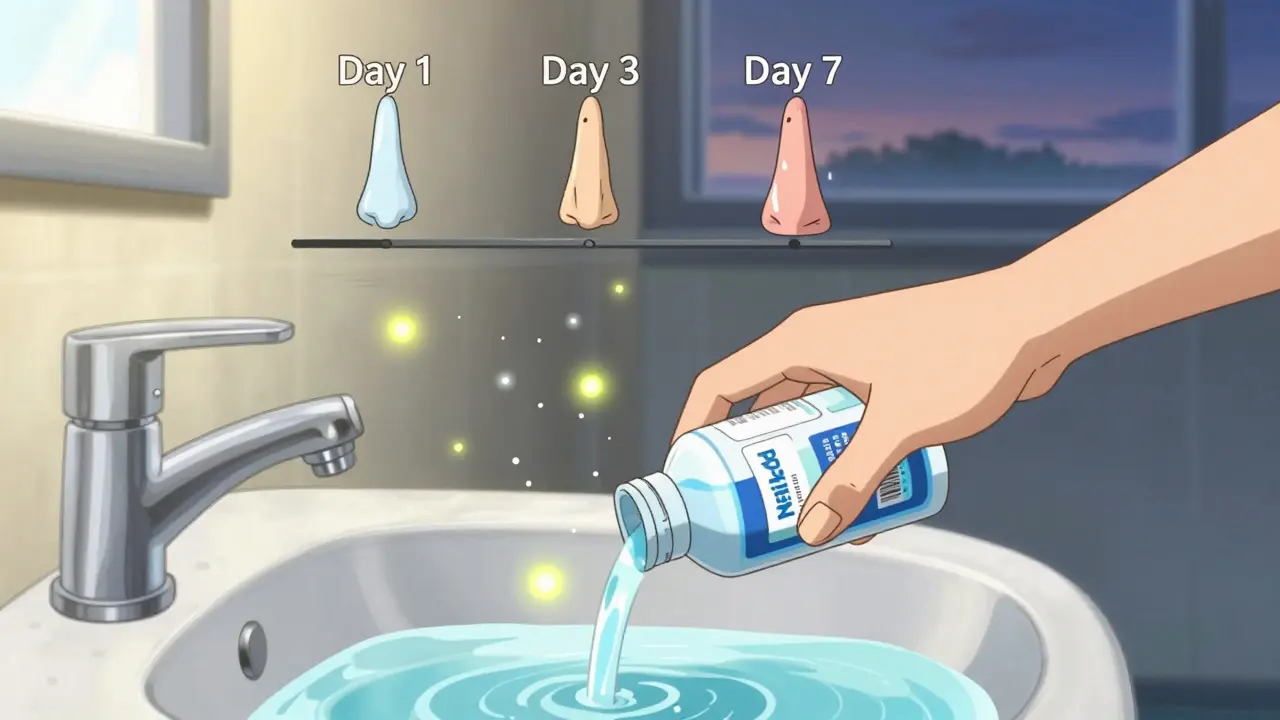
Rebound doesn’t hit overnight. It usually starts 12-24 hours after your last spray. You wake up feeling more blocked than before. The urge to spray again is overwhelming. But each time you do, you’re feeding the cycle. The Mayo Clinic says symptoms peak 48-72 hours after stopping the spray, and full recovery can take anywhere from one to three weeks-if you quit cold turkey.
What’s in Your Spray-and What’s Not
Not all nasal sprays are the same. Decongestant sprays contain stimulants like:
- Oxymetazoline (0.05%) - found in Afrin, Otrivin
- Phenylephrine (0.25%) - found in Neo-Synephrine
- Xylometazoline (0.05%) - common outside the U.S.
These are all alpha-adrenergic agonists. They’re powerful, fast, and dangerous if used too long. Contrast that with saline sprays-just salt water. They don’t shrink blood vessels. They just flush out mucus, allergens, and irritants. No rebound. No risk. And they’re safe to use every day, even multiple times a day.
Then there are steroid sprays like Flonase (fluticasone) and Nasacort (triamcinolone). These aren’t quick fixes. It takes 3-7 days to work. But once they do, they reduce inflammation at the root level. No dependency. No rebound. And since 2014, Flonase has been available over the counter. A 120-spray bottle costs around $25. It’s not cheap, but it’s cheaper than months of rebound misery.
The Three-Day Rule (And Why It’s Not a Suggestion)
Every single OTC nasal decongestant spray sold in the U.S. has this warning printed on the label: “Do not use for more than 3 days.” The FDA has required it since 2002. Yet, Cleveland Clinic surveys show 38% of users ignore it. Why? Because it works so well. And because people don’t understand the science behind it.
Doctors and pharmacists agree: three days is the absolute limit. Not four. Not five. Three. After that, the risk of rebound rises sharply. Houston Methodist research shows vascular sensitization begins after just 72 hours. That’s why experts now say: if you’re using it for more than two days, start a steroid spray on day three. Don’t wait until you’re stuck.
And here’s something most people don’t know: rebound congestion can happen even if you’re only using the spray once a day. It’s not about frequency-it’s about duration. One spray a day for five days? Still risky.
How to Break the Cycle
If you’re already stuck in rebound, quitting cold turkey is brutal. Your nose will feel completely blocked for days. But it’s the only way out. Here’s what actually works:
- Start a steroid spray immediately. Flonase or Nasacort. Use one spray in each nostril daily. It won’t help right away. Give it 3-5 days.
- Use saline rinses 4-6 times a day. A NeilMed Sinus Rinse bottle costs about $15. Mix the salt packets with sterile water. Flush gently. It reduces swelling, clears mucus, and soothes irritated tissue.
- Taper off slowly. If you’ve been spraying 3 times a day, drop to 2 for 48 hours, then 1 for 48 hours, then stop. This reduces withdrawal shock.
- Avoid oral decongestants. Pseudoephedrine (Sudafed) can help with congestion, but it raises blood pressure and can cause palpitations. Not worth the risk unless you’re under a doctor’s care.
Recovery takes time. Most people feel better in 7-14 days. Some take up to 21. But if you keep using the spray, you’ll never get out. Reddit threads like “Afrin hell” are full of people who spent weeks in misery before they finally quit. One user wrote: “I thought my allergies were getting worse. It was the spray making it worse.”

What to Use Instead
For short-term relief during a cold or flu? A decongestant spray for three days max-fine.
For allergies? Daily saline rinses and a steroid spray. That’s the gold standard. Studies show steroid sprays cut allergy symptoms by 50% after one week. Decongestants give 80-90% relief in minutes-but only for three days.
For dry air or pollution? Saline spray. For post-nasal drip? Ipratropium bromide (Atrovent)-a prescription spray that dries up runny noses without rebound.
And for chronic congestion? See an ENT. You might have a deviated septum, polyps, or chronic sinusitis. Those need real treatment-not a quick spray fix.
Who’s Most at Risk
Rebound congestion doesn’t care who you are-but some people are more vulnerable:
- People with high blood pressure-decongestants can spike blood pressure by 5-7 mmHg
- Older adults-slower metabolism means longer drug exposure
- People with chronic sinus issues-already inflamed tissue reacts more strongly
- Anyone who’s used these sprays for more than a week in the past-your body remembers
And here’s the kicker: the market for these sprays is huge. In 2022, Americans spent $1.2 billion on OTC nasal decongestants. That’s billions of doses. And an estimated 15-20% of chronic rhinitis cases are caused by these sprays themselves.
Final Advice: Use Smart, Not Hard
OTC nasal sprays are not daily maintenance tools. They’re emergency tools. Like a fire extinguisher. You don’t keep spraying it to prevent fires-you use it when there’s a blaze.
If you need to breathe better during a cold, go ahead. Use it. But set a timer. Mark your calendar. Three days. Then stop. Switch to saline and a steroid spray if you’re still congested. Your nose will thank you.
And if you’re already stuck? Don’t panic. You’re not alone. Thousands of people have broken this cycle. It’s not easy-but it’s possible. And the sooner you stop, the sooner you’ll breathe normally again.
Can I use OTC nasal spray every day?
No. OTC decongestant nasal sprays like Afrin or Neo-Synephrine should never be used every day. Using them for more than three consecutive days can cause rebound congestion, where your nose becomes more blocked than before. Only saline sprays and steroid sprays like Flonase are safe for daily use.
How long does rebound congestion last?
Rebound congestion typically lasts 7-21 days after you stop the spray, depending on how long you used it and how you manage withdrawal. Abruptly stopping can make symptoms worse for up to 4-6 weeks. Tapering off and using saline rinses and steroid sprays can shorten recovery to 1-3 weeks.
Is Flonase better than Afrin?
For long-term use, yes. Flonase (fluticasone) is a steroid spray that reduces inflammation at the source. It takes 3-7 days to work, but it doesn’t cause rebound congestion. Afrin gives instant relief but can’t be used beyond 3 days without causing worse congestion. Flonase is safer for allergies and chronic congestion; Afrin is only for short-term relief.
Can nasal spray damage your nose?
Yes. Long-term misuse of decongestant sprays can damage the nasal lining, leading to chronic swelling, dryness, and in rare cases, perforation of the nasal septum. This damage can be permanent and may require surgery. The risk increases with use beyond 10 days and with higher frequency (more than 3 sprays per nostril daily).
What’s the best way to stop using nasal spray?
Don’t quit cold turkey. Start a steroid spray like Flonase daily, use saline rinses 4-6 times a day, and reduce your decongestant spray by one application every 48 hours. For example, if you’re using it three times a day, go to two for two days, then one for two days, then stop. This reduces withdrawal symptoms and helps your nasal tissue heal.
Why do doctors say not to use decongestant sprays for allergies?
Because allergies are caused by inflammation, not just swollen blood vessels. Decongestant sprays only mask the symptom temporarily and make it worse over time. Steroid sprays treat the inflammation directly and are the recommended first-line treatment. Using a decongestant for allergies is like putting a bandage on a broken bone-it doesn’t fix the problem.
Lily Steele
January 29, 2026 AT 16:21I used Afrin for a week last winter thinking it was just a stubborn cold. Woke up one day and couldn't breathe at all. Didn't realize it was the spray until I read this. Saline rinses saved me. No joke, life-changing.
Gaurav Meena
January 30, 2026 AT 20:47Bro this is so true! In India we call it 'nasal addiction' 😅 I used Neo-Synephrine for months after my sinus surgery. My ENT nearly yelled at me. Flonase is the real MVP. Saline twice a day = free therapy.
Jodi Olson
January 31, 2026 AT 14:24It's fascinating how a simple physiological feedback loop can be weaponized by consumer marketing. The decongestant spray is a perfect example of pharmacological exploitation of homeostatic mechanisms. The body's vasomotor regulation is not a switch-it's a pendulum, and we've been swinging it into the abyss for decades.
Carolyn Whitehead
February 1, 2026 AT 00:51Same. I thought I was just allergic to everything. Turns out I was allergic to my own spray. Started using saline and Flonase and now I don't even miss the burn. Best decision ever. 😌
Amy Insalaco
February 1, 2026 AT 08:30Let’s be honest-this is just the FDA’s way of pushing pharmaceutical-grade steroid sprays. Flonase is a $25 monthly expense while Afrin is $8. The real agenda here is profit-driven medicalization of self-care. The three-day rule? Arbitrary. My ENT said if you're using it once daily, you're fine. It’s not the duration-it’s the dosage and the individual’s vascular reactivity.
Katie and Nathan Milburn
February 2, 2026 AT 04:46While the clinical evidence regarding rebound congestion is well-documented, the psychological dependency aspect is rarely addressed. The act of spraying becomes ritualistic-reinforced by immediate relief-and thus transcends physiological causality. This warrants a behavioral intervention model, not merely pharmacological substitution.
Beth Beltway
February 2, 2026 AT 15:54Of course you're not supposed to use it long-term. But who reads the label? The manufacturers don't want you to stop. They want you addicted. And the FDA? They're asleep at the wheel. This is why we have opioid crises and now nasal spray crises. It's corporate negligence dressed up as medicine.
Marc Bains
February 3, 2026 AT 13:57As someone who grew up in a household where nasal sprays were a daily ritual, I can tell you-this is the kind of info that needs to go viral. My mom used Afrin for 15 years. She didn't know she was hurting herself. We need public health campaigns, not just Reddit posts. This deserves a TikTok series.
Melissa Cogswell
February 4, 2026 AT 03:14For anyone trying to quit: the first 72 hours are brutal. I used a humidifier, drank tons of water, and did saline rinses every 2 hours. By day 5, I could breathe through one nostril. By day 10, normal. Flonase doesn't feel like it's working at first, but trust the process. It's slow but it's real.
Diana Dougan
February 4, 2026 AT 12:25Wow this is so deep. I thought I was just allergic to my cat. Turns out I’m allergic to my own nose. Who knew? 😏 Also Flonase? More like Flonase™️ the expensive placebo. I just snort salt water now and call it a day. #lazybuteffective
Bobbi Van Riet
February 5, 2026 AT 11:02I had rebound congestion for 6 months before I figured it out. I was using it 3 times a day for 2 weeks straight. The moment I stopped, I felt like I was suffocating. I started with saline rinses twice a day and Flonase once. It took 18 days to feel normal again. But here’s the thing-once you’re out, you never go back. I keep saline in my bag everywhere now. It’s like a security blanket.
Holly Robin
February 6, 2026 AT 22:46EVERY SINGLE OTC NASAL SPRAY IS A LIE. THEY’RE ALL DESIGNED TO MAKE YOU ADDICTED SO THEY CAN SELL YOU MORE. THE FDA IS IN BED WITH BIG PHARMA. THEY LET THIS HAPPEN ON PURPOSE. I SAW A VIDEO OF A WOMAN WHO LOST HER NOSE CARTILAGE FROM AFRIN. SHE HAD TO GET A SILICON PROSTHETIC. THIS ISN’T A SIDE EFFECT. THIS IS A FEATURE.
Kimberly Reker
February 7, 2026 AT 13:26My dad used to say, 'If it feels too good to be true, it probably is.' This is that. I switched to saline and Flonase after reading this. My nose hasn't felt this good since college. Seriously, try it. It’s not glamorous, but it works. And no, you don’t need a prescription for saline.
Eliana Botelho
February 8, 2026 AT 05:41Okay but why do we even have these sprays on the shelf if they’re so dangerous? It’s like selling sugar-free soda that actually makes you crave sugar more. The whole system is broken. We need to ban OTC decongestant sprays. Let them be prescription only. If you’re that congested, you should have to talk to a doctor first. No one should be able to buy a chemical that rewires their nasal biology without oversight.