
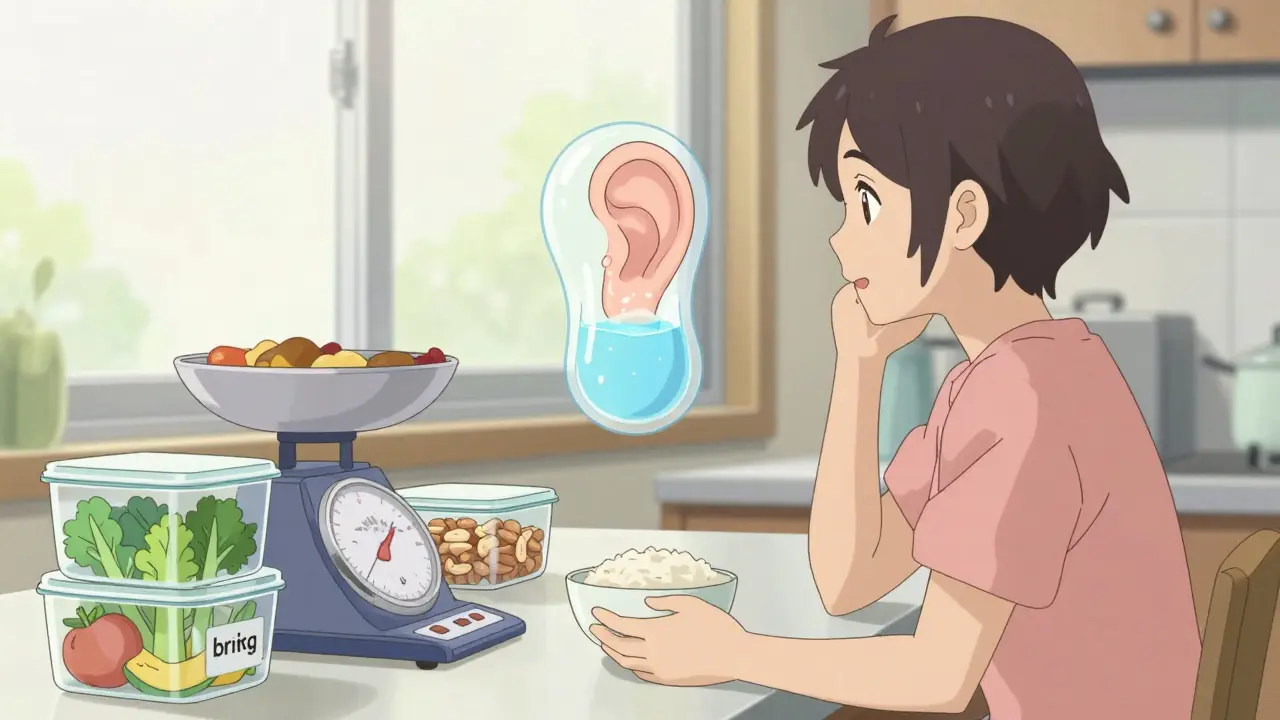
When you live with Meniere’s disease, sudden dizziness, ringing in the ear, and that heavy, full feeling can turn everyday life into a minefield. And while medications like diuretics or steroid injections are often discussed, there’s one of the most powerful, science-backed tools most people overlook: your diet.
Why Salt Is the Silent Trigger
Meniere’s isn’t caused by something you caught or inherited-it’s a fluid problem inside your inner ear. Too much fluid builds up in the endolymphatic sac, creating pressure that messes with your balance and hearing. Sodium pulls water into your bloodstream, and that extra fluid doesn’t just stay in your legs or face-it ends up in your inner ear. Every teaspoon of salt you eat? It’s like pouring water into a leaky balloon inside your head. Research since the 1920s has pointed to this link. But it wasn’t until a 2024 study published in Acta Otolaryngologica that we got solid proof. In a six-month trial with 50 patients, those who cut sodium to 1,500 mg per day and drank 35 ml of water per kilogram of body weight saw their vertigo attacks drop by over half. Their hearing improved by an average of 12.3 decibels. Tinnitus got quieter. The dizziness scores dropped nearly 50%. This wasn’t a placebo. This was measurable, repeatable change.How Much Sodium Is Too Much?
Most people don’t realize how easy it is to hit 3,000 mg of sodium before lunch. A single slice of store-bought bread can have 230 mg. A cup of canned soup? 800 mg. A fast food burger? Over 1,200 mg. The American Heart Association says healthy adults should aim for no more than 2,300 mg a day. But for Meniere’s, that’s not enough. The sweet spot? Between 1,500 and 2,000 mg per day. That’s about three-quarters of a teaspoon of table salt-total-for the whole day. Not per meal. Not per snack. Per day. Some experts, like Dr. Richard Miyashita from Tokyo Medical University, argue that going even lower-under 3,000 mg-is enough to trigger hormonal changes that help your inner ear drain fluid better. Others, including the NIH and Mayo Clinic, stick to 1,500-2,000 mg as the target. The 2024 study confirms 1,500 mg works best for moderate to severe cases. If you’re just starting out, aim for 2,000 mg and work down. Don’t try to go from 4,000 mg to 1,000 mg overnight. That’s a recipe for failure.Fluid Balance: Drink More Water, Not Less
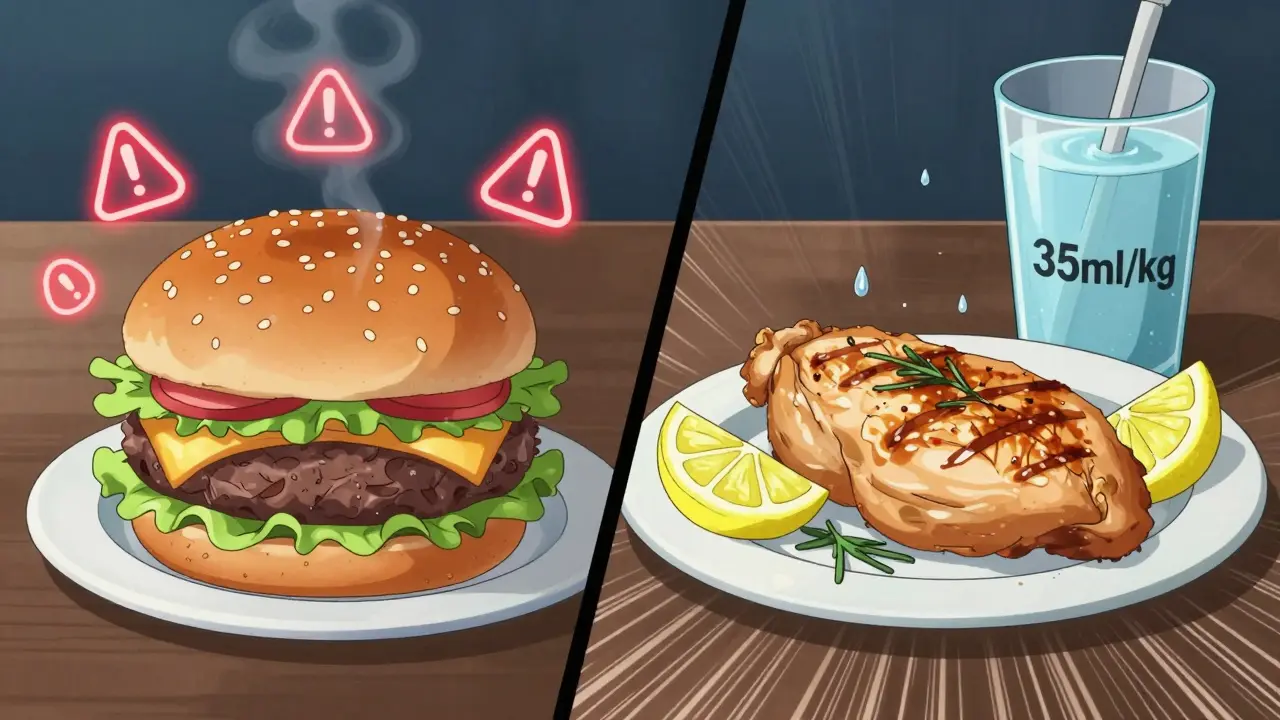
You’ve probably heard, “Drink less water to reduce swelling.” That’s wrong. Dehydration makes your body hold onto fluid even harder. It’s like a drought-your body goes into survival mode and hoards every drop. The 2024 study didn’t just restrict sodium-it told patients to drink 35 ml of water per kilogram of body weight daily. For someone weighing 70 kg (about 154 lbs), that’s 2.45 liters, or just over 8 cups. Spread it out. Sip all day. Don’t chug it at once. This isn’t about flushing out salt. It’s about keeping your body’s fluid system balanced so your inner ear doesn’t have to compensate by trapping fluid. Think of it like tuning a musical instrument. Too much tension? It cracks. Too loose? It goes out of tune. Your inner ear needs just the right pressure-and water helps maintain it.What to Eat (and What to Avoid)
You don’t need to starve. You just need to be smart.- Do eat: Fresh fruits, vegetables, lean meats, eggs, plain rice, oats, unsalted nuts, beans (rinsed well), plain yogurt, and herbs like basil, rosemary, and garlic powder.
- Avoid: Processed meats (bacon, ham, deli slices), canned soups, frozen meals, soy sauce, ketchup, mustard, pickles, chips, pretzels, restaurant food (especially fast food), and anything labeled “seasoned” or “flavored.”
Hidden Sodium Traps
Most of the sodium in your diet isn’t from the salt shaker. It’s from what’s already in your food.- Bread and rolls
- Cheese
- Canned beans and vegetables
- Condiments (even “natural” ones)
- Breakfast cereals
- Instant oatmeal packets
- Restaurant meals-even “healthy” ones
What About Caffeine and Alcohol?
They’re not sodium, but they make things worse. Caffeine narrows blood vessels in your inner ear. That reduces blood flow, which your ear needs to flush out excess fluid. Coffee, tea, energy drinks, and even dark chocolate can trigger attacks in sensitive people. Alcohol causes dehydration and disrupts your balance system. It also affects how your body regulates fluid. One drink might not do it-but two? That’s when symptoms flare. You don’t have to quit cold turkey. But if you’re still having attacks, try cutting them out for 30 days. You might be surprised how much better you feel.Why Diet Beats Drugs-For Now
Diuretics like hydrochlorothiazide are often prescribed. They help you pee out extra fluid. But they come with side effects: dizziness, low potassium, kidney stones, and fatigue. They’re a band-aid. And they don’t fix the root problem: too much sodium. A 2018 study by Miyashita found that 68% of patients on a low-sodium diet saw major improvement-with zero side effects. Compare that to diuretics, which help only 50-70% of people, and you start to see the difference. Diet isn’t magic. But it’s safe. It’s cheap. And it’s something you control every single day.
What If It Doesn’t Work?
Not everyone responds the same way. Some people need more than diet. That’s okay. If you’ve stuck with the diet for at least three months-no cheating, no exceptions-and you’re still having frequent vertigo or worsening hearing, talk to your doctor about next steps. Options include:- Intratympanic steroid injections (dexamethasone)-reduces inflammation with minimal risk
- Gentamicin injections-highly effective for vertigo but can damage hearing
- Surgery (rarely needed)
Real-Life Tips for Sticking With It
Changing your diet is hard. Social events, convenience, cravings-they all fight you. Here’s what works:- Keep a food journal for a week. Track every bite and sip. You’ll see where the sodium hides.
- Plan meals ahead. Cook extra and freeze portions. No last-minute takeout.
- Keep salt-free snacks on hand: raw veggies, unsalted nuts, fruit, rice cakes.
- Use apps like MyFitnessPal to log sodium. Set a daily limit of 1,800 mg to give yourself a buffer.
- Find a support group. You’re not alone. Many people with Meniere’s share tips online.
What’s Next?
A major NIH-funded trial called the Meniere’s Dietary Intervention Trial is currently recruiting 300 patients across the U.S. It’s comparing 1,500 mg vs. 2,300 mg sodium limits over 12 months. Results are expected by late 2025. This could finally give us the high-quality evidence we’ve been waiting for. Until then, the science we have is strong enough. The 2024 study, the American Academy of Otolaryngology guidelines, and decades of clinical experience all point to one thing: if you have Meniere’s, your plate is your first line of defense. You don’t need a miracle drug. You need to eat differently. And that’s something you can start today.Can I still eat out with Meniere’s disease?
Yes, but you need to be strategic. Skip fried foods, sauces, and soups. Ask for grilled or steamed proteins with no salt added. Choose plain rice or steamed vegetables. Order dressings and condiments on the side so you can control how much you use. Avoid fast food entirely-it’s almost always over 1,500 mg of sodium per meal.
Is sea salt or Himalayan salt better than table salt?
No. All types of salt are mostly sodium chloride. Sea salt, Himalayan salt, kosher salt-they all contain nearly the same amount of sodium per gram. The trace minerals in them don’t make them safer for Meniere’s. If you’re cutting sodium, you’re cutting all salt, regardless of type.
How long until I see results from a low-sodium diet?
Most people notice less dizziness and fewer attacks within 4 to 8 weeks. Hearing and tinnitus improvements often take longer-3 to 6 months. Don’t give up after a week. This is a long-term change, not a quick fix.
Can I drink alcohol occasionally?
Some people can tolerate one drink every few weeks without triggering symptoms. Others can’t have any. If you’re still having attacks, try eliminating alcohol for 30 days. If your symptoms improve, it’s likely a trigger. There’s no universal rule-only your body’s response matters.
Do I need to take supplements on a low-sodium diet?
Not usually. A balanced diet rich in fruits, vegetables, lean proteins, and whole grains provides all the nutrients you need. If you’re on a diuretic, your doctor may check your potassium levels. But sodium restriction alone doesn’t cause deficiencies. Avoid potassium supplements unless prescribed.
Is this diet safe for people with kidney problems?
If you have advanced kidney disease, a very low-sodium diet (under 1,500 mg) may not be appropriate. Always talk to your doctor or a renal dietitian before making major changes. But for most people with Meniere’s and healthy kidneys, 1,500-2,000 mg is safe and beneficial.
Christina Bilotti
January 15, 2026 AT 16:27Oh wow, another person who thinks they’ve cracked the code on Meniere’s like it’s some kind of wellness cult initiation. Let me guess-you also do yoga in a cold room while chanting mantras to your endolymphatic sac? Congratulations, you’ve discovered that salt makes you bloated. Shocking. I’ve been on this diet since 2017 and still get vertigo, but hey, at least I’m not drinking 2.5 liters of water like some kind of human aquarium. The real issue? Your inner ear doesn’t care about your Pinterest board. It cares about your autonomic nervous system, which you clearly haven’t read a paper on.
Also, ‘low-sodium’ labels? Please. That’s like calling a cigarette ‘light’ and thinking you’re healthy. You’re not fooling anyone, least of all the 77% of sodium that’s hiding in plain sight like a corporate conspiracy. I’m just here waiting for the next ‘miracle cure’ that’s actually just a placebo with better marketing.
brooke wright
January 16, 2026 AT 14:07I tried this for two weeks and lost 8 pounds, but my husband started yelling at me because I wouldn’t let him put salt on his eggs. He said I turned our kitchen into a lab and he’s not a guinea pig. I cried in the shower. Then I made a big pot of unsalted chicken soup and ate it with my fingers. It tasted like freedom. I still get dizzy, but now I feel like I’m fighting back, not just taking pills. I’m not perfect-I had a slice of pizza last week. But I didn’t cry after. Progress, not perfection. I think that’s what matters.
Also, I started using lemon and smoked paprika. It’s weirdly good. Like, I miss salt, but I don’t miss feeling like my head is underwater. Maybe that’s enough.
vivek kumar
January 17, 2026 AT 17:41While the 2024 Acta Otolaryngologica study is methodologically sound, its sample size of 50 is statistically underpowered for generalization, especially given the heterogeneity of Meniere’s presentations. Furthermore, the 35 mL/kg hydration protocol assumes normal renal function and ignores circadian fluid regulation-critical factors often overlooked in dietary interventions.
Additionally, the claim that ‘all salt is equal’ disregards the differential impact of sodium sources: sodium bicarbonate in baking soda, sodium citrate in processed cheeses, and sodium phosphate in deli meats have distinct osmotic and acid-base effects that may modulate endolymphatic pressure differently than NaCl. The article’s oversimplification risks promoting dogma over precision medicine.
Moreover, the suggestion to avoid alcohol entirely contradicts emerging evidence from a 2023 Korean cohort study showing moderate red wine consumption (10g ethanol/day) improved microvascular perfusion in the cochlea. A blanket prohibition without individual titration is clinically irresponsible.
Finally, the NIH trial design (1,500 mg vs. 2,300 mg) fails to account for pharmacogenetic variability in ENaC channel expression, which significantly alters sodium sensitivity. Until we stratify by genotype, we’re just guessing.
Jody Fahrenkrug
January 19, 2026 AT 17:08I’ve been doing this for 6 months. Still have bad days. But the heavy ear feeling? Gone most mornings. I cook everything from scratch now. Even my oatmeal is plain with cinnamon and banana. No more canned soup. No more chips. I miss them, but I miss the dizziness more.
Also, I started using this salt-free seasoning from Trader Joe’s-it’s got garlic, onion, and a hint of citrus. Tastes like food again. I’m not a diet guru. I’m just someone who doesn’t want to fall over in the grocery store anymore. If this helps even one person avoid the ER, it’s worth it.
Also, don’t stress if you slip. One bad meal doesn’t ruin everything. Just get back to it tomorrow. You’ve got this.
Chelsea Harton
January 19, 2026 AT 17:29so like… salt = bad? wat. i thought it was like… water? or stress? or maybe aliens? i dont know. but i ate a bag of pretzels yesterday and now my ear feels like a balloon filled with soup. maybe its magic. or maybe i just need to stop being a dumbass. or both. idk. but i’m trying. sorta. maybe. tomorrow.
Bobbi-Marie Nova
January 19, 2026 AT 18:44Okay but can we talk about how everyone’s acting like this is some kind of spiritual awakening? You’re not a monk. You’re just trying not to throw up in the shower. I’m not judging you for eating a bagel with cream cheese-I’m judging the guy who told you to go full keto and ‘detox your lymphatic system.’
Also, I made my own spice blend: garlic powder, smoked paprika, black pepper, and a tiny bit of cayenne. It’s like a party in my mouth. No salt needed. And guess what? I didn’t faint when I stood up. That’s a win.
Also, if you’re still having attacks after 3 months, talk to your doctor. But if you’re just starting? Don’t overthink it. Eat real food. Drink water. Skip the processed junk. That’s it. You don’t need a PhD to do this.
Allen Davidson
January 20, 2026 AT 06:42I’ve been helping people with Meniere’s for over a decade. The diet works-but only if you treat it like a lifestyle, not a punishment. The key isn’t perfection. It’s consistency. You don’t have to eat perfectly every day. You just have to show up.
Start with one change: swap your bread for low-sodium whole grain. That alone cuts 400-600 mg per day. Then add one more: cook one meal from scratch. Then another. Slowly. You’ll build momentum.
And if you feel discouraged? That’s normal. But don’t quit. The first improvement isn’t always in your vertigo. Sometimes it’s just-you wake up and your ear doesn’t feel like a water balloon. That’s huge.
And yes, you can still eat out. Just ask for no salt. Always. And skip the bread basket. That’s your new ritual. Small wins. Big results.
Samyak Shertok
January 21, 2026 AT 03:18Oh, so now the answer to Meniere’s is… eating like a 1950s housewife? No processed food? No sodium? Are we back in the Stone Age? Did the NIH just hire a Whole Foods marketing team?
Let me ask you this-if salt is the villain, why does the entire planet eat it? Why do cultures that consume 10x the sodium have lower rates of Meniere’s? Why did ancient Egyptians use salt to preserve bodies, not cure vertigo?
And let’s not pretend this is ‘science.’ This is anecdote dressed in a lab coat. The 2024 study? Tiny. Short-term. No control for stress, sleep, or cortisol. You think your inner ear is a water balloon? It’s a quantum harmonic oscillator. You can’t fix it with a low-sodium tofu salad.
Meanwhile, I’m sipping my salted soy sauce ramen while you all are crying over your unsalted quinoa. Who’s really winning here? The one who lives with the disease-or the one who lets it dictate their entire identity?
Maybe the real problem isn’t your diet. It’s your desperation to find a villain. Salt isn’t the enemy. Fear is.