

Managing multiple medications is hard. If you’re taking five or six pills a day-some in the morning, some at night, others once a week-it’s easy to lose track. You forget one dose. Then another. Before you know it, you’re running low, skipping days, or worse, taking the wrong dose. This isn’t just inconvenient-it’s dangerous. About half of people with chronic conditions don’t take their meds as prescribed, according to the World Health Organization. That leads to more hospital visits, higher costs, and worse health outcomes. But there’s a simple fix most people don’t know about: refill synchronization.
What Is Refill Synchronization?
Refill synchronization, also called med sync, is when your pharmacy lines up all your regular medications to be refilled on the same day each month. Instead of having to pick up your blood pressure pill on the 5th, your diabetes med on the 12th, and your cholesterol drug on the 20th, everything arrives on the 15th. You show up once. You leave with all your pills. No more calendar chaos. It sounds basic, but it works. Studies show that when patients sync their refills, adherence improves by 3 to 5 percentage points on average. That might not sound like much, but in real terms, it means fewer heart attacks, fewer ER trips, and less time in the hospital. For someone with diabetes or high blood pressure, that difference can mean the difference between staying healthy and ending up in the ICU.How It Works: A Step-by-Step Breakdown
Getting started is easier than you think. Here’s how it actually happens:- Initial consultation: You walk into your pharmacy and ask about med sync. The pharmacist pulls up your full medication list-prescriptions, over-the-counter drugs, even supplements. They look at how often each one needs refilling and spot conflicts.
- Adjusting quantities: If your blood pressure med runs out in 20 days but your diabetes pill lasts 30, the pharmacist gives you a few extra pills the first time so everything lines up. This is called a “starter dose” and is perfectly legal and safe.
- Setting the sync date: You pick a date that works for you-like the 15th of every month. That becomes your refill day. The pharmacy sets up automatic reminders for you.
- Monthly check-in: Every month, your pharmacist reviews your meds. If your doctor changed your dose or added a new pill, they adjust your sync schedule. No need to call in or remember.
Who Benefits the Most?
Not everyone needs this. But if you fit any of these profiles, you’re a perfect candidate:- You take three or more maintenance medications (like for high blood pressure, diabetes, cholesterol, thyroid, or depression).
- You’ve run out of pills before your next refill was due.
- You’ve missed doses because you forgot or got confused.
- You’re on Medicare Advantage or have a prescription plan that covers maintenance drugs.
Why It Works: The Psychology Behind It
It’s not just about convenience. It’s about behavior. Humans are terrible at managing complex routines. We forget. We get busy. We assume we’ll remember tomorrow. Synchronization cuts through that noise. Think of it like a calendar reminder-but for your pills. Instead of 5 different alarms, you have one. One day. One trip. One conversation with your pharmacist. That simplicity reduces decision fatigue. It builds a habit. People who sync their refills report feeling more in control. One Reddit user wrote: “Since my pharmacist synced my 5 medications to the 15th, I haven’t missed a single dose in 18 months. This changed my diabetes management.” And it’s not just anecdotal. A 2017 study in the American Journal of Managed Care found synchronized patients were three times more likely to stay on their meds than those who didn’t. Especially those who started with low adherence.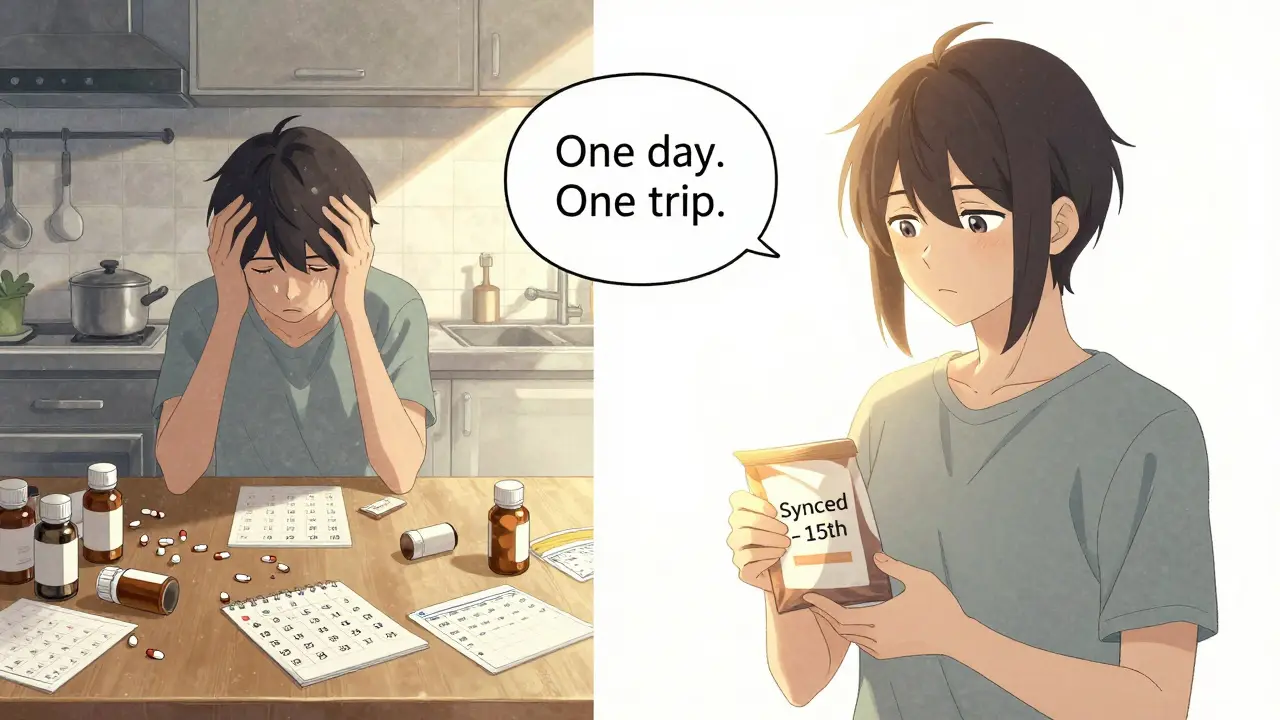
What About Insurance Problems?
Here’s the catch: not all insurance plans allow early refills. That’s the #1 complaint from pharmacists and patients alike. If your plan only lets you refill your statin after 28 days, but your sync date is on day 25, you’re stuck. Good pharmacies have workarounds. They’ll call your doctor for an early refill authorization. Or they’ll work with your insurer to get a one-time exception. But you have to ask. Don’t assume it’ll happen automatically. If your pharmacy says no, ask for a different one. Not all pharmacies handle this the same way. Chain stores like CVS and Walgreens have dedicated med sync teams. Independent pharmacies often have more flexibility because they know their patients personally.How to Get Started
Ready to try it? Here’s what to do:- Make a list of every medication you take regularly, including doses and how often you refill.
- Call or visit your pharmacy. Say: “I’m interested in medication synchronization. Can you help me align my refills?”
- Bring your pill bottles or a printed list. The more accurate, the better.
- Ask if they have a med sync program. If they say no, ask if they can create one for you. Many will, especially if you’re on multiple meds.
- Confirm your sync date. Pick a day you won’t forget-like your birthday or the 1st of the month.
- Ask about refill reminders. Most pharmacies now text or email you before your sync day.
What Doesn’t Work
Med sync isn’t a fix for everything. It won’t help if:- You take medications only occasionally (like antibiotics or painkillers).
- Your doses change often (like insulin or steroids).
- You’re getting meds from multiple pharmacies.
The Bigger Picture: Why Pharmacies Are Investing in This
You might wonder why pharmacies care. After all, they’re businesses. But here’s the thing: better adherence means fewer hospitalizations. And hospitals cost way more than pills. Medicare Part D plans are now rated on how well they help patients stay on their meds. Higher ratings mean more money from the government. That’s why CVS, Walgreens, and others are pushing med sync hard. They’re not just helping you-they’re getting paid to do it. In 2022, over 12 million Americans were enrolled in med sync programs. That’s up from 355,000 in 2014. And by 2025, experts predict 75% of U.S. pharmacies will offer it. This isn’t a trend. It’s becoming standard care.Real Results: One Patient’s Story
A 72-year-old man in Arizona had hypertension, type 2 diabetes, and high cholesterol. His adherence rate was only 65%-meaning he missed nearly one in three doses. His blood pressure was high. His A1C was out of control. He was tired all the time. His pharmacist enrolled him in med sync. They aligned his three meds to the 10th of every month. They gave him extra pills for the first month. They set up text reminders. They checked in every month. Six months later, his adherence jumped to 92%. His blood pressure dropped by 15 points. His A1C improved from 8.2 to 6.9. He stopped feeling exhausted. He said, “I didn’t realize how much I was struggling until I didn’t have to think about it anymore.” That’s the power of simplicity.What’s Next for Refill Synchronization?
The future is digital. CVS now links med sync to its app-patients get automated reminders, track their adherence, and even get discounts on copays. Walgreens has a “Sync & Save” program that reduces out-of-pocket costs for synced meds. Kroger Health is testing virtual pharmacist visits tied to sync days. Soon, your pharmacy might know you’re running low before you do. They’ll text you: “Your meds are ready. Pickup on the 15th. Need delivery?” This isn’t science fiction. It’s happening now.Is refill synchronization free?
Yes, the synchronization service itself is free. There’s no extra charge for aligning your refill dates. You still pay your regular copay or insurance cost for each medication. The pharmacy doesn’t bill you extra for the convenience-it’s part of their standard care offering.
Can I sync medications from different pharmacies?
It’s possible, but not ideal. Med sync works best when all your maintenance medications are filled at one pharmacy. If you’re getting pills from three different stores, the pharmacist can’t see your full list or coordinate refills properly. For the best results, consolidate your prescriptions at one pharmacy. Most insurers let you switch without penalty.
What if I need to change my sync date?
You can change it anytime. Life happens-you might be traveling, or your schedule shifts. Just call your pharmacy and ask to move your sync date. They’ll adjust your refill quantities and update your reminders. No penalty, no hassle.
Does med sync work for insulin or injectables?
It depends. Insulin and other injectables often require frequent dose changes, so they’re harder to sync. But if you’re on a stable dose and refill every month, your pharmacist may still include it. Always ask. Some pharmacies offer special sync plans for insulin users with pre-filled pens or delivery options.
How long does it take to see results?
Most people notice a difference in the first month. You’ll stop worrying about running out. You’ll feel more confident. Clinical adherence improvements (like PDC scores) typically show up within 3 to 6 months. The real benefit-fewer hospital visits-takes longer, but studies show it happens.
Jake Rudin
January 18, 2026 AT 15:15Refill synchronization… it’s not just logistics-it’s behavioral architecture, isn’t it? You’re not just aligning pill bottles; you’re engineering consistency into a system designed to fail. The human brain is a chaotic, context-dependent machine; it thrives on cues, rhythms, repetition. Syncing refills creates a temporal anchor-a daily ritual that replaces cognitive load with automaticity. And that’s why adherence jumps: not because people suddenly became responsible, but because the environment stopped demanding responsibility. It’s behavioral design at its most elegant.
Aman Kumar
January 18, 2026 AT 21:44This is the exact kind of ‘solutions’ that only work for people who already have the privilege of access-stable housing, reliable transportation, a pharmacy within 10 miles, insurance that doesn’t treat you like a fraud. Meanwhile, millions of diabetics in rural India are still choosing between insulin and rice. You call this ‘life-changing’? It’s a luxury service wrapped in clinical jargon. Real healthcare equity doesn’t come from syncing refills-it comes from making meds affordable and accessible to begin with.
Tracy Howard
January 20, 2026 AT 07:20Oh please. This is why American healthcare is so tragically absurd. We turn basic human dignity-taking your damn pills-into a ‘program’ with ‘teams’ and ‘sync dates’ like it’s a premium Spotify playlist. In Canada, we just… give you the meds. No bureaucracy. No ‘starter doses.’ No ‘pharmacist check-ins.’ You walk in, you get your prescription, you take it. No one treats you like a child who can’t remember their own birthday. This is what happens when you monetize compassion. Pathetic.
Phil Hillson
January 20, 2026 AT 22:43Look I get it but honestly this sounds like a lot of work for something that should just be automatic. I mean why does a pharmacy need to call my doctor just to give me my blood pressure pills on the same day as my cholesterol med? Why can't the system just do that? Also I hate when pharmacists act like they're my personal health coach. I just want my meds. Not a pep talk.
Jacob Hill
January 20, 2026 AT 23:19I love this. I’ve been syncing for 2 years now. My pharmacist knows me by name. She remembers my cat died last year and asked how I was doing. She noticed my new blood pressure med made me dizzy and called my doctor before I even complained. This isn’t just about pills-it’s about being seen. People think healthcare is about algorithms and data, but it’s really about relationships. Thank you, pharmacy staff. You’re the real MVPs.
Jackson Doughart
January 21, 2026 AT 04:59The psychological impact of synchronization cannot be overstated. The reduction in decision fatigue is quantifiable. The cognitive burden of managing multiple regimens-each with its own timing, dosage, and potential interaction-is a silent, chronic stressor. By consolidating refills, one effectively externalizes memory management to a trusted institutional agent. This is not merely convenience; it is a form of cognitive offloading that restores agency to the patient. The data supports this. The human experience confirms it. This model deserves expansion, not skepticism.
Astha Jain
January 21, 2026 AT 15:22omg this is sooo basic why is this even a thing? like i just use my phone to remind me to take my pills and i dont even have a pharmacy that does this and im fine?? like why are we making this a whole program? its just pills. people need to be more responsible. also i think its funny how they say 'no extra charge' but then they upsell you on vitamins and supplements during your 'sync visit'. smh.
Valerie DeLoach
January 22, 2026 AT 21:45For those of us who’ve watched elders struggle with pill organizers, color-coded charts, and handwritten calendars-this isn’t innovation. It’s dignity. I’ve seen my grandmother miss doses because she couldn’t read the tiny print on the bottle. I’ve seen her cry because she thought she took her pill twice. Syncing isn’t about convenience-it’s about preserving autonomy. And if pharmacies are finally stepping up to make that possible? Then let’s celebrate it. Not with jargon. But with gratitude.
Christi Steinbeck
January 23, 2026 AT 04:27Y’all need to try this NOW. I was on 7 meds and felt like a walking pharmacy. Now I get everything on the 1st. My texts remind me. My pharmacist checks in. I haven’t missed a single dose in 14 months. I feel like I’ve reclaimed my life. This isn’t just about health-it’s about freedom. Stop overthinking it. Walk into your pharmacy. Say ‘I want sync.’ Do it. Your future self will thank you.
Lewis Yeaple
January 23, 2026 AT 06:25It is imperative to clarify that the cited 3–5 percentage point improvement in adherence is statistically significant but clinically marginal in many contexts. Furthermore, the 8–11 percentage point gain referenced in the retail pharmacy study is derived from a non-randomized cohort with potential selection bias. The meta-analysis by Smith et al. (2020) demonstrates that synchronization effects plateau after 6 months unless paired with behavioral reinforcement. Therefore, while the intervention is commendable, its long-term efficacy remains contingent upon supplementary interventions.
Malikah Rajap
January 23, 2026 AT 18:58Okay but what if you’re a single mom working two jobs and your kid has a fever on your sync day? What if your pharmacy closes at 7 and you get off work at 7:15? What if your insurance still won’t let you refill early even after the pharmacist calls? This feels like a feel-good story for people who already have time, money, and support. Meanwhile, I’m choosing between my insulin and my daughter’s school supplies. So yeah-nice program. But don’t call it ‘peace of mind’ if you’ve never had to choose.