

When controlled substances like opioids, stimulants, or sedatives aren’t stored properly, they can disappear - not because of a supply chain issue, but because someone with access took them. Diversion isn’t just theft. It’s a patient safety crisis. In U.S. healthcare facilities, an estimated 37,000 diversion incidents happen every year. Many of these could be stopped with better storage practices.
Why Storage Matters More Than You Think
Controlled substances aren’t like regular meds. They’re tightly regulated under the Controlled Substances Act (CSA) of 1970. The DEA requires every pharmacy, hospital, or clinic that handles them to have effective controls to prevent theft and misuse. But what does that really mean? It means locking them up isn’t enough. You need systems that track who touches them, when, and why.Facilities with poor storage protocols see diversion rates 4.2 times higher than those using electronic tracking. Why? Because paper logs can be forged. Manual counts can be fudged. And if someone can walk into a cabinet without a trace, they can take what they want - and no one will know until it’s too late.
One real example: A nurse at a rural hospital was caught replacing oxycodone pills with saline vials. She did it for months. No one noticed because the inventory was checked only once a week, and the logs weren’t reviewed daily. That’s a classic failure point.
The Two Main Ways to Store Controlled Substances
There are two main systems in use: manual and automated. Each has pros and cons.- Manual Storage: Locked cabinets, vaults, or drawers with physical keys or combination locks. Staff sign out doses on paper or in a basic digital log.
- Automated Storage: Automated Dispensing Cabinets (ADCs) that require dual authentication - like a badge and a fingerprint - to open. Every access is logged, time-stamped, and tied to a user ID.
ADCs reduce diversion risk by 73% compared to manual systems. They also cut down on human error. But they cost between $45,000 and $75,000 per unit. For small clinics or critical access hospitals, that’s a big barrier.
That’s why many smaller facilities still rely on manual systems. But if you’re using one, you need to make up for the lack of tech with even stricter procedures.
Essential Rules for Manual Storage Systems
If you’re not using an ADC, here’s what you must do:- Limit access to one or two people. The NIH recommends only pharmacists and one designated technician have keys or codes. More people = more risk.
- Use dual control for every access. Two authorized staff must be present when opening the vault or cabinet. One unlocks, the other watches. No exceptions.
- Store in a visible location. Don’t hide the cabinet behind shelves or in a back room. If it’s in plain sight, it’s harder to sneak in and out.
- Never allow personal bags, purses, or coats near medication areas. In 31% of diversion cases, stolen drugs were hidden in personal items. Ban them from the pharmacy and med room.
- Review logs daily. A pharmacist must check every dispensing record each morning. Look for patterns: same time every day? Same person? Unusual quantities? That’s your red flag.
A hospital in Ohio cut its diversion incidents by 74% after banning bags and adding dual authentication. It took three training sessions to get staff on board - but once they did, compliance stuck.
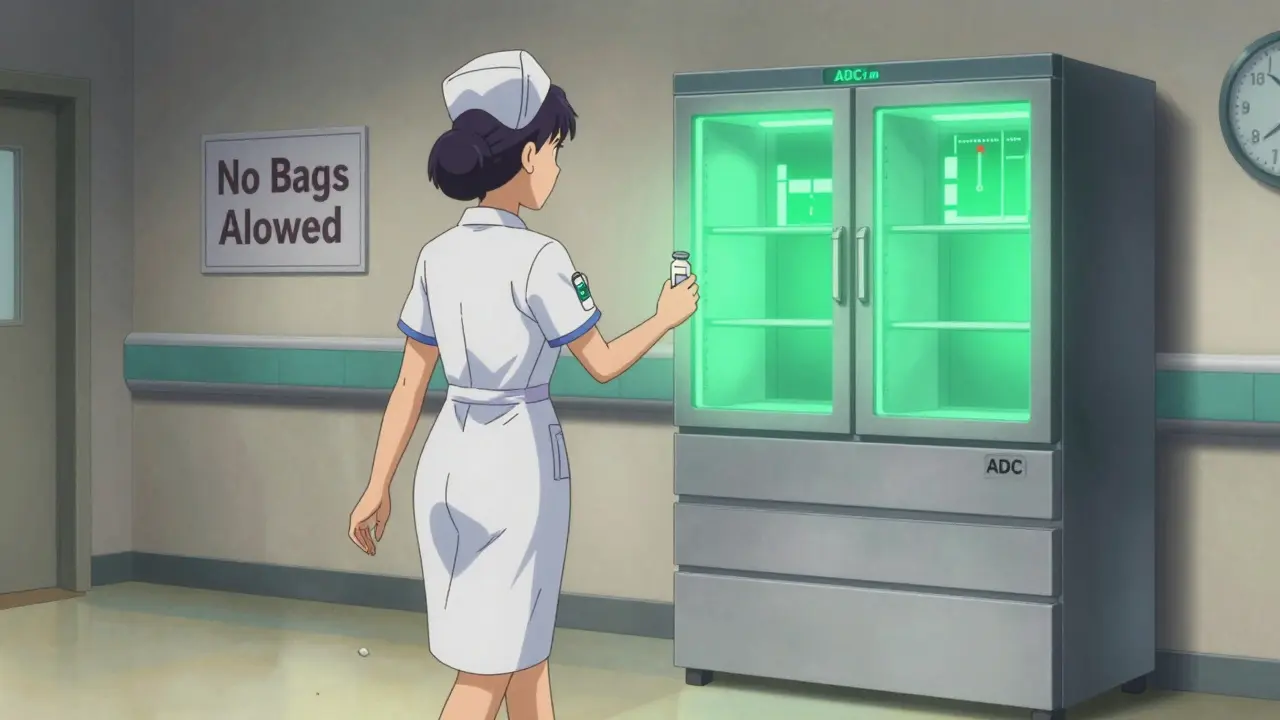
How Automated Systems Work (And Why They’re Better)
ADCs aren’t just fancy lockers. They’re smart systems that do three things:- Track every single dose taken - who, when, and why
- Require two-factor authentication (badge + biometric)
- Alert pharmacists to anomalies in real time
For example, if someone tries to dispense 10 vials of fentanyl at 3 a.m. - and they’re not the usual night shift pharmacist - the system flags it. The pharmacist gets a notification before the dose leaves the cabinet.
Studies show ADCs reduce vulnerability to diversion at 23% of risk points, compared to 87% in manual systems. They also make audits faster. Instead of counting pills manually, you pull a digital report.
But here’s the catch: if you install an ADC and don’t train staff, it fails. One hospital put one ADC in 12 operating rooms to save money. Staff started overriding the system because it was too slow. Within six months, two nurses diverted drugs. The system wasn’t the problem - the workflow was.
Where Diversion Happens (And How to Plug the Gaps)
Most theft doesn’t happen at the vault. It happens in the gaps between systems.Here are the top three risk points:
- Compounding or preparing doses manually. If you’re mixing drugs in a back room with no camera or log, that’s a blind spot. Always document every step - even if it’s just a handwritten note signed by two people.
- Transferring drugs from the pharmacy to floor stock. If a nurse walks out with a box of pills and no one logs it, that’s a vulnerability. Use a handoff checklist with signatures.
- Disposing of unused doses. Some staff flush pills down the toilet or throw them in the trash. That’s illegal. All waste must be documented and witnessed. The DEA requires two people to witness destruction - and keep a record.
Between 2019 and 2022, 68% of large-scale diversion cases involved one of these manual handoffs. No digital trail. No oversight. Easy to cover up.

What the Law Demands
The DEA doesn’t just ask for compliance - they inspect. In 2022, 98% of DEA site visits included a full review of controlled substance storage areas. If they find:- Unlocked cabinets
- Missing logs
- Unexplained inventory discrepancies
...you could face fines up to $187,500. And if a patient is harmed because a drug was diverted? Liability costs can hit $287,000 per incident.
Starting January 1, 2025, any facility handling more than 10kg of Schedule II substances annually must have real-time inventory tracking. That means every pill, vial, or patch must be scanned and logged as it moves. Paper logs won’t cut it anymore.
What’s Coming Next
The future of storage isn’t just automation - it’s intelligence.AI-powered systems are now being tested at Johns Hopkins and Mayo Clinic. These tools learn normal behavior - who takes what, when, and how often. If someone starts acting differently - say, taking more doses during night shifts - the system alerts a pharmacist within 48 hours.
And it’s getting smarter. One pilot reduced false alarms by 63% while catching 92% of diversion attempts. That’s not science fiction. It’s happening now.
By 2026, the global market for diversion prevention tech will hit $1.2 billion. If you’re still using lockboxes and clipboards, you’re already behind.
What You Can Do Today
You don’t need to buy an ADC tomorrow. But you do need to act now:- Review your current storage setup - is it visible? Locked? Logged?
- Train staff on the why behind the rules. People follow rules better when they understand the risk.
- Start daily audits. Even if you’re manual, make sure someone checks logs every morning.
- Remove personal bags from med areas. Make it policy. Enforce it.
- Plan for ADCs. Even if you can’t afford one now, start budgeting. Real-time tracking is coming - and you’ll need it.
Diversion isn’t about bad people. It’s about bad systems. Fix the system, and the risk drops.
trudale hampton
March 22, 2026 AT 06:18Been in healthcare for 15 years. Saw a nurse get fired for swapping fentanyl with saline. Not because she was a bad person-she was just burnt out and addicted. Systems fail people, not the other way around.
Lockboxes don’t fix burnout. Better staffing and mental health support do.
Shaun Wakashige
March 22, 2026 AT 19:48lol at the $75k ADCs. Just give everyone a badge and call it a day. 🤡
Natali Shevchenko
March 24, 2026 AT 17:29It’s funny how we treat drug diversion like it’s a moral failure, when it’s really a systemic one. We don’t blame the broken lock for the stolen bike-we blame the thief. But in healthcare, we blame the nurse who’s been working 12-hour shifts for 18 days straight while the hospital cuts security budgets.
The real crime isn’t the pill that disappears-it’s the fact that we’ve normalized overwork, underpay, and understaffing while pretending that a locked cabinet will solve everything.
Automation helps, sure. But no algorithm can replace compassion. And until we start treating our staff like human beings instead of disposable cogs, this cycle will keep spinning.
Nicole James
March 26, 2026 AT 01:31Who’s really behind this? The DEA? The pharmaceutical companies? The hospitals that refuse to fund proper systems? I’ve seen the reports-there’s a pattern. Every time a facility implements ADCs, the numbers drop… but only for a few months. Then the ‘anomalies’ disappear from the logs. Coincidence? I think not.
Someone’s covering it up. And the real diversion? The truth.
Desiree LaPointe
March 26, 2026 AT 06:15Oh wow. A 73% reduction? With a $75,000 machine? That’s not innovation-that’s extortion. You’re telling me a hospital in rural Alabama is supposed to drop that kind of cash when they can’t even afford a functioning HVAC system? And yet, here we are, lecturing people to ‘just follow the rules.’
Meanwhile, the same hospitals that can’t afford ADCs are the ones getting audited by the DEA. And when they fail? Fines. Lawsuits. Careers destroyed.
It’s not about compliance. It’s about class. The rich get smart cabinets. The poor get paperwork and blame.
Jackie Tucker
March 28, 2026 AT 00:25Interesting how everyone ignores the real elephant in the room: the fact that these drugs are being prescribed at epidemic levels in the first place. We’re not solving diversion-we’re just moving the problem from the pharmacy to the ER to the morgue.
And yes, I’m aware that this is the same system that gave us OxyContin. But hey-let’s just lock up the pills and call it a day. Works for me.
Thomas Jensen
March 28, 2026 AT 16:15They say ‘trust but verify’-but what if the people you’re trusting are crying in the break room because they can’t afford their kid’s insulin? I’ve seen it. A nurse takes a pill. Not because she’s a junkie. Because she’s scared she’ll lose her job if she admits she’s struggling.
Fix the system. Not the lock.
matthew runcie
March 30, 2026 AT 04:13Good post. Simple rules work. Dual control. No bags. Daily logs. Done.
shannon kozee
March 31, 2026 AT 23:04Just added dual control in our med room. First week: zero incidents. Second week: same. Staff complained at first. Now they say it feels safer. Weird, right?
Paul Cuccurullo
April 1, 2026 AT 22:31Let us not forget: behind every diverted pill is a patient who didn’t get their pain relief. Behind every forged log is a family wondering why their loved one didn’t wake up. This isn’t about policy. It’s about humanity. And if we’re not treating it that way, we’ve already lost.
Solomon Kindie
April 2, 2026 AT 21:49Johny Prayogi
April 3, 2026 AT 21:45Just got our ADC installed last month. Biggest win? No more guessing who took what. Also, the system auto-generates audit reports. I used to spend 3 hours a week counting pills. Now I drink coffee. 🙌
Nishan Basnet
April 5, 2026 AT 13:12In India, we don’t have ADCs-but we do have community accountability. Nurses watch each other. Pharmacists know who’s been coming in late. Trust is built, not coded.
Maybe the answer isn’t tech. Maybe it’s culture.
Allison Priole
April 7, 2026 AT 09:38I work in a small ER. We don’t have an ADC. But we started doing daily check-ins with the night nurse-just asking how they’re doing, not just checking the log. Last month? No incidents. And for the first time in years, someone actually said thank you.
Maybe we’re overcomplicating this. Sometimes, people just need to feel seen.