
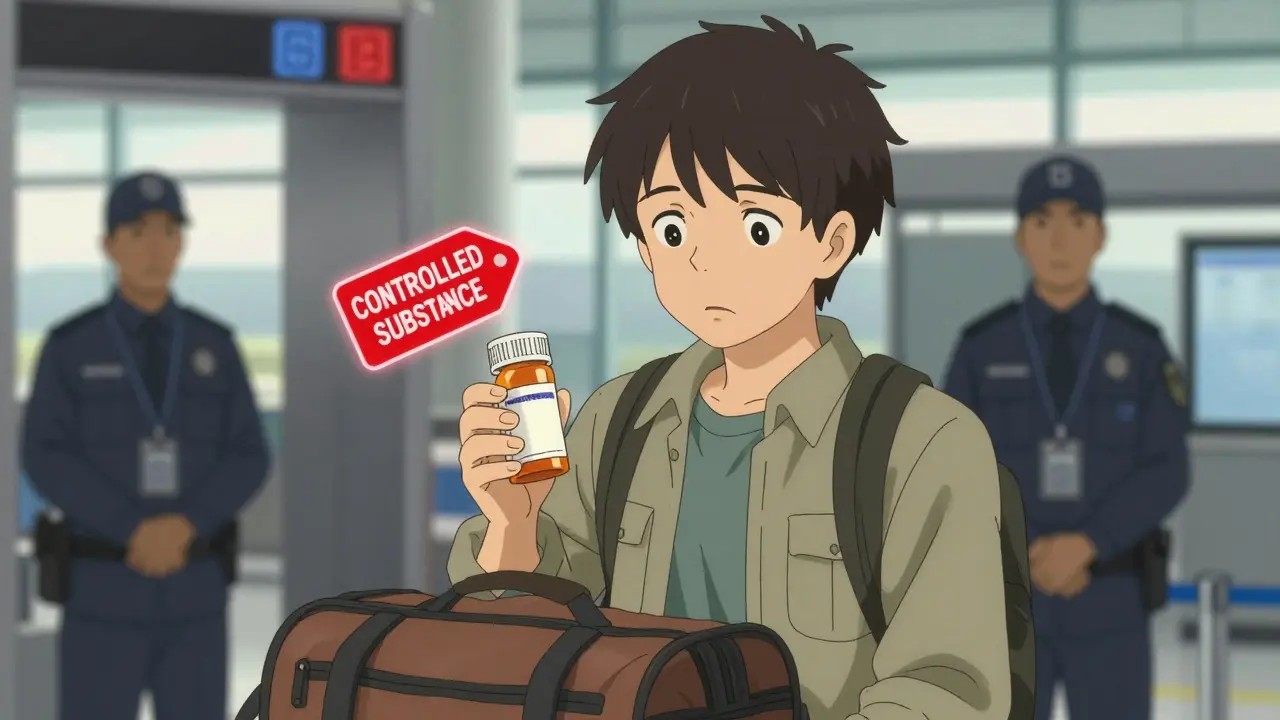
When you’re traveling with controlled medications - like opioids, benzodiazepines, or stimulants - you’re not just carrying pills. You’re carrying your ability to function, sleep, or manage pain. And unfortunately, that makes you a target. Medication theft during travel isn’t rare. It happens in hotel rooms, at airport security, even in rental cars. According to the CDC, about 12% of all medication-related travel incidents involve controlled substances, and most of those are preventable.
Know What You’re Carrying and Why It Matters
Controlled medications are classified by the U.S. Drug Enforcement Administration (DEA) into five schedules based on abuse potential and medical use. Schedule II drugs - like oxycodone, hydrocodone, and fentanyl - have the highest risk of addiction and are the most commonly stolen. Schedule III to V medications, such as certain sleep aids or muscle relaxants, are less targeted but still at risk.The problem isn’t just personal. Theft of these drugs fuels the illegal market. The International Narcotics Control Board estimates that over 40% of diverted prescription opioids in some regions originate from travelers who didn’t secure their meds properly.
That’s why simply tossing your pills into a suitcase isn’t an option. You need a plan - one that covers storage, documentation, and awareness.
Always Keep Medications in Carry-On Luggage
Checked bags are lost, delayed, or stolen. The SITA 2022 Baggage Report shows that roughly 25.5 bags per 1,000 passengers experience mishandling. If your medication is in that bag, you could be left without it for days - or worse, never get it back.The Transportation Security Administration (TSA) requires all medications, especially controlled substances, to be in your carry-on. This isn’t a suggestion. It’s a rule. And it’s not just for security - it’s for your safety.
Even if you’re flying internationally, never check your meds. Airlines like Qantas, Emirates, and Delta all follow this standard. If you’re unsure, ask the airline directly before you fly. Better safe than stranded without your pain relief or anxiety medication.
Use Original Prescription Containers - No Exceptions
The gold standard for traveling with controlled meds? The original pharmacy bottle. It has your name, the prescriber’s info, the drug name, strength, and dosage. This isn’t just for TSA. It’s for customs officers, hotel staff, and police who might question you.Cleveland Clinic data shows that 78% of medication issues at airports happen because people didn’t have their pills in labeled containers. One traveler on Reddit was detained for four hours at Heathrow because he had oxycodone in a pill organizer. No label. No prescription. No explanation. Just panic.
If you need to transfer pills for convenience - say, to a daily pill box for a week-long trip - do it legally. The International Narcotics Control Board allows it, but only if the secondary container has the same info: your name, doctor’s name, drug name, strength, and instructions. Write it clearly with a permanent marker. Take a photo of your original prescription too, just in case.
Carry the Right Paperwork
A prescription alone isn’t enough for international travel. Many countries require a doctor’s letter explaining why you need the medication. The CDC’s 2024 Yellow Book says 67% of countries may confiscate your meds without proper documentation. Forty-one countries require advance approval for even small amounts of Schedule III-V drugs.What should the letter include?
- Your full name and date of birth
- The medication name and dosage
- The reason for use (e.g., chronic pain, ADHD, anxiety)
- The prescribing doctor’s name, license number, and contact info
- A signature and official stamp
Some countries, like Japan and Saudi Arabia, are especially strict. Japan has blocked over 2,100 travelers in 2022 for carrying cold medicines with pseudoephedrine. Saudi Arabia bans 147 controlled substances entirely - even with a prescription. Check your destination’s rules on the International Narcotics Control Board website before you book your flight.
Never Leave Medications Unattended
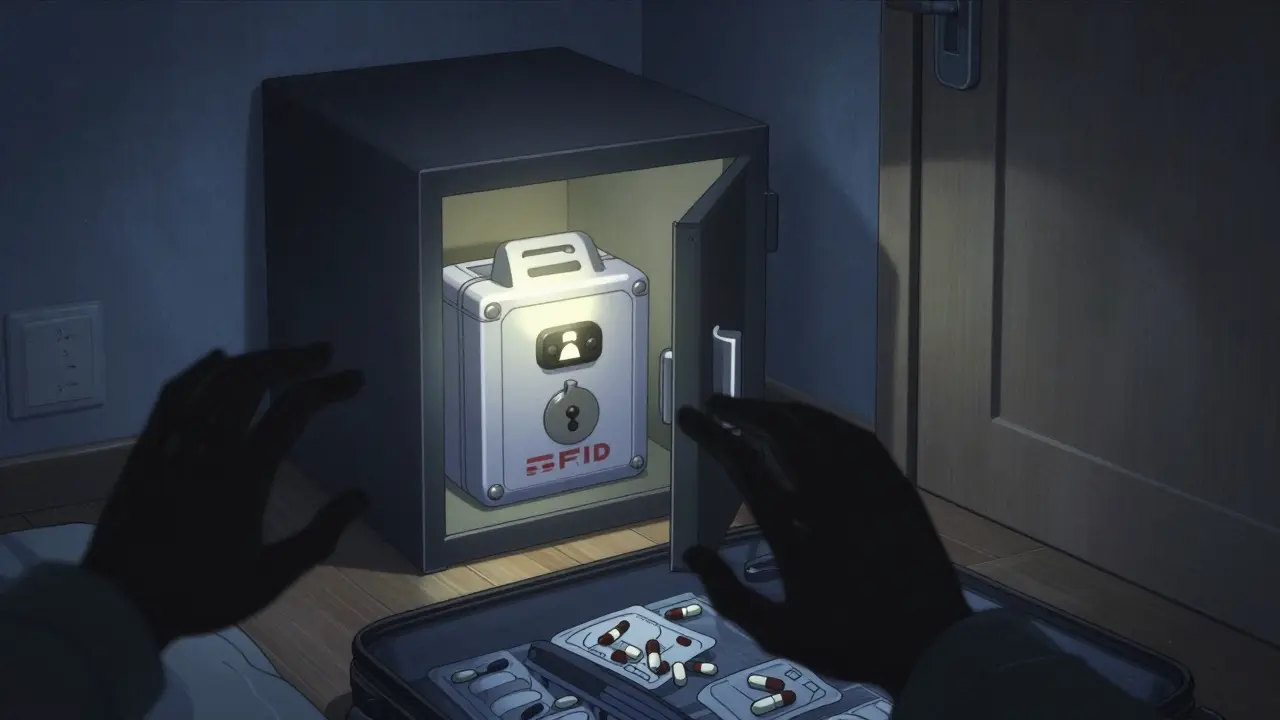
Most thefts happen when you’re not around. A 2023 study by Dr. Sarah Wyman at Cleveland Clinic found that 92% of medication thefts occur during hotel stays or when meds are left in rental cars.Don’t assume your hotel room is safe. Housekeeping has access. So do thieves. TripAdvisor logged 317 cases of medication theft from hotel rooms between January 2022 and June 2023. 89% of those involved travelers who left pills on the nightstand, in a drawer, or - worst of all - in a suitcase.
Use the hotel safe. If it doesn’t have one, ask the front desk to store your meds. Some hotels keep a locked cabinet for guests. If you’re staying in an Airbnb or vacation rental, bring a small lockbox. Or use an RFID-blocking medication case - these block electronic signals that thieves use to scan for valuables. User reports on PackPoint show that using these cases with a hotel safe cuts theft risk by 76%.
Watch the Temperature
It’s not just about theft. Some meds degrade if they get too hot or cold. Buprenorphine films, for example, must be kept between 68-77°F (20-25°C). Exposure to extreme temps can reduce effectiveness by up to 35%, according to FDA stability studies.Don’t leave your meds in a hot car or in a checked bag that sits on a tarmac in 100°F heat. Keep them in your carry-on, ideally in a padded pouch next to your body. If you’re flying to a very cold or hot destination, consider bringing a small insulated pouch with a gel pack - but make sure it’s not frozen solid, as that could trigger alarms at security.
Know the Rules for Refills and Replacements
If your meds are stolen, you can’t just walk into a pharmacy and get a new bottle. DEA rules are strict. Schedule II drugs - like oxycodone - can’t be refilled early unless you get special authorization. That process can take days.Insurance companies also require proof. UnitedHealthcare’s 2023 policy says only 17% of claims for stolen controlled substances are approved without a police report filed within 24 hours. With a report, approval jumps to 89%.
Before you leave, get a copy of your prescription and keep it in a separate place - maybe emailed to yourself or saved on your phone. Know the name and number of your pharmacy. If you’re traveling abroad, find out if your insurance covers overseas replacements.

Be Aware of State Laws in the U.S.
Even within the U.S., rules vary. TSA allows meds in non-original containers for domestic flights - but 32 states, including California, Texas, and Florida, require original pharmacy labels. If you’re pulled over or questioned by police, you could be in trouble if your pills aren’t labeled correctly.That’s why, no matter where you’re going, stick with the original bottle. It’s the only thing that works everywhere.
Consider Digital Backup Systems
The DEA launched a pilot program in April 2024 that lets pharmacists verify prescriptions electronically in 17 states. This means if your meds are stolen, you might be able to get a replacement in under four hours - instead of waiting three days.Long-term, the World Health Organization predicts blockchain-based digital prescriptions will become standard. Pilot programs in the EU have cut medication-related travel incidents by 92%. The U.S. is moving slowly due to HIPAA rules, but it’s coming.
For now, take a photo of your prescription and store it in a secure cloud app like Google Drive or iCloud. Add a note with your doctor’s contact info. If something goes wrong, you’ll have proof - and you’ll be ready.
What Not to Do
- Don’t carry more than a 14-day supply for a 7-day trip. Extra pills increase your risk and attract attention.
- Don’t announce you’re carrying painkillers in public. Thieves listen. The American Academy of Family Physicians says medication diversion spikes 37% during peak travel seasons.
- Don’t rely on airport security to protect your meds. They screen for threats - not theft.
- Don’t assume your insurance will cover replacement without a police report.
Final Checklist Before You Leave
- ✅ Original prescription bottles with full labeling
- ✅ Doctor’s letter (for international travel)
- ✅ All meds in carry-on - never checked luggage
- ✅ Photo of prescription and doctor’s contact info saved on phone
- ✅ Medication stored in hotel safe or RFID-blocking case
- ✅ Police report template saved on phone (in case of theft)
- ✅ Know your destination’s medication laws
- ✅ Carry no more than a 14-day supply + 2-3 extra doses
Traveling with controlled medications isn’t about paranoia. It’s about preparedness. You’ve worked hard to manage your health. Don’t let a thief - or a customs officer - take that away from you. Be smart. Be quiet. Be ready.
Can I put my controlled medications in a pill organizer when traveling?
Yes - but only if you also carry the original prescription bottle. The pill organizer can be used for daily convenience, but you must have the labeled container with you at all times. Airport security and customs require proof of prescription, and only original or properly labeled secondary containers are accepted.
What happens if I’m caught with controlled meds without a prescription abroad?
Consequences vary by country. In some places, like Japan or the UAE, you could be detained, fined, or even jailed. In others, your meds will be confiscated and you’ll be asked to leave. Always carry documentation. Never assume your U.S. prescription is valid overseas.
Can I fly with a prescription for a controlled substance that’s not in my name?
No. U.S. Customs and Border Protection, the DEA, and all international airlines require that controlled medications be prescribed to the person carrying them. Sharing or carrying someone else’s meds - even a family member’s - is illegal and can result in fines up to $10,000.
Do I need to declare my medications at customs?
You’re not always required to declare them, but you must be ready to show them if asked. In most countries, you’ll be screened only if you trigger an alert or if your behavior raises suspicion. Having your documents organized makes this process smooth. Never lie or hide your meds - it’s worse than being upfront.
How much of a controlled medication can I bring on a trip?
For Schedule II drugs, carry no more than a 14-day supply for a short trip, plus 2-3 extra doses. For Schedule III-V, the International Narcotics Control Board allows up to a 30-day supply as of September 2024. Always check your destination’s limits - some countries have stricter rules. More than you need raises red flags.
What if my meds are stolen while I’m abroad?
File a police report immediately - even if you’re not sure you’ll get help. Contact your embassy or consulate. They can help you find local pharmacies or connect you with your U.S. doctor. If you have travel insurance, submit your claim with the police report. Without it, reimbursement is unlikely. Keep your pharmacy’s contact info handy; some may fax a new prescription if you have proof of theft.
Bryan Anderson
January 2, 2026 AT 12:56I’ve traveled with my oxycodone for years and always stick to the original bottle. Once at Heathrow, I had a TSA agent double-check my prescription because my pill organizer was in my carry-on next to it. She said she’d never seen anyone so organized. Just doing the basics saves you so much stress.
Also, I always email myself a copy of the prescription and doctor’s letter. Never rely on your phone battery alone.
Matthew Hekmatniaz
January 2, 2026 AT 23:24Just got back from Japan. They didn’t bat an eye when I showed them my original bottle + doctor’s letter. But I heard a guy from Texas get detained because he had hydrocodone in a Ziploc. He didn’t even know Japan bans it outright.
Pro tip: Print out the INCB country list and highlight yours. Saves you from scrolling at 3 a.m. before your flight.
Liam George
January 4, 2026 AT 14:37Let’s be real - this whole system is a control mechanism disguised as safety. The DEA doesn’t care about your pain. They care about control. The ‘original bottle’ rule? That’s surveillance dressed up as protocol.
They track your meds. They track your travel. They track your doctor. Soon they’ll require GPS-enabled pill bottles. And you’ll thank them for it.
Meanwhile, the real thieves? The pharmaceutical companies and the insurance bots who deny refills because your ‘formulary changed.’ You’re being played. Always have been.
Carry your meds. But never trust the system. Ever.
Bill Medley
January 4, 2026 AT 22:52Original container. Carry-on. Doctor’s letter. Photocopy. Hotel safe.
That’s it.
Richard Thomas
January 5, 2026 AT 16:46There’s something deeply human about carrying your medicine like a secret. It’s not just about legality or safety - it’s about dignity. You’re not a criminal for needing help. But society treats you like one if you’re caught without the right paper.
I’ve had to explain my benzodiazepine use to customs officers in five countries. Each time, I felt like I was begging for the right to be human. They never asked why I needed it - just if I had proof.
And yet, the system works. It’s not perfect, but it’s the only one we have. So we adapt. We label. We photograph. We carry extra doses like a lifeline.
Maybe one day, we won’t need to prove our pain. Until then, we do the work. Quietly. Relentlessly. Because no one else will do it for us.
And if you’re reading this and you’re carrying meds - you’re not alone. You’re surviving. And that’s enough.
Paul Ong
January 7, 2026 AT 08:09Just got back from Mexico and I kept my pills in my pocket the whole time
Original bottle no cap
Hotel safe was sketchy so I slept with it
Don’t be a hero but don’t be dumb either
They don’t care if you’re in pain they just care if you got the paper
And yeah I took a pic of my rx on my phone
Done
Andy Heinlein
January 7, 2026 AT 23:59Y’all are overthinking it lol
I just keep my meds in my backpack with my wallet and never say a word
Never had an issue
But I also don’t carry more than I need
And I always smile at security
Works every time 😎
Ann Romine
January 9, 2026 AT 18:18My mom was detained in Dubai for carrying a 7-day supply of gabapentin in a pill organizer. She had the prescription but not the original bottle. They held her for 12 hours. She cried the whole way home.
So I always carry two copies of the original label - one in my purse, one in my checked bag (just in case). I also write the doctor’s number on the back of the bottle with a Sharpie.
It’s not paranoia. It’s love.
Don’t let your meds become someone else’s tragedy.