
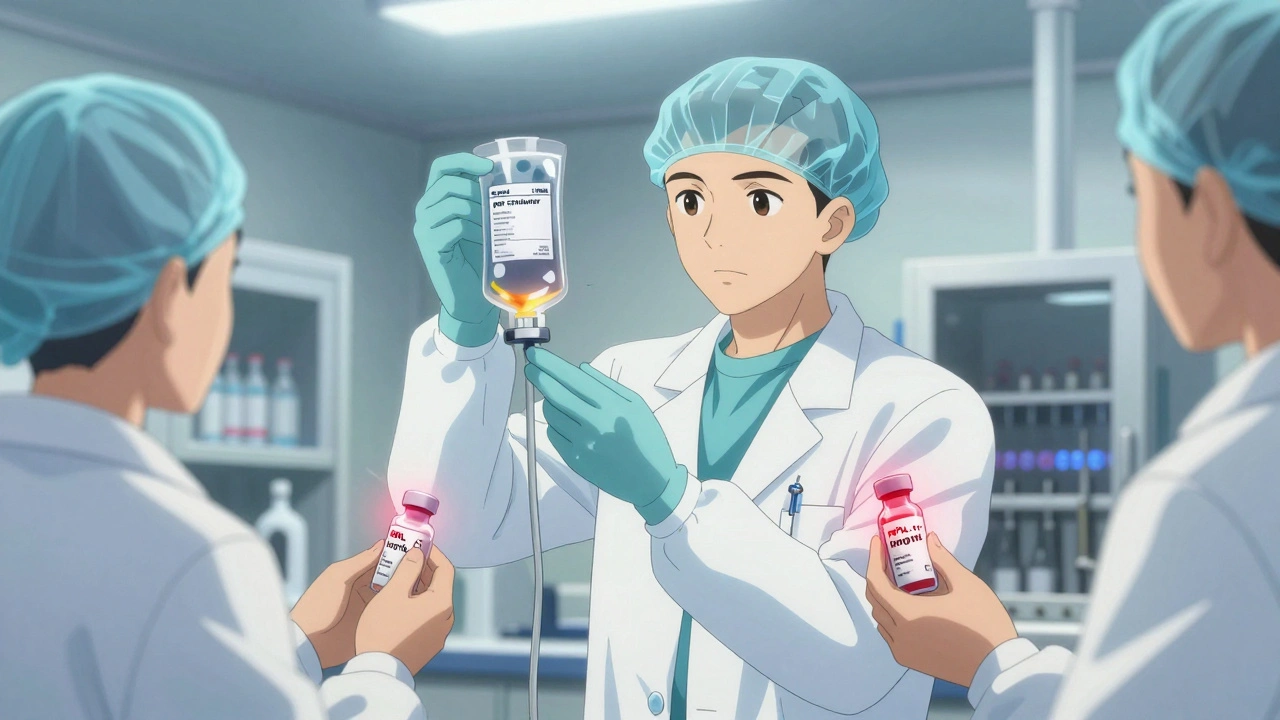
Customized medications aren’t just a convenience-they’re a lifeline for patients who can’t take standard drugs. Maybe it’s a child who needs a dye-free, sugar-free liquid version of a pill they can’t swallow. Or an elderly patient allergic to lactose who needs a capsule without fillers. Or someone with chronic pain needing a topical gel instead of oral pills that cause stomach issues. These are real needs. But behind every successful compounded prescription is a high-stakes process where a single mistake can lead to hospitalization-or worse.
Why Compounding Errors Happen
Compounding isn’t mass production. It’s handmade medicine. Unlike FDA-approved drugs that go through thousands of clinical trials, compounded medications are made one batch at a time. That means there’s no safety net of large-scale testing. If a pharmacist miscalculates a dose, uses the wrong ingredient, or skips a cleanroom check, the error goes straight to the patient. The data shows this isn’t theoretical. Studies report that 3% to 15% of compounded preparations have significant deviations from the intended strength. Between 2018 and 2022, the FDA recorded 27 fentanyl overdose incidents tied to mislabeled concentrations. One case involved a compounded tramadol solution labeled as ‘per container’ instead of ‘per mL.’ A geriatric patient received 10 times the intended dose. She ended up in the ICU. These aren’t rare outliers. They’re symptoms of systemic gaps. Many compounding pharmacies operate under Section 503A rules, which allow them to avoid FDA inspections and current Good Manufacturing Practices (CGMPs). Only 18% of U.S. compounding pharmacies are accredited by the Pharmacy Compounding Accreditation Board (PCAB), and error rates in non-accredited facilities can hit 25%. In contrast, accredited pharmacies report error rates below 2%.The Core Rules: USP <795>, <797>, and <800>
The backbone of safe compounding isn’t luck. It’s science. The United States Pharmacopeia (USP) sets the gold standard with three key chapters:- USP <795>: For non-sterile compounding-things like creams, capsules, and oral liquids. Requires a dedicated clean area with ISO Class 8 air quality. No dusty countertops. No open windows. No shortcuts.
- USP <797>: For sterile compounding-IV bags, injections, eye drops. Requires an ISO Class 5 cleanroom with laminar airflow hoods. Staff must wear full sterile garb. Every step is documented. Every surface is swabbed and tested.
- USP <800>: For hazardous drugs-chemotherapy, hormones, opioids. Requires special ventilation, spill kits, and PPE. No touching a vial of fentanyl without gloves, goggles, and a respirator.
Double-Check Everything-No Exceptions
One of the most effective ways to stop errors before they happen is the dual-check system. It’s simple: two qualified pharmacists or technicians independently verify every step.- First check: Ingredient identity. Is that white powder fentanyl or lactose? Use FTIR or HPLC to confirm.
- Second check: Calculation. Does 0.5 mg/mL × 10 mL = 5 mg? Or did someone misplace a decimal? A second person recalculates from scratch.
- Third check: Labeling. Is it labeled ‘5 mg/mL’ or ‘5 mg per container’? The FDA now requires all concentrations to be in ‘mg/mL’ format to prevent deadly confusion.
Technology Is Your Ally, Not Your Replacement
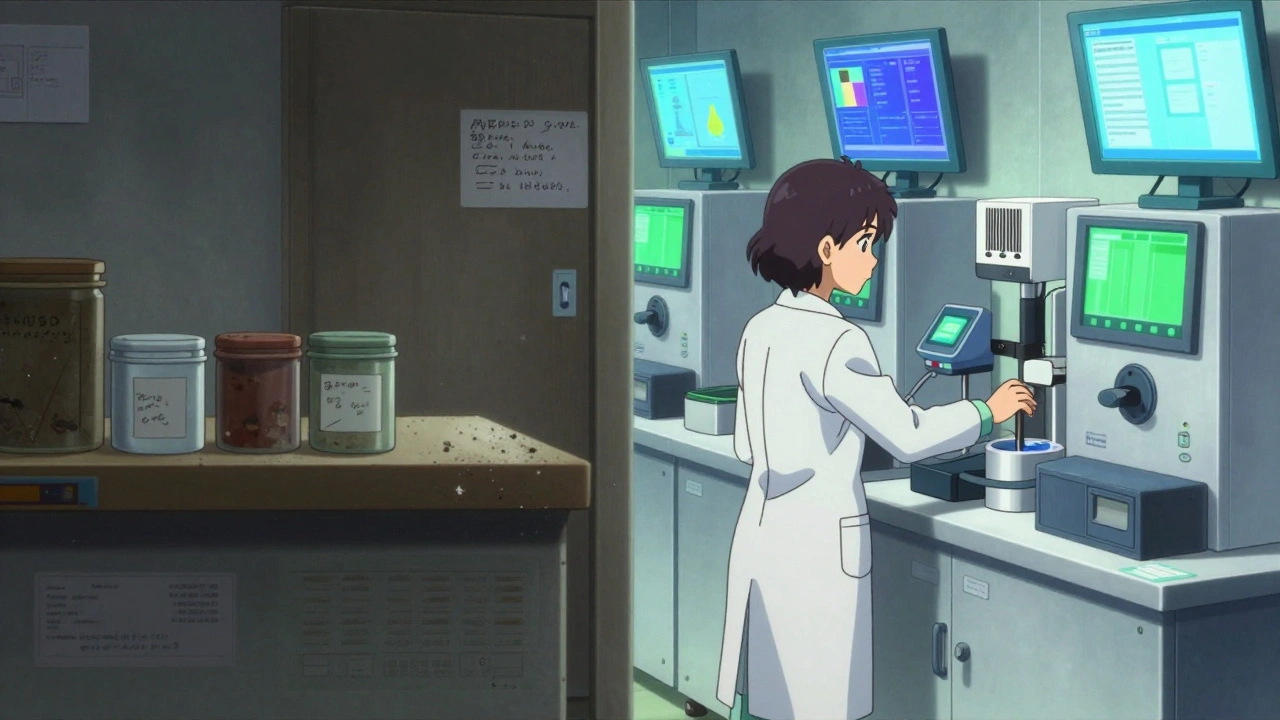
Software isn’t magic. But it’s the best tool we have to catch human mistakes. Tools like Compounding.io and PharmScript automate calculations, flag out-of-range doses, and store electronic batch records. A 2022 study in the Journal of the American Pharmacists Association found these systems reduced errors by 40%. Newer AI tools like CompoundingGuard AI have cut calculation errors by 87% in pilot programs. But here’s the catch: software only works if it’s used correctly. If a pharmacist overrides a warning because ‘I’ve done this a hundred times,’ you’re back to square one. The best systems don’t just calculate-they require confirmation. They won’t let you proceed unless both users sign off.Training Isn’t a One-Time Event
You wouldn’t let a pilot fly a plane after one training session. Why would you let someone compound fentanyl after a single workshop? The International Academy of Compounding Pharmacists (IACP) says quarterly competency assessments are non-negotiable. Staff must prove they can:- Accurately calculate doses down to the microgram
- Perform aseptic technique without contaminating a sterile field
- Use HPLC or FTIR to verify ingredients
- Interpret beyond-use dates (BUDs) correctly
Labeling: The Last Line of Defense
The label is the final thing a patient or nurse sees before giving the medication. If it’s wrong, nothing else matters. The FDA’s 2023 draft guidance demands:- Always use ‘mg/mL’-never ‘per vial’ or ‘per container’
- Include the beyond-use date in clear, readable text
- List all ingredients, including non-active ones like preservatives
- Warn if the product contains hazardous drugs
The Cost of Getting It Right
Accreditation isn’t cheap. PCAB certification costs $15,000 to $25,000 upfront. Cleanrooms with ISO Class 5 air flow run $50,000. HPLC machines cost $30,000. Staff training adds 20-40 hours a month. But the cost of getting it wrong? A patient dies. A lawsuit. A pharmacy shut down. A community loses trust. A 2021 National Association of Boards of Pharmacy study found that 503B outsourcing facilities-those with full CGMP compliance-had a 22% lower error rate than traditional 503A pharmacies. That’s not because they’re bigger. It’s because they’re held to the same standards as drug manufacturers.What Patients Should Ask
If you or a loved one rely on compounded medication, don’t assume it’s safe. Ask:- Are you PCAB accredited?
- Do you use dual verification for every batch?
- Do you test ingredients with HPLC or FTIR?
- Is the label clearly marked with concentration in mg/mL?
- Can I see your beyond-use date documentation?
The Future: More Oversight, Less Risk
The Compounding Quality Act of 2024 is moving through Congress. It would create national minimum standards for all compounding pharmacies. Mandatory adverse event reporting. Uniform training. Real-time FDA oversight. Experts predict 30-40% of compounding pharmacies will close or merge over the next decade-not because demand is falling, but because the cost of compliance is rising. The ones that survive will be the ones that treat safety like a science, not a suggestion. For now, the only thing standing between a patient and a dangerous error is a pharmacist who followed the rules. And if you’re responsible for making those medicines? Don’t cut corners. Don’t rush. Don’t assume. Double-check. Every time.What is the most common cause of compounding errors?
The most common cause is calculation errors-especially with microdosing for children or high-potency drugs like fentanyl. A misplaced decimal or misread concentration can lead to 10x overdoses. This is why dual verification and standardized labeling in mg/mL are critical.
Are all compounding pharmacies regulated the same way?
No. There are two types: 503A pharmacies, which operate under state rules and aren’t inspected by the FDA, and 503B outsourcing facilities, which follow FDA’s Current Good Manufacturing Practices (CGMP) and are regularly inspected. 503B facilities have a 22% lower error rate due to stricter oversight.
How can I tell if my compounded medication is safe?
Ask if the pharmacy is PCAB accredited. Check that the label shows concentration in mg/mL, includes the beyond-use date, and lists all ingredients. If the label says ‘per vial’ or ‘per container,’ it’s a red flag. Also, verify the pharmacy uses dual verification and tests ingredients with HPLC or FTIR.
What’s the difference between USP <795> and <797>?
USP <795> applies to non-sterile preparations like creams, capsules, and oral liquids. It requires a clean area with ISO Class 8 air quality. USP <797> applies to sterile preparations like IVs and injections. It requires an ISO Class 5 cleanroom, sterile garb, and media fill testing. Mixing them up can lead to contamination and infection.
Why do some pharmacies skip safety steps?
Some do it to save time or money. Dual verification adds 25-40% to preparation time. Cleanrooms and testing equipment cost tens of thousands of dollars. But skipping these steps puts patients at risk. The 2012 NECC outbreak, which killed 64 people, started because a pharmacy cut corners on sterility.
Is compounding safer now than it was 5 years ago?
Yes, but progress is uneven. Since 2020, 22 states have mandated continuing education in compounding safety. PCAB accreditation has risen from 8% to 18%. AI verification tools are cutting calculation errors by up to 87%. But many small pharmacies still operate without accreditation or proper testing. The risk is lower overall-but still real.
Gillian Watson
December 4, 2025 AT 14:27Gareth Storer
December 5, 2025 AT 02:17Pavan Kankala
December 5, 2025 AT 06:11Augusta Barlow
December 6, 2025 AT 05:21Rachel Bonaparte
December 6, 2025 AT 17:12Rebecca Braatz
December 7, 2025 AT 16:11Michael Feldstein
December 8, 2025 AT 21:08jagdish kumar
December 9, 2025 AT 11:58Benjamin Sedler
December 10, 2025 AT 04:12Carolyn Ford
December 10, 2025 AT 20:41Dematteo Lasonya
December 11, 2025 AT 17:09Martyn Stuart
December 13, 2025 AT 10:27Jessica Baydowicz
December 14, 2025 AT 05:55Yasmine Hajar
December 15, 2025 AT 12:35