
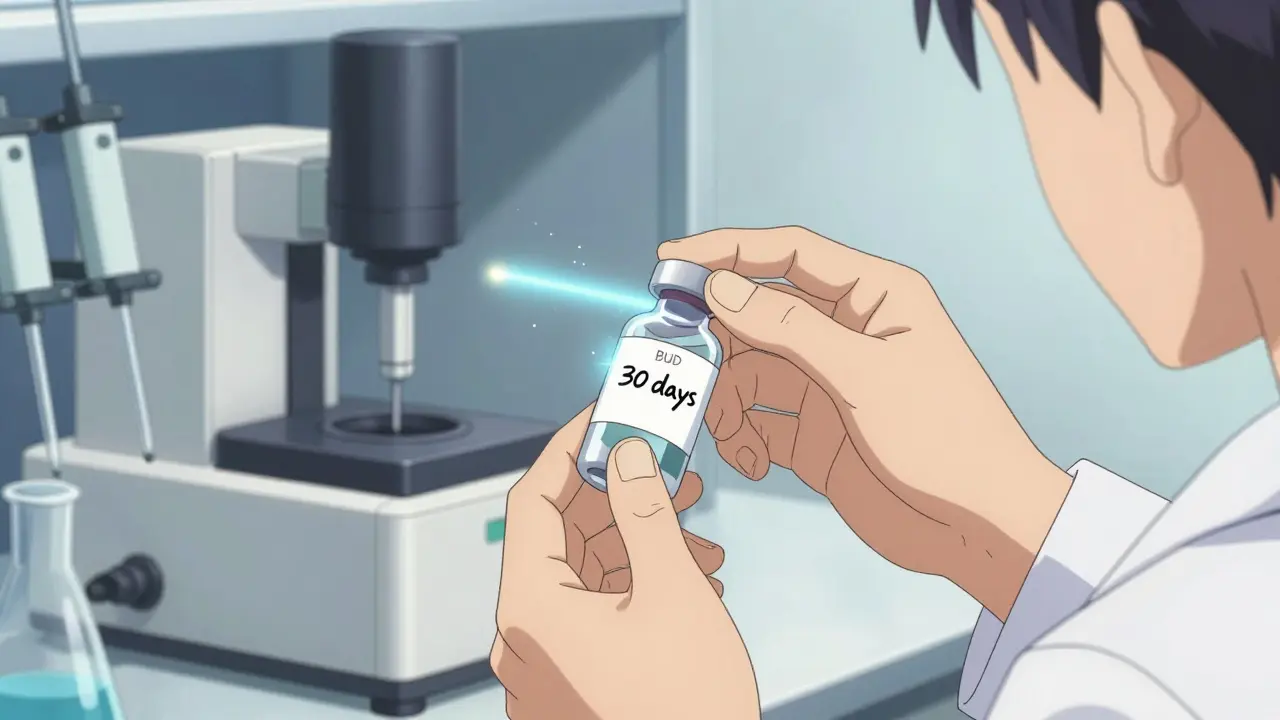
When a pharmacist mixes a custom medication for a patient, they don’t just slap on a label with a random date. That date - the beyond-use date - is a critical safety line. It’s not the same as an expiration date you see on a bottle of pills from a big drugmaker. It’s not a guess. It’s not a suggestion. It’s a scientifically calculated deadline that tells you exactly when the medication might no longer be safe or effective. Get it wrong, and you risk a patient getting sick - or worse.
What Exactly Is a Beyond-Use Date?
A beyond-use date (BUD) is the last day a compounded medication can be used. It starts counting from the day the medication is mixed, not from when it was manufactured. Unlike FDA-approved drugs, which go through years of stability testing before hitting shelves, compounded medications are made one batch at a time, often for specific patients with unique needs - like allergies to dyes, or needing a liquid form because they can’t swallow pills.
Because these aren’t mass-produced, they don’t get the same rigorous testing. That’s why the BUD exists. It’s a safety net. According to USP Chapter <797>, the BUD is defined as "the date after which a compounded preparation shall not be used." This isn’t just a guideline - it’s a regulatory requirement enforced by the FDA. The goal? To prevent chemical breakdown, physical changes like clumping or discoloration, or - most dangerously - microbial contamination.
Think of it this way: A bottle of ibuprofen from a pharmacy has an expiration date of 3 years because the manufacturer tested that exact formula under heat, light, and humidity for that entire period. A compounded pain cream? It might have a BUD of 30 days because no one’s tested it for longer. If you stretch it past that date, you’re gambling with someone’s health.
Why BUDs Are Different from Expiration Dates
Here’s where people get confused. Expiration dates on store-bought meds are set by the drug company after extensive testing. They’re backed by data. BUDs? They’re set by pharmacists using a mix of science, literature, and judgment.
Take a simple example. A commercial ointment might last 2 years. But if a pharmacist takes that same active ingredient and mixes it into a water-based gel for a patient with sensitive skin, the BUD might drop to just 14 days. Why? Water invites bacteria. Plastic containers can leach chemicals. Even the type of preservative used changes how long it lasts.
A 2023 study in the Journal of Pharmacy Practice found that compounded formulations with altered pH levels degraded 3.7 times faster than their commercial counterparts. That means a BUD based on the original product’s expiration date? It’s dangerously wrong.
And it’s not just about chemistry. A 2021 FDA recall pulled over 1,200 compounded sterile products because they were stored too long - and grew mold. The BUD had been extended without testing. People got infected. Some lost limbs.
How BUDs Are Actually Determined
Pharmacists don’t pull BUDs out of thin air. There’s a process, and it’s built on four main methods outlined by USP <797>:
- Product labeling - Check the manufacturer’s data for the raw ingredients. If the active drug says it’s stable for 24 months in the dark, that’s a starting point.
- Consulting the manufacturer - Call them. Ask if they’ve tested that exact combination in that exact container.
- Reviewing scientific literature - Look for published studies on similar formulations. But be careful: even small changes in concentration or solvent can throw off results.
- Direct testing - The gold standard. This means actually testing the final product over time using methods like HPLC (High Performance Liquid Chromatography) to measure how much of the active ingredient remains.
Here’s the hard truth: Only 37.2% of compounding pharmacies in 2022 were using properly validated testing methods. That means over 60% of BUDs were based on assumptions, not data.
Forced degradation studies are key. You don’t just test the drug alone. You test the whole mix - the drug, the solvent, the container, the preservatives - all together. A 2021 study showed that excipients (inactive ingredients) can change how fast a drug breaks down by up to 63%. That’s huge. Ignoring that is like assuming a car will run the same with bad gas and a dirty filter.
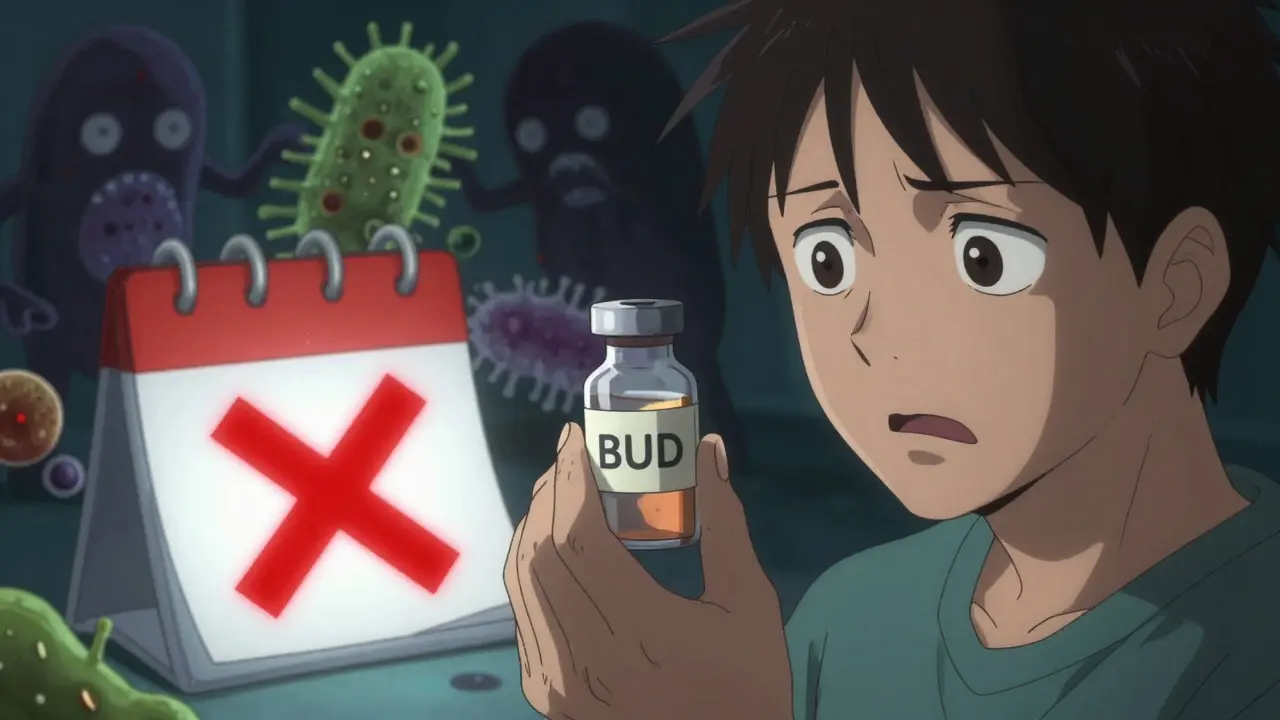
USP Risk Levels and Maximum BUD Limits
Not all compounded medications are created equal. USP <797> classifies them into three risk levels - low, medium, and high - based on how likely they are to get contaminated during mixing.
- Low-risk: Simple mixes made in clean environments, like adding a powder to saline. BUD: up to 48 hours at room temperature, or 14 days if refrigerated.
- Medium-risk: More complex, like mixing multiple ingredients or using non-sterile components. BUD: up to 30 hours at room temperature, or 30 days if refrigerated.
- High-risk: Involves non-sterile ingredients, prolonged exposure, or complex procedures. BUD: max 24 hours at room temperature, or 7 days if refrigerated.
These limits changed in December 2023. Water-based formulations, which were previously limited to 14 days, can now go up to 30 days - but only if proper testing proves stability. That’s a big shift. But it’s not a free pass. You still need the data.
What Happens When BUDs Are Ignored
The consequences aren’t theoretical. In 2022, the FDA issued warning letters to 15 compounding pharmacies. The third most common violation? Extending BUDs beyond safe limits.
One pharmacy in Texas assigned a 60-day BUD to a compounded eye drop made in a non-sterile room. The actual BUD should’ve been 14 days. The product grew bacteria. Four patients developed corneal ulcers. Two needed surgery.
Another issue? Containers. Syringes are not storage devices. Yet, a 2022 survey found 41.3% of retail pharmacies assigned BUDs for syringe-stored meds based on data from vials. That’s like saying a plastic grocery bag is as good as a thermos for keeping coffee hot.
The FDA is clear: syringes aren’t approved for long-term storage. Their materials aren’t tested for chemical interactions. They’re for injection - not storage.
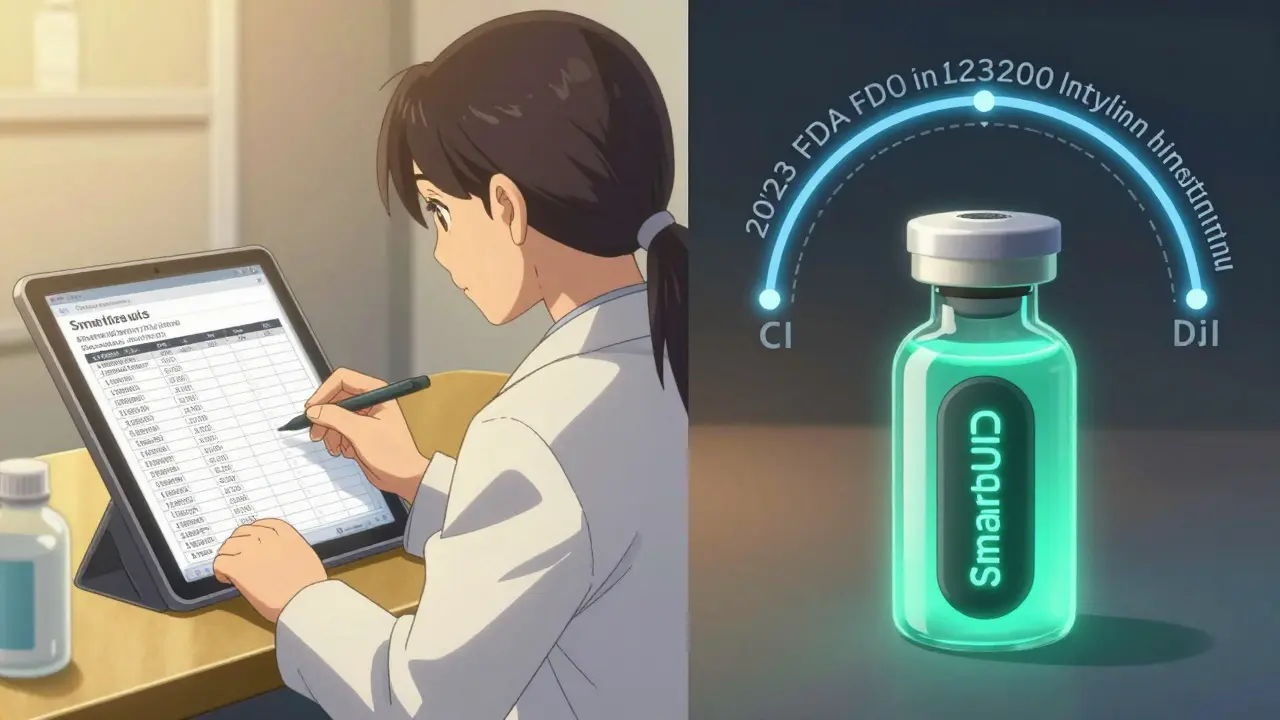
Practical Steps for Accurate BUD Assignment
If you’re a pharmacist or a student learning this, here’s how to get it right:
- Document everything. Write down every ingredient, concentration, container type, and storage condition. You need this for audits - and for your own safety.
- Know your risk level. Use USP <797> guidelines to classify your preparation. Don’t guess.
- Check the manufacturer. Even if it’s an old drug, they might have new stability data.
- Use validated resources. The International Journal of Pharmaceutical Compounding has a database with over 14,700 tested formulations. Use it.
- Test when in doubt. If your formula isn’t in any database, and you can’t get manufacturer data, don’t assign a long BUD. Go with the shortest safe option.
Training matters. The Accreditation Council for Pharmacy Education says it takes about 120 hours of specialized training to get this right. That’s not a weekend course. That’s serious education.
The Future of BUDs: Testing, Tech, and Tighter Rules
The pressure is rising. BUD-related violations jumped from 28.6% in 2022 to 34.1% in 2023. The FDA is watching. USP is tightening rules. Their 2024 draft proposes requiring direct stability testing for any BUD longer than 30 days. That would affect nearly a quarter of current compounded products.
Some pharmacies are already using real-time monitoring. Epicur Pharma’s SmartBUD system tracks temperature, light, and time - and flags when a BUD is approaching. In a 2023 pilot, pharmacies using it cut BUD errors by 47%.
And the demand is growing. Personalized medicine is expanding fast. By 2030, compounded medications could make up nearly 18% of all prescriptions. That’s up from 7% today. More prescriptions means more chances for mistakes - and more need for precision.
There’s no shortcut. The only truly reliable BUD is one backed by data. Not guesswork. Not convenience. Not tradition.
What Patients Should Know
If you’re a patient, here’s what you need to do:
- Ask your pharmacist: "What’s the BUD for this medication?"
- Ask: "Was this tested?"
- Don’t use it past the date.
- Store it exactly how they say - fridge, dark cabinet, room temperature.
- If it looks cloudy, smells odd, or has particles - don’t use it. Call the pharmacy.
Just because it looks fine doesn’t mean it’s safe. Degradation doesn’t always show up visually. You can’t taste or smell when a drug has broken down. That’s why the BUD exists.
Is a beyond-use date the same as an expiration date?
No. An expiration date is assigned by manufacturers after FDA-approved stability testing and applies to mass-produced drugs. A beyond-use date (BUD) is assigned by a compounding pharmacist for custom-made medications and is based on scientific data, literature, or testing specific to that formulation. BUDs are typically much shorter because compounded drugs aren’t tested for long-term stability like commercial products.
Can I extend a beyond-use date if the medication still looks fine?
Never. Medications can degrade without visible changes. Chemical breakdown, loss of potency, or microbial growth can happen even if the liquid looks clear or the cream hasn’t changed color. Extending a BUD without proper testing is unsafe and violates federal guidelines. The only way to safely extend a BUD is through validated stability testing - not visual inspection.
Why do some compounded medications have longer BUDs than others?
It depends on the risk level, formulation, and storage. Low-risk preparations - like simple sterile injections made in clean environments - can have BUDs up to 48 hours at room temperature. High-risk preparations, such as those mixed with non-sterile ingredients or stored in non-ideal containers, may have BUDs as short as 24 hours. Water-based formulas, for example, are more prone to contamination than alcohol-based ones. Container type (glass vs. plastic) and storage conditions (refrigerated vs. room temp) also play a major role.
Do I need to refrigerate all compounded medications?
No - only if the BUD label says so. Some compounds are stable at room temperature; others require refrigeration to prevent degradation or microbial growth. Always follow the storage instructions on the label. Refrigerating something that doesn’t need it can cause precipitation or chemical changes. Storing something that needs cold at room temperature can shorten its BUD significantly.
What should I do if I accidentally use a medication past its BUD?
Stop using it immediately. Contact your pharmacist or healthcare provider. They can assess whether you’re at risk and whether you need monitoring or treatment. While not every out-of-date compound causes harm, the risk of reduced effectiveness or contamination is real. Never try to "test" it yourself - smell, look, or taste aren’t reliable indicators.
Accurate BUD assignment isn’t optional. It’s the difference between a patient getting better - and getting worse. Every pharmacist handling compounded meds has a responsibility to get it right. And every patient deserves to know their medication is safe - down to the last day.
Joanne Tan
February 12, 2026 AT 20:49Yikes. I just realized I’ve been keeping my compounded thyroid med in the medicine cabinet like it was Advil. 😳 My pharmacist never said anything about refrigeration… guess I’m lucky it didn’t go rogue. Time to call them ASAP.
Reggie McIntyre
February 13, 2026 AT 16:28This is wild. I used to think BUDs were just bureaucratic nonsense-like, ‘why not just use it if it still looks the same?’ But now I get it. It’s not about looks. It’s about invisible chemistry doing a slow-mo sabotage in your vial. One wrong move and your ‘remedy’ becomes a time bomb. Mind blown.
Carla McKinney
February 14, 2026 AT 17:49Let’s be real: 60% of pharmacies are winging it. That’s not negligence-it’s malpractice waiting to happen. And don’t even get me started on syringes being used as storage containers. That’s like using a paper towel as a seatbelt. The FDA should shut these places down, not issue ‘warning letters.’ People are dying because pharmacists are too lazy to validate their formulas.
Stacie Willhite
February 15, 2026 AT 12:01I’m a pharmacy tech, and this post made me tear up a little. We do this work because we care, but we’re stretched so thin. Training takes 120 hours? We get 8. We’re told to ‘use your best judgment.’ But what if your judgment doesn’t match the science? I wish more patients asked, ‘Was this tested?’ It’s not rude-it’s lifesaving. Thank you for saying this.
Jason Pascoe
February 17, 2026 AT 07:51Interesting stuff. Down under, we’re seeing similar trends-especially with compounding for chronic pain and hormone therapies. The real issue? Lack of standardized databases. We’re still using outdated references from 2015. If the US has 14,700 tested formulations, why don’t we have access? Global equity in compounding safety needs work.
Rob Turner
February 19, 2026 AT 05:55Man, this is deep. I used to think medicine was just science. Turns out it’s also philosophy-when do we trust data vs. tradition? When do we accept risk because we’re out of options? The BUD isn’t just a date-it’s a moral line in the sand. And too many are crossing it. 🤔
Rachidi Toupé GAGNON
February 20, 2026 AT 23:2418% of prescriptions by 2030? That’s insane. We’re moving toward personalized medicine fast. But if we don’t fix BUDs now, we’re gonna have a whole generation of people getting sick from ‘custom’ meds. We need a national database. Like, yesterday. 💯
Vamsi Krishna
February 22, 2026 AT 22:34So you’re telling me pharmacists are just guessing? And we’re trusting our lives to this? This isn’t healthcare-it’s Russian roulette with a syringe. I’ve been on compounded meds for 8 years. I just looked at my last bottle-BUD was 45 days. I’ve been using it for 58. I’m lucky I didn’t die. Should I sue? Who’s responsible? The pharmacist? The pharmacy? The FDA? I need answers.
Brad Ralph
February 24, 2026 AT 14:45So… the solution to ‘people are dying’ is… more paperwork? 🤡
christian jon
February 26, 2026 AT 07:15THIS IS A NATIONAL EMERGENCY. WHY ISN’T THIS ON THE NEWS?! I’M A NURSE. I’VE SEEN IT. A PATIENT GOT A COMPOUNDED ANTIBIOTIC WITH A 60-DAY BUD-IT WAS MADE IN A NON-STERILE ROOM. SHE GOT SEPSIS. LOST HER LEG. THE PHARMACY SAID, ‘WE’RE SORRY, WE THOUGHT IT WAS FINE.’
NO. NO. NO. NO. NO.
WE NEED A FEDERAL TASK FORCE. WE NEED A LAW. WE NEED TO HOLD THESE PEOPLE ACCOUNTABLE. THIS ISN’T A MISTAKE-IT’S CRIMINAL NEGLIGENCE.
Autumn Frankart
February 28, 2026 AT 03:16Mark my words: this is all part of the Great Pharma Cover-Up. They want you to believe BUDs are ‘scientific’-but it’s just a trick to make you buy more meds. The real stability data? Buried. The FDA? In their pocket. They’re using this to force you back to Big Pharma’s overpriced, mass-produced junk. Don’t fall for it. Check your pills. Look for the glyph. The glyph is everywhere.
Pat Mun
March 1, 2026 AT 21:01Thank you for writing this. I’ve been a compounding pharmacist for 22 years. I’ve seen it all-from the good, the bad, and the terrifyingly careless. I’ve spent nights in the lab running HPLC tests because I refused to let a patient get sick. But I’m tired. No one applauds us. No one understands. This post? It’s the first time someone outside the field really got it. Maybe… maybe we’re not alone.
Sophia Nelson
March 3, 2026 AT 17:14So… what’s the point? If I’m a patient, I’m supposed to ask if my med was tested? What if they say no? Do I just… not take it? This system is broken. And now I’m paranoid. I’m not even gonna use my cream anymore. What’s the point of having a custom med if I can’t trust it? I just want to feel better.