
Why Your Prescription Copays Keep Adding Up
If you’re taking three or more medications for chronic conditions like high blood pressure, diabetes, or arthritis, you’ve probably noticed something frustrating: every time you pick up a prescription, you pay a copay. And if those refills are spread out across the month, you’re paying that fee multiple times - sometimes up to 12 times a year. That’s not just annoying. It’s expensive. For many people, those small $10, $20, or $40 payments add up to hundreds of dollars annually. Worse, the stress of juggling different refill dates makes it easier to miss a dose, which can lead to hospital visits and even higher costs down the road.
The good news? You don’t have to keep paying this way. There’s a simple, free service most pharmacies offer called medication synchronization - or med sync - that can cut your pharmacy visits in half and slash your total copay costs without changing your medications or insurance.
What Is Medication Synchronization?
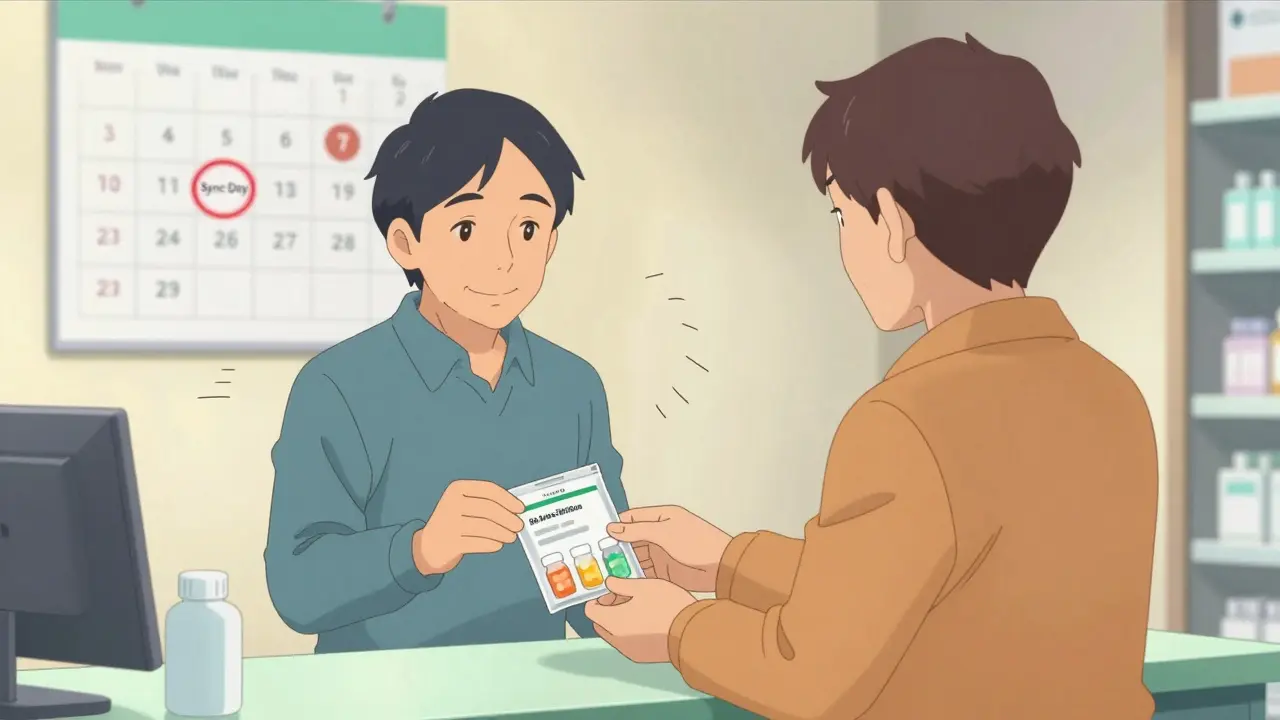
Medication synchronization is when your pharmacy aligns all your chronic prescriptions to be refilled on the same day each month. Instead of getting one pill bottle every week, you get them all together once a month. This isn’t a new idea - it started in community pharmacies around 2010 and became widely adopted by 2015. Today, 87% of major pharmacy chains in the U.S., including CVS, Walgreens, and Rite Aid, offer it for free.
The goal isn’t just convenience. It’s adherence. Studies show that when patients have to make multiple trips to the pharmacy, they’re more likely to skip doses. One NIH study found that for every 10% increase in out-of-pocket cost per prescription, medication use drops by 2.3%. That’s not just about money - it’s about health. When you miss doses, your condition can worsen. That leads to emergency room visits, hospital stays, and higher overall costs.
Med sync fixes this by reducing your pharmacy visits from 12 or more per year to just 4. That means fewer copays, less time driving, and fewer chances to forget a pill.
How It Works: The Four-Step Process
Getting started is easier than you think. Here’s how it works:
- Ask your pharmacist - Walk in or call your pharmacy and say, “I’d like to enroll in medication synchronization.” You don’t need a doctor’s note. This is a pharmacy service, not a medical order.
- They review your full list - The pharmacist will look at all your prescriptions, including over-the-counter meds and supplements. They’ll check for interactions, duplicates, or drugs that might be better combined.
- They adjust your refills - This is the key step. If your blood pressure med is due in 10 days and your cholesterol pill is due in 25, they’ll give you a small “short fill” of the earlier one so both are ready at the same time. This might mean getting an extra week’s supply of one med - and yes, it’s allowed under Medicare and most private plans.
- You pick up everything on one day - Once everything’s synced, you’ll get a call or text every month when your meds are ready. You pick them up once, pay one copay (or maybe even zero, depending on your plan), and walk out with all your pills for the next 30 days.
The whole process usually takes 1 to 3 months to fully set up, depending on how your prescriptions are scheduled. Don’t be surprised if you get a few extra pills in the first month - that’s normal. It’s just to get you on the same cycle.
What You Can Save
Let’s say you take six maintenance medications. If they’re all on different refill schedules, you’re probably paying six copays a month - that’s $720 a year if each copay is $10. With med sync, you pay one copay a month - $120 a year. That’s $600 saved, just by changing when you pick up your pills.
And it’s not just about the copay. You’ll also save on gas, time off work, and childcare if you’re picking up meds for someone else. One Reddit user shared that syncing her 72-year-old mother’s eight prescriptions cut her monthly pharmacy trips from 12 to 4, saving $120 a year in transportation alone.
There’s also a bigger health benefit. CMS data from 2020 to 2022 showed that patients using med sync had 23.6% fewer hospital admissions for medication-related problems. That’s not just savings - it’s safety.
What Doesn’t Work With Med Sync
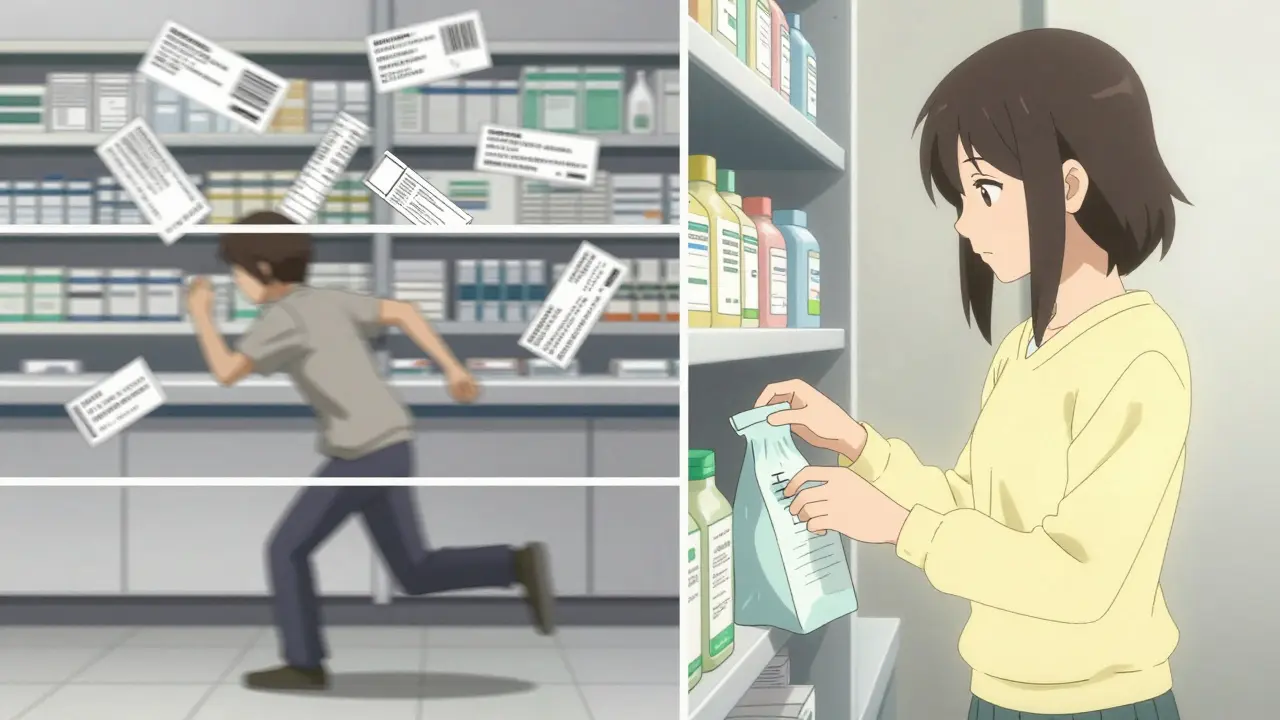
Med sync isn’t magic. It won’t work for every medication. Here are the common roadblocks:
- Acute medications - Antibiotics, painkillers, or short-term prescriptions don’t sync well because they’re not meant for long-term use.
- 90-day supplies - If your insurer lets you get a 90-day supply, your refill cycle is longer than 30 days. Some pharmacies can sync these, but it requires special approval.
- Insurance restrictions - Medicare Part D rules limit early refills to two days before you’ve used 70% of your current supply. If your pharmacy can’t get an exception, they might have to wait.
- Specialty drugs - High-cost medications like those for rheumatoid arthritis or hepatitis C often come with copay assistance programs. These can conflict with med sync if your insurer uses a “copay accumulator” program, which we’ll explain next.
Copay Accumulators and Maximizer Programs - The Hidden Trap
This is where things get tricky. Many insurers, especially for expensive specialty drugs, use programs called copay accumulators and copay maximizers.
Here’s how they work: Drug manufacturers often offer coupons that lower your out-of-pocket cost - say, from $650 to $50 per month. But if your insurer uses a copay accumulator, that $600 saved by the coupon doesn’t count toward your deductible or out-of-pocket maximum. So even though you’re paying less now, you’re still responsible for the full $650 when it comes to hitting your plan’s cap. That means you’ll pay more later.
Worse, some plans use “copay maximizers,” which force you to use the manufacturer coupon first - even if it’s not in your best interest. In one case, a patient’s $5,000 annual coupon was voided by their insurer’s accumulator program, raising their monthly cost from $50 to $650.
These programs are becoming more common. The Kaiser Family Foundation warned in 2024 that they’re undermining the financial benefits of med sync for patients on specialty drugs. If you’re on a high-cost medication, talk to your pharmacist about whether your plan uses these programs. Ask if the manufacturer offers an alternative funding option - some now send direct financial aid to the pharmacy, bypassing the insurer entirely.
Combination Medications - The Ultimate Coordination Tool
If you’re on two or more drugs that treat the same condition - like blood pressure pills - ask your doctor if a combination medication is available. These are single pills that contain two or more active ingredients.
For example, instead of taking lisinopril and hydrochlorothiazide separately, you might take a single pill called HCTZ/lisinopril. That’s one pill instead of two. One refill instead of two. One copay instead of two.
Between 2018 and 2023, the FDA approved 127 new combination medications. Many are now covered under Medicare Part D. MaxCareRx found that patients on combination pills had up to 27% fewer missed doses because there’s less to manage.
It’s not always possible - not every drug has a combo version. But it’s worth asking. Your doctor and pharmacist can check if a combo exists for your regimen.

What to Do Next
If you’re taking three or more chronic medications, here’s your action plan:
- Call your pharmacy - Ask if they offer medication synchronization. If they say no, ask to speak to the pharmacist. Some locations don’t advertise it.
- Bring your full list - Include every pill, vitamin, and OTC med you take. Don’t assume they know what you’re on.
- Ask about your insurance plan - Specifically, ask: “Do you use copay accumulators or maximizers?” If yes, ask if your manufacturer offers direct assistance.
- Ask your doctor - “Are there combination pills available for any of these medications?”
- Stick with it - The first month can be messy. You might get an extra week of one med. That’s okay. After two months, it smooths out.
Don’t wait until you’re overwhelmed. Start now. The savings are real. The health benefits are proven. And it’s free.
What If My Pharmacy Won’t Do It?
If your local pharmacy refuses or says they can’t sync your meds, try another location - even if it’s a different chain. Most major chains have the same system. CVS’s ScriptSync, Walgreens’ ReadyFill, and Rite Aid’s MedSync all work the same way.
If you’re on Medicare, you can also call your Part D plan’s customer service and ask if they have a preferred pharmacy for med sync. Some plans partner with specific pharmacies to make this easier.
And if you’re still stuck, ask for a medication therapy management (MTM) session. It’s a free, 20- to 30-minute appointment with a pharmacist to review your entire regimen. Many patients get med sync set up during these sessions.
Can I sync my prescriptions if I’m on Medicare?
Yes. Medicare Part D plans fully support medication synchronization. In fact, CMS encourages it because it reduces hospitalizations. Most Medicare beneficiaries who use med sync see fewer out-of-pocket costs and fewer missed doses. Just make sure your pharmacy is enrolled in your Part D plan’s network.
Will med sync lower my copay amount per prescription?
No - it doesn’t change the cost of each individual prescription. But it reduces how often you pay. Instead of paying six copays a month, you pay one. That cuts your total annual out-of-pocket spending significantly, even if each copay stays the same.
Can I sync my 90-day prescriptions with 30-day ones?
It’s possible, but it requires special approval. Your pharmacist can request an early refill exception from your insurer. Medicare allows this if the refill is within two days before the 70% point of your current supply. For 90-day supplies, that means you can refill after 63 days. Your pharmacist will handle the paperwork.
What if I miss my sync day?
Don’t panic. Most pharmacies will still fill your prescriptions if you’re a day or two late. But if you miss it by more than a week, your cycle might reset. Call ahead and ask if you can pick up early or if they can hold your meds. Many will do it if you’ve been consistent.
Do I need to pay extra for this service?
No. Medication synchronization is a free service offered by pharmacies. It’s built into their workflow to improve adherence and reduce waste. You only pay your regular copay - just fewer times per year.
Can I sync medications from different doctors?
Yes. The pharmacy can coordinate all your prescriptions, no matter which doctor wrote them. They’ll check for interactions and make sure everything works together. Just make sure you give them a complete list - including any new prescriptions you get.
How do I know if I’m eligible?
If you take three or more maintenance medications for chronic conditions - like diabetes, high blood pressure, cholesterol, or asthma - you’re eligible. Even if you’re on just two, it’s worth asking. The only exceptions are medications you take on an as-needed basis, like painkillers or antibiotics.
Final Thought: It’s Not Just About Money
Reducing your copays is a win. But the real win is peace of mind. When you know your pills are ready on the same day every month, you stop worrying about running out. You stop forgetting. You stop feeling like you’re failing because you missed a dose.
Medication synchronization isn’t a trick. It’s a smart, simple system designed by pharmacists to help people like you stay healthy - without breaking the bank. And with 95% of chronic medication management expected to use this method by 2030, it’s not going away. It’s becoming the standard.
Start today. Call your pharmacy. Ask for med sync. You’ve got nothing to lose - and hundreds of dollars, and maybe even your health, to gain.
Coy Huffman
February 4, 2026 AT 06:37Amit Jain
February 6, 2026 AT 00:41Keith Harris
February 6, 2026 AT 15:41Kunal Kaushik
February 7, 2026 AT 01:01Prajwal Manjunath Shanthappa
February 7, 2026 AT 03:33Wendy Lamb
February 8, 2026 AT 19:21Antwonette Robinson
February 9, 2026 AT 13:59Ed Mackey
February 9, 2026 AT 19:39Katherine Urbahn
February 10, 2026 AT 11:05Alex LaVey
February 11, 2026 AT 03:24Jhoantan Moreira
February 11, 2026 AT 09:41Justin Fauth
February 11, 2026 AT 21:15Joy Johnston
February 12, 2026 AT 10:29Shelby Price
February 13, 2026 AT 03:34Sherman Lee
February 13, 2026 AT 09:26