

Why Sunlight Makes Your Lupus Skin Rash Worse
For people with cutaneous lupus, stepping outside on a sunny day isn’t just about getting a tan-it’s a gamble with your skin. Up to 75% of those with this condition experience flare-ups after even brief sun exposure. It’s not a bad sunburn. It’s an immune system gone haywire. Ultraviolet light-both UVA and UVB-triggers a chain reaction in the skin that turns mild redness into lasting lesions, scarring, or even full-body flares.
Unlike regular sun sensitivity, lupus-related photosensitivity doesn’t show up right away. Symptoms often appear 24 to 72 hours later. That delay tricks people into thinking they’re safe. You might sit by a window at work, think you’re protected, and wake up with a butterfly-shaped rash across your cheeks and nose. That’s acute cutaneous lupus. And it’s not rare-85% of people with this form report sun exposure as the direct trigger.
The Science Behind the Burn
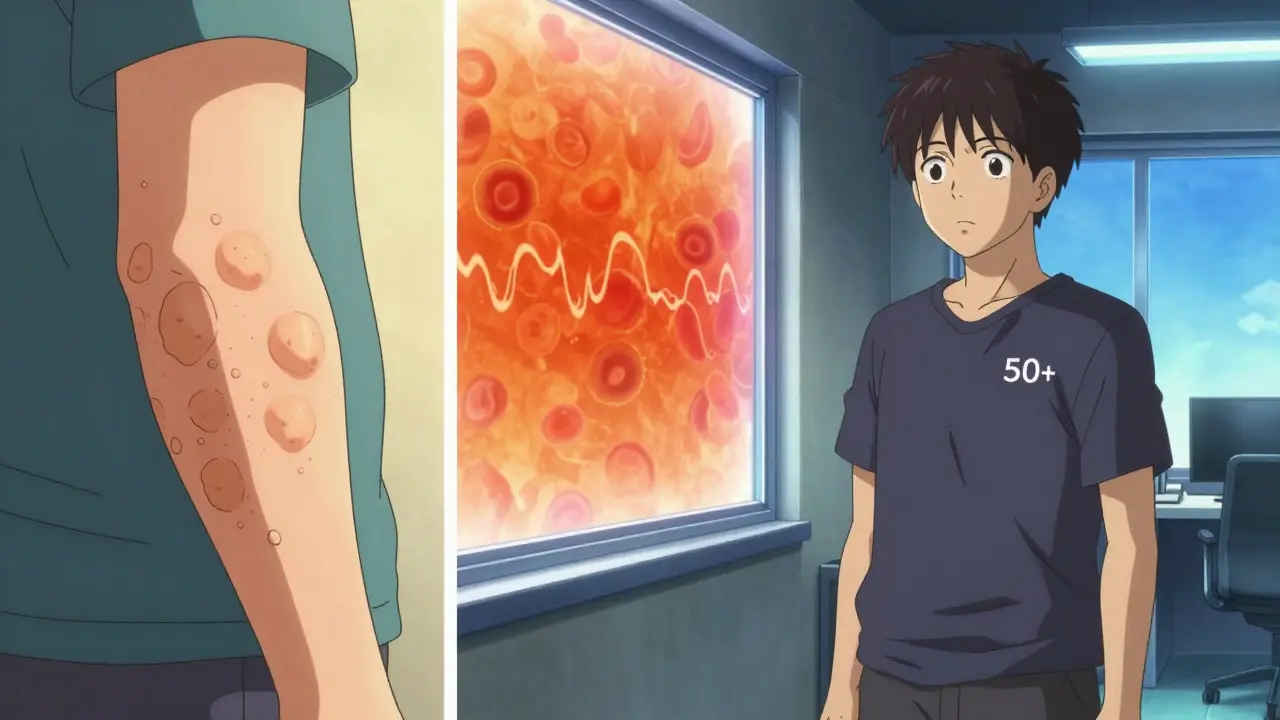
It’s not just heat or brightness. UV light damages skin cells in a very specific way in lupus patients. Keratinocytes-the top layer of skin cells-undergo apoptosis (cell death) at 2.3 times the rate compared to people without lupus. This isn’t just irritation; it’s a signal to the immune system that something’s wrong.
When those cells die, they release proteins that the immune system mistakes for invaders. One key player is interferon-kappa (IFN-κ), a signaling molecule that spikes 400-600% after UV exposure in lupus-prone models. That floods the skin with inflammation. Chemokines like CCL5 and CCL8 surge too, pulling immune cells into the skin where they attack healthy tissue.
There’s also a clear link to antibodies. People who test positive for Ro/SSA antibodies are 78% likely to have severe photosensitivity. Those without the antibody? Only 42%. That’s not just correlation-it’s a diagnostic clue.
How Different Lupus Skin Rashes Act Up in the Sun
Not all cutaneous lupus looks the same, and not all react the same way to sunlight.
- Acute cutaneous lupus (ACLE): The classic malar or “butterfly” rash. Appears after sun exposure, often within hours. Bright red, flat, and fades without scarring-but it’s a red flag for possible systemic flare.
- Subacute cutaneous lupus (SCLE): Red, scaly patches that look like ringworm or psoriasis. They show up on arms, shoulders, and chest. 92% of SCLE cases are tied to UV exposure. These don’t scar but can linger for weeks.
- Chronic cutaneous lupus (CCLE) / Discoid lupus: Thick, raised, scaly plaques that scar. Sunlight doesn’t usually cause new ones here-it makes existing lesions worse. 76% of discoid patients report flare-ups after sun exposure. The damage is permanent.
Here’s the catch: nearly half of people who think they have lupus-related photosensitivity actually have something else-like polymorphous light eruption (PMLE). The difference? PMLE fades within days. Lupus reactions last 3 to 21 days. If your rash sticks around longer than three weeks, it’s almost certainly lupus.
Indoor Triggers You Can’t Ignore
It’s not just the sun. Fluorescent lights, especially older CFL bulbs, emit UVA rays that can trigger flares. On Reddit’s r/lupus community, 74% of over 380 people reported lighting as a problem. One user wrote: “I got a full malar rash after 15 minutes sitting near a window at my office.” Glass blocks UVB but not UVA-so you’re not protected just because you’re indoors.
Studies show that switching from CFL to LED lighting cuts UV exposure by 92%. That’s not a minor tweak-it’s a game-changer for daily comfort. Same goes for windows. Standard glass lets through 90% of UVA. UV-blocking window film reduces that to less than 0.1%. Many companies, including Microsoft and Johnson & Johnson, have installed this in their offices since 2020.
What Actually Works: Skin-Targeted Treatments
There’s no cure for cutaneous lupus, but you can control it. And the most effective tool isn’t a pill-it’s prevention.
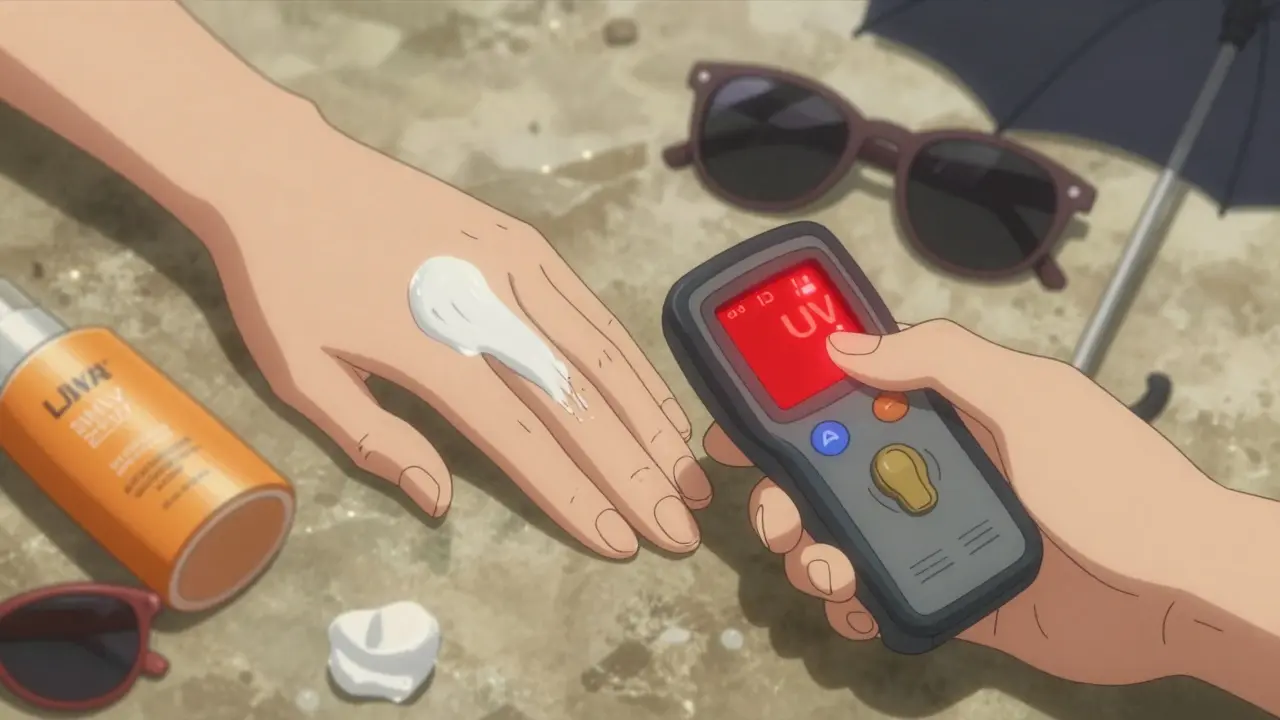
Topical sunscreens are the first line of defense. Not just any sunscreen-broad-spectrum SPF 50+ with zinc oxide or titanium dioxide. These sit on the skin and physically block UV rays. Studies show consistent daily use reduces flares by 87%. Reapply every two hours. Even if you’re inside. Even if it’s cloudy.
UPF 50+ clothing blocks 98% of UV radiation. Hats with wide brims, long sleeves, and UV-protective scarves make a huge difference. Many patients report 73% fewer flares when they combine sunscreen with physical barriers.
For the eyes, photophobia is common. FL-41 tinted glasses reduce light sensitivity by 68%. They’re not fashion accessories-they’re medical tools.
When topical measures aren’t enough, doctors turn to prescription creams. Topical calcineurin inhibitors like tacrolimus reduce inflammation without thinning the skin (unlike steroids). Topical retinoids help with discoid lesions by normalizing skin cell growth. And for stubborn cases, intralesional steroid injections can flatten thick, scarring plaques.
New Hope: Drugs That Target the Root Cause
While sun protection is essential, new medications are changing the game for those with frequent flares.
Anifrolumab, approved by the FDA in 2021, blocks interferon-a key driver of lupus inflammation. In clinical trials, it cut skin activity scores by 34% more than placebo, especially in photosensitive patients. JAK inhibitors, still in phase II trials, show promise in blocking the same pathway, reducing photosensitivity reactions by 55%.
These aren’t magic bullets. But for people who’ve tried everything and still get flares, they offer real relief. And they work best when paired with strict photoprotection.
What Doesn’t Work (and Why People Get Frustrated)
Many patients report being dismissed by doctors early on. In a 2022 survey, 58% said their primary care provider didn’t believe their sun sensitivity was linked to lupus. That delay means missed chances to prevent scarring and systemic flares.
Also, not all sunscreens help. Chemical filters like oxybenzone can irritate lupus skin. Fragrances, alcohol, and parabens in “natural” products can trigger reactions. Stick to mineral-based, fragrance-free options. And don’t assume a higher SPF is always better-SPF 50+ with zinc oxide is the sweet spot.
Living with It: Real-Life Strategies That Stick
Managing cutaneous lupus isn’t about avoiding life-it’s about adapting it.
- Plan outdoor time before 10 a.m. or after 4 p.m. when UV is lowest.
- Carry a small umbrella or UV-blocking parasol. They’re portable, cheap, and effective.
- Use UV meters on your phone (like UVLens or SunSmart) to track daily exposure. Three devices now in testing are 92% accurate at predicting flare risk.
- Ask your workplace to switch to LED lighting or install UV film on windows. Many employers are legally required to make reasonable accommodations.
- Keep a symptom journal. Note what you were doing, where you were, and how long you were exposed. Patterns emerge over time.
What’s Next for Lupus Skin Care
Research is moving fast. Scientists are testing “smart” wearables that glow when UV exposure hits danger levels. Others are developing topical creams that block interferon right at the skin’s surface. The goal? Not just to treat flares-but to stop them before they start.
For now, the message hasn’t changed since the 1980s: protect your skin like your health depends on it-because it does. And it does.
Can I still go outside if I have cutaneous lupus?
Yes-but you need to be strategic. Avoid direct sun between 10 a.m. and 4 p.m. Wear UPF 50+ clothing, a wide-brimmed hat, and broad-spectrum SPF 50+ sunscreen with zinc oxide. Reapply every two hours. Even on cloudy days or indoors near windows, UV rays can trigger flares. Many people with lupus live full, active lives-they just plan ahead.
Is sunscreen enough to protect me from lupus flares?
Sunscreen is critical, but not enough on its own. Studies show that combining sunscreen with physical barriers like UPF clothing and UV-blocking window film reduces flares by up to 70%. Chemical sunscreens can irritate sensitive skin-stick to mineral formulas with zinc oxide or titanium dioxide. And remember: sunscreen wears off. Reapplication is non-negotiable.
Why do fluorescent lights trigger my lupus rash?
Older fluorescent bulbs (CFLs) emit UVA radiation, which penetrates deeper into the skin than UVB. Even if you’re not in direct sunlight, this exposure can trigger the same immune response in lupus patients. Switching to LED lighting cuts UV exposure by 92%. Many workplaces now make this change for employees with photosensitivity.
Does having a lupus skin rash mean I have systemic lupus?
Not necessarily. Cutaneous lupus can exist on its own. But skin flares, especially the malar rash, are often the first sign of systemic lupus. About half of people with chronic skin lesions eventually develop joint pain, fatigue, or kidney issues. That’s why doctors monitor you closely-even if your symptoms seem limited to the skin.
Are there any new treatments for lupus skin lesions?
Yes. Anifrolumab, approved in 2021, targets interferon pathways and reduces skin activity scores by 34% more than placebo. JAK inhibitors in clinical trials show a 55% reduction in photosensitivity reactions. Topical treatments like tacrolimus and retinoids help with localized lesions. For thick, scarring plaques, steroid injections directly into the skin can flatten them. These work best when combined with strict sun protection.
Shelby Price
February 5, 2026 AT 10:26Katherine Urbahn
February 5, 2026 AT 20:39Keith Harris
February 6, 2026 AT 23:50Caleb Sutton
February 7, 2026 AT 18:15Joseph Cooksey
February 9, 2026 AT 15:10Joy Johnston
February 10, 2026 AT 17:22Amit Jain
February 12, 2026 AT 05:31Daz Leonheart
February 12, 2026 AT 10:02Kunal Kaushik
February 13, 2026 AT 06:38Harriot Rockey
February 14, 2026 AT 16:52Jesse Naidoo
February 15, 2026 AT 21:41