
Generic drugs are the backbone of modern healthcare. About 90% of prescriptions in the U.S. are filled with generics-cheaper, widely available, and trusted to work just like brand-name drugs. But behind that trust lies a growing crisis: contamination. In recent years, contaminated generics have led to cancer diagnoses, chemotherapy failures, and even fatal overdoses. This isn’t a rare glitch. It’s a systemic problem rooted in global manufacturing, weak oversight, and cost-cutting that puts patients at risk.
What’s Contaminating Generic Drugs?
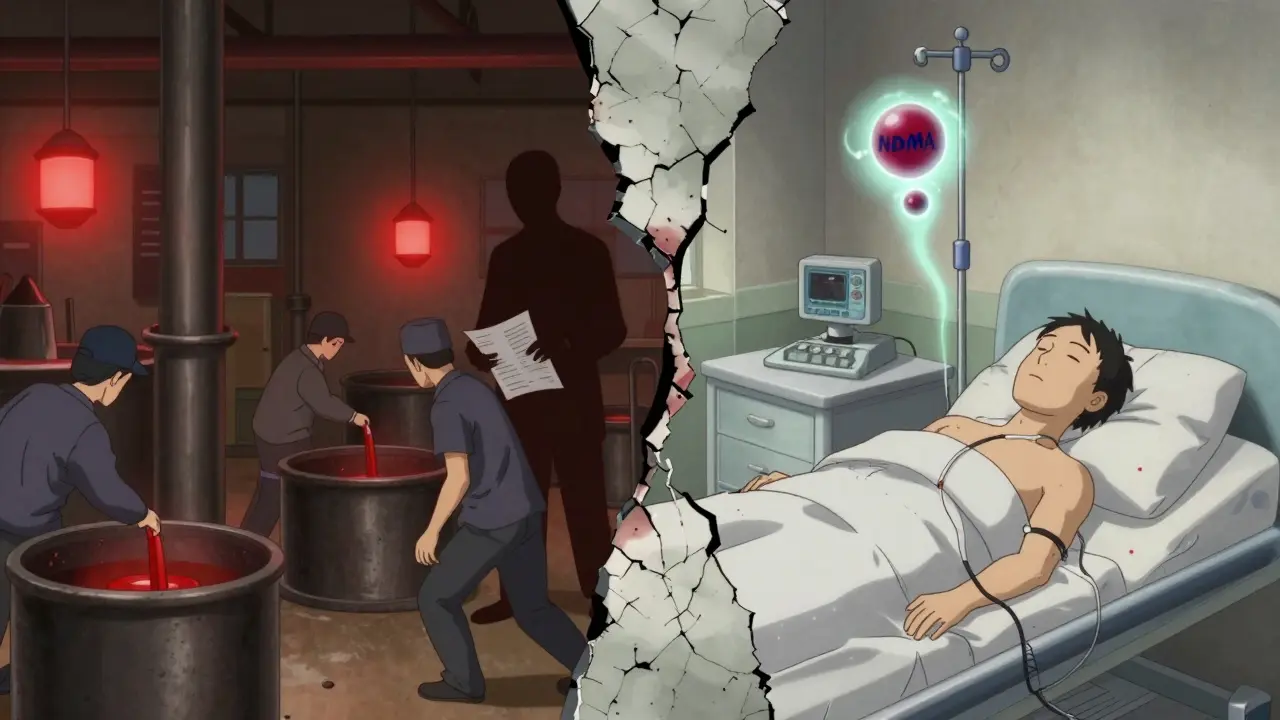
Contamination in generics doesn’t come from dirt or poor storage. It comes from chemical byproducts created during manufacturing-often because processes are rushed, poorly monitored, or deliberately altered to save money. The most dangerous contaminants are carcinogens like NDMA and benzene.NDMA, a known human carcinogen, was found in blood pressure medications like Valsartan at levels up to 200 times the FDA’s safe limit. The source? A Chinese manufacturer, Zhejiang Huahai Pharmaceutical, changed its production method to cut costs. They added sodium nitrite-a cheap chemical-to speed up synthesis. But without proper controls, it reacted with other ingredients to form NDMA. Patients who took the contaminated pills for years saw cancer rates more than triple compared to the general population.
Then there’s benzene, a known cause of leukemia. In 2025, independent testing of Walgreens’ Mucinex brand generic expectorant found benzene levels as high as 4.7 parts per million-more than double the FDA’s 2 ppm limit. Patients like Miriam Birdsong and Cheryl Mikel, both plaintiffs in a federal lawsuit, developed bone marrow abnormalities after using the product for just 18 months. The contamination came from solvent residues left behind during the manufacturing process.
And it’s not just these two. Chemotherapy drugs from Indian manufacturers have been found with less than 80% of the labeled active ingredient-far below the FDA’s 85-115% acceptable range. One batch of cisplatin failed dissolution testing so badly that 7 out of 11 cancer patients receiving it saw their tumors continue growing despite treatment. In another case, fentanyl patches from Sandoz leaked up to 15% of their dose due to faulty seals, putting users at risk of accidental overdose.
Where Are These Drugs Made-and Why?
The U.S. doesn’t make most of its generic drugs anymore. Over 80% of the active ingredients come from China. Nearly 40% of finished pills and injections come from India. These countries dominate because they can produce drugs at a fraction of the cost. But that low cost comes with trade-offs.India alone has been flagged over 100 times since 2018 for quality violations. Zee Laboratories, one of the largest Indian generic makers, was cited 46 times-once for finding visible particles in 100% of sampled vials of cisplatin. In 2022, an FDA inspection of Intas Pharmaceuticals’ facility in Ahmedabad uncovered a shocking scene: employees shredding and pouring acid on quality control documents to hide failures. That facility supplied chemotherapy drugs to 92% of U.S. cancer centers. When those drugs failed, patients were left without treatment.
The FDA inspects only 13% of Indian drug plants each year-despite the fact that India supplies nearly half of America’s generic drugs. With over 28,000 foreign manufacturing sites and just $78 million in annual inspection funding, the agency is overwhelmed. And even when violations are found, the FDA often redacts the names of the drugs involved. That means doctors and pharmacists can’t tell which specific products are risky.
Real Patients, Real Consequences
This isn’t theoretical. Real people are getting sick.In the Valsartan lawsuits, 68% of patients exposed to contaminated pills developed cancer within five years. Colorectal cancer rates jumped from 4 per 100,000 in the general population to 27 per 100,000 among those taking the tainted blood pressure meds. One patient, a 52-year-old teacher from Ohio, was diagnosed with liver cancer after using Valsartan for four years. Her oncologist later confirmed the NDMA exposure was likely the cause.
For cancer patients, the stakes are even higher. A Memorial Sloan Kettering study found that patients receiving substandard chemotherapy had a 34% failure rate-more than double the 12% failure rate seen with verified brand-name drugs. One woman with stage III breast cancer received a batch of contaminated paclitaxel. Her tumor didn’t shrink. She lost six months of treatment time. By the time she got a clean batch, the cancer had spread.
Even routine medications are at risk. A pharmacist in Michigan told a Reddit thread in March 2025 that she’d seen three different batches of generic levothyroxine fail potency tests in six months. Patients’ TSH levels spiked unpredictably-some became hypothyroid, others hyperthyroid. Only when she switched them back to the brand did their levels stabilize.
Why Is This Still Happening?
The problem isn’t just bad actors. It’s a system designed to prioritize speed and cost over safety.Since the 1984 Hatch-Waxman Act, generic manufacturers haven’t had to prove their drugs are safe through clinical trials. They only need to show they’re “bioequivalent”-meaning they release the same amount of active ingredient at the same rate as the brand. That’s fine… if the manufacturing process is controlled. But when companies cut corners, the bioequivalence claim becomes meaningless. A drug might release the right amount of active ingredient-but also release toxic byproducts.
And there’s little consequence for failure. Most recalls are voluntary. Fines are rare. Even when the FDA issues a warning letter, many companies keep selling. The 2025 Generic Drug User Fee Amendments (GDUFA III) introduced real-time stability testing for high-risk drugs, but enforcement is still weak. Only 3% of Indian plants use continuous manufacturing-a technique proven to reduce contamination by 78%. Why? Because upgrading equipment costs $5 million to $15 million. And no one’s making them pay for it.
Meanwhile, the FDA’s Drug Supply Chain Security Act requires full electronic tracking of drugs by 2027. But right now, only 62% of pharmacies can even verify if a drug’s traceability data is valid. That means a contaminated batch can travel from a factory in India to a pharmacy shelf in Ohio without anyone knowing where it came from.
What Can You Do?
You can’t control what’s made in a factory overseas. But you can take steps to protect yourself.- Check FDA recall lists weekly. A 2025 Pharmacy Times survey found 68% of pharmacists check these lists regularly. You can do the same at fda.gov/recalls.
- Ask your pharmacist about the manufacturer. If your generic levothyroxine keeps causing weird side effects, ask if it’s from a different batch. Some pharmacies can switch you to a brand with a better track record.
- Don’t assume “generic” means “safe.” Some generics are made by companies with clean records. Others aren’t. If your insurance lets you choose, opt for a generic made by a U.S.-based company or one with a strong reputation-like Teva, Mylan, or Sandoz (even though Sandoz had a recall, they’ve improved since).
- Report side effects. If you think a generic drug made you sick, report it to the FDA’s MedWatch program. These reports help build the case for stronger enforcement.
The Future: Can This Be Fixed?
The FDA says it’s working on solutions. Its 2026-2030 plan includes AI tools to predict contamination risks and blockchain systems to track drugs from factory to pharmacy. But experts remain skeptical. Dr. Dinesh Thakur, a former pharmaceutical executive turned whistleblower, says, “Without meaningful penalties and independent oversight, the problem will continue.”Legal cases are starting to change the game. The Valsartan multidistrict litigation, with over 1,300 cases, could set a precedent. If courts find manufacturers knowingly hid contamination risks-as internal documents suggest they did-fines could reach millions per case. That might finally force companies to invest in real quality control.
Until then, the burden falls on patients and providers. The system is broken. But awareness is power. Knowing which drugs have been recalled, who made them, and what the risks are gives you a fighting chance.
Are all generic drugs unsafe?
No, not all generics are unsafe. Many are made by reputable manufacturers with strong quality controls. The issue isn’t generics as a category-it’s specific manufacturers, especially those in countries with weak oversight, who cut corners. Some generic brands have perfect safety records. The key is knowing which ones and staying alert to recalls.
How do I know if my generic drug is contaminated?
You usually can’t tell by looking or feeling. Contaminants like NDMA or benzene are invisible and odorless. The only way to know is through lab testing or a recall notice. Check the FDA’s recall page weekly, and if you notice unusual side effects-like unexplained nausea, fatigue, or changes in blood work-talk to your doctor and ask if your drug has been flagged.
Can I switch to the brand-name drug instead?
Yes, if your insurance allows it. Brand-name drugs are more expensive, but they’re often manufactured under stricter controls in the U.S. or Europe. If you’ve had bad reactions to a generic, ask your doctor to write a prescription for the brand with a “dispense as written” note. Many insurers will approve it if you show documented side effects or lab results.
Why doesn’t the FDA shut down these factories?
The FDA can issue warning letters, block imports, or even sue-but shutting down a factory is rare. Many foreign plants are critical to the global supply chain. If the FDA shuts down one, it can cause drug shortages. So they often allow companies to fix problems instead. But without financial penalties or criminal charges, many companies see recalls as a cost of doing business-not a reason to change.
Are U.S.-made generics safer?
Generally, yes. U.S.-based manufacturers are subject to more frequent inspections and stricter enforcement. While not perfect, they’re far less likely to have the kinds of systemic failures seen in some foreign plants. If you can choose a generic made in the U.S., it’s a safer bet-especially for high-risk drugs like chemotherapy, heart meds, or thyroid hormones.
What’s Next?
The next few years will be critical. The FDA’s new transparency policy-finally naming contaminated drugs in inspection reports-could be a turning point. If patients and doctors can see exactly which products are risky, they can avoid them. That puts pressure on manufacturers to clean up their act.But real change won’t come from warnings alone. It will come from lawsuits, from public outrage, from patients demanding better. The system was built to save money. Now it’s costing lives. The question isn’t whether we can fix it. It’s whether we’re willing to pay the price to make it right.
Souhardya Paul
December 16, 2025 AT 23:13So many of us take generics without a second thought, but this post laid out the reality in a way that’s hard to ignore. I didn’t realize how little oversight exists-80% of active ingredients from China, FDA inspecting only 13% of Indian plants? That’s not a regulatory system, that’s a game of Russian roulette with your meds. And the fact that recalls don’t name the exact drugs? That’s not just negligence, it’s betrayal. I’m starting to check my prescriptions by manufacturer now. If my pharmacist can’t tell me where it’s made, I’m asking for a brand.
Also, the part about chemo patients getting substandard batches… that’s not just a statistic. That’s someone’s mom, their brother, their friend. We treat these drugs like commodities, but they’re life or death. We need real consequences, not just warning letters that get ignored.
Kayleigh Campbell
December 17, 2025 AT 07:10so like… we’re literally gambling with our thyroid meds now? 😑
i had a friend who went from hypothyroid to hyperthyroid in two weeks because her generic levothyroxine kept changing batches. her doctor was like ‘maybe it’s stress’-no, Karen, it’s the damn pill. i switched to Synthroid and my TSH finally stopped doing the cha-cha. why is this even a thing? we pay for insurance so we don’t have to risk poisoning ourselves with cheap pills. this is wild.
Dave Alponvyr
December 18, 2025 AT 15:21Switch to brand if you can. Seriously. It’s not that expensive if you’re on a good plan.
sue spark
December 19, 2025 AT 16:22i’ve been reading up on this since last month and it’s terrifying. i never knew my blood pressure med could give me cancer. i just thought the side effects were normal aging. now i’m scared to take anything. what do we even do? just stop all meds? that’s worse.
but i’m checking recalls every week now. i don’t care if it’s a pain. better safe than dead.
Cassandra Collins
December 20, 2025 AT 15:57you think this is bad? wait till you find out the FDA is in on it. they’re paid off by big pharma to keep the cheap pills flowing. the real story? the same companies that make the contaminated generics also own the brand names. they make you pay 10x for the ‘safe’ version while selling the poison to everyone else. it’s all a scam. i saw a whistleblower video on a dark web forum-there’s a whole network of fake inspections. the FDA doesn’t even go to the plants. they get photoshopped reports. this is worse than watergate.
Josias Ariel Mahlangu
December 21, 2025 AT 10:33It is not surprising. In my country, we have seen the same pattern-foreign manufacturers, lax oversight, and then the poor pay the price. The West outsources its moral responsibility along with its drug production. You want cheap medicine? Fine. But do not pretend it is safe. You are not saving money-you are stealing years from people’s lives. And when they die, you will say ‘we didn’t know.’ But you did know. You just chose not to look.
Billy Poling
December 23, 2025 AT 06:35It is imperative to recognize that the structural deficiencies in the regulatory framework governing generic pharmaceuticals represent a profound failure of public policy. The Hatch-Waxman Act, while well-intentioned in its original formulation, has been perverted into a mechanism that incentivizes cost minimization over patient safety, resulting in a systemic erosion of pharmacological integrity. The absence of mandatory clinical trials for bioequivalence, coupled with the gross underfunding of the FDA’s inspectional capacity, creates a permissive environment wherein corporate malfeasance is not only possible but statistically inevitable. The fact that continuous manufacturing-a proven method for reducing contamination by 78%-is adopted by only 3% of facilities speaks not to technological limitation, but to institutional indifference. Moreover, the voluntary nature of recalls and the absence of meaningful criminal penalties for documented violations constitute a de facto license to endanger. Until Congress enacts legislation mandating third-party audits, public disclosure of all contamination data, and liability for downstream patient harm, this crisis will persist. We are not merely witnessing a failure of oversight-we are witnessing the commodification of human health.
Arun ana
December 23, 2025 AT 16:13as an indian, i feel ashamed. yes, we make most of the world’s generics, and yes, some factories cut corners. but not all of us. my cousin works at a pharma plant in Hyderabad-strict QA, audits every 3 months, zero tolerance. the problem isn’t india-it’s the companies that hide behind the ‘made in india’ label. if you’re scared, ask for teva or sun pharma-they’re good. don’t punish all of us because of a few bad apples. and pls stop saying ‘indian drugs are dangerous’-it’s not fair. we’re trying to fix it, but you guys don’t pay enough for quality. if you want safe drugs, pay for them. simple.
Dylan Smith
December 24, 2025 AT 16:45the FDA has been warning about this since 2018 and still nothing changes. they just keep letting the same factories ship pills. i bet if you looked at the inspection reports you’d see the same names over and over. they’re not even trying. why? because the government is scared of drug shortages. so they let people get cancer instead of letting people go without meds. that’s the real choice they made. and now they want us to check recalls every week like it’s our job. it’s not. it’s their job. and they’re failing