

Most people think cochlear implants are only for those who are completely deaf. That’s not true anymore. If you’re struggling to understand conversations even with hearing aids, especially in noisy places or on the phone, you might be a candidate - even if you still hear some sounds. The rules changed in 2023, and what used to be a last-resort option is now a timely intervention to protect your brain, your relationships, and your quality of life.
What Really Makes Someone a Candidate?
The old standard was simple: if your hearing loss was profound and hearing aids didn’t help at all, you qualified. Today, it’s more nuanced. The updated guidelines from the American Cochlear Implant Alliance say this: if you understand fewer than 50% of words in quiet while wearing properly fitted hearing aids, you should be referred for evaluation. That’s it. No need to wait until you can’t hear anything at all. This shift came from real-world data. A 2013 study found that 95% of people who ended up getting implants had a hearing loss of at least 60 dB at key frequencies - and 92% scored below 60% on word recognition tests. That’s where the “60/60 rule” came from. But the 2023 guidelines went further. They lowered the bar to 50% word recognition, because waiting until you’re at 40% means your brain has already started forgetting how to process sound. That’s irreversible. It’s not just about numbers, though. Your ability to understand speech in real life matters more than test scores in a soundproof booth. That’s why clinics now use tools like the AzBio sentence test - it mimics real conversations with background noise. If you’re nodding along in quiet but missing half of what your grandkid says at the dinner table, that’s a red flag.It’s Not Just About Both Ears
Many people assume cochlear implants are only for those with hearing loss in both ears. That’s outdated. A growing number of candidates have single-sided deafness - one ear is normal or near-normal, the other is dead. This affects about 8.3% of people with hearing loss, but until recently, they were turned away. Now, they’re eligible. Why? Because even one deaf ear makes it impossible to tell where sounds come from, causes constant listening fatigue, and makes group conversations exhausting. Even more surprising: you don’t need to have lost your hearing for decades to qualify. Some doctors used to think if you’d been deaf for 15 years, it was too late. But studies show that as long as your cognitive health is intact and you’re willing to do the rehab work, outcomes are just as good whether you’ve had hearing loss for two years or twenty. The key isn’t time - it’s neural health. The longer you wait, the more your brain loses its ability to interpret sound, even if the ear itself is still physically capable.What Does the Evaluation Actually Involve?
Getting evaluated isn’t a quick visit. It’s a full-day process spread over several appointments. First, your hearing aids are checked. Not just turned up - verified with real-ear measurements to make sure they’re actually delivering the right sound levels to your ear. A shocking 43% of people who were turned down for implants had poorly fitted hearing aids. That’s not implant failure - that’s hearing aid failure. Then comes the testing. You’ll do:- Unaided hearing tests to measure your baseline
- Aided tests with your current hearing aids
- Word recognition tests using CNC words and AzBio sentences
- A speech, spatial, and qualities of hearing scale (SSQ) - this asks how well you hear in real situations: at restaurants, in cars, with multiple people talking

What Happens After the Implant?
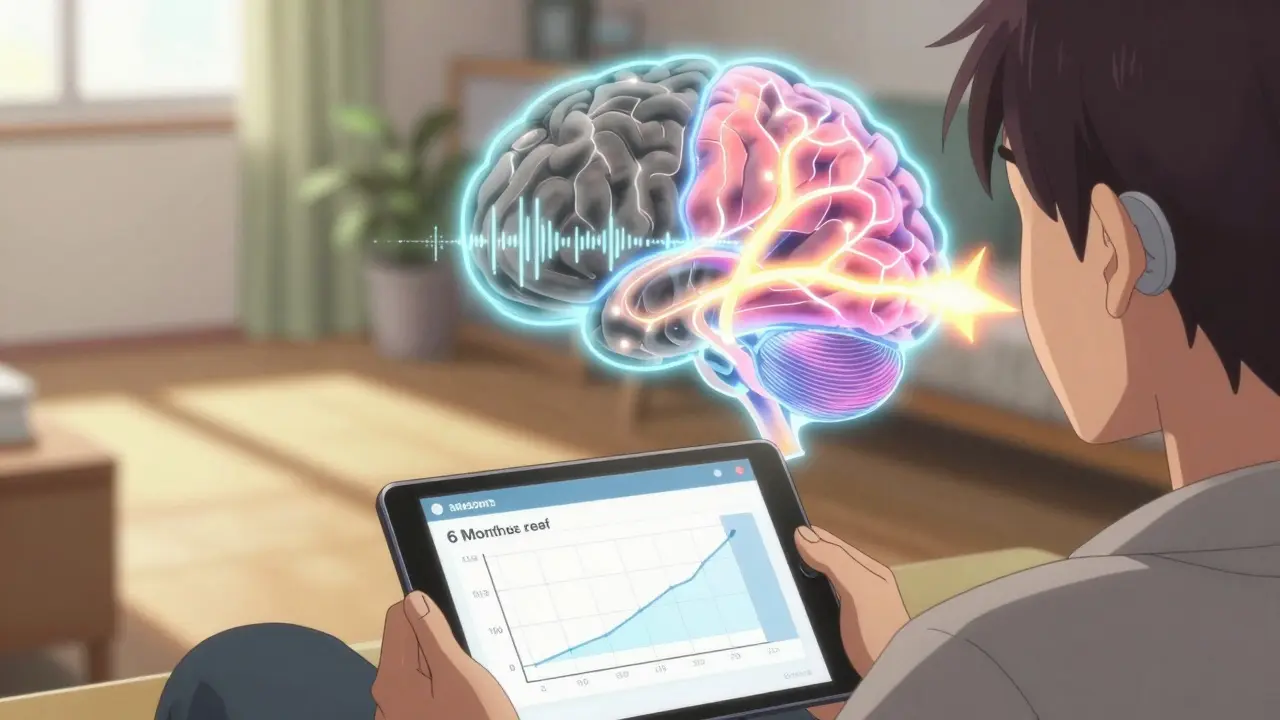
The surgery itself is outpatient. Most people go home the same day. The device isn’t turned on right away - it takes about 3 to 6 weeks for healing. Then comes activation: the audiologist programs the device, and you hear sounds for the first time - often strange, robotic, like a cartoon character. That’s normal. Your brain hasn’t heard speech like this in years. Rehabilitation is where the real work happens. You’ll work with an audiologist or speech therapist weekly at first. You’ll practice listening to recordings, identifying words, focusing on voices in noise. Studies show that people who stick with rehab for at least 6 months see the biggest gains. Outcomes are strong. A 2022 study of over 1,200 recipients found that, on average, sentence understanding improved by 47 percentage points. Eighty-nine percent said their daily communication got substantially better. Phone calls? Ninety-two percent of users reported being able to use the phone again. That’s life-changing. But it’s not perfect. Sixty-three percent of users say music still sounds unnatural. Background noise remains a challenge, even with the latest tech. And it takes time - sometimes up to a year - to reach your best performance. Patience isn’t optional.Why So Few People Get Them?
Here’s the hard truth: about 38 million American adults have disabling hearing loss. Only 128,000 cochlear implants were done in 2022. That’s less than 1%. Why? Three big reasons:- Doctors don’t know the criteria. A 2021 survey found only 32% of primary care physicians could correctly identify who qualifies.
- Patients don’t ask. Many think hearing aids are the end of the line. They don’t know implants exist or that they’ve gotten better.
- There’s no referral system. Unlike diabetes or high blood pressure, there’s no standard pathway for hearing loss. You have to know to ask.
Who Shouldn’t Get One?
Not everyone is a candidate. If you have a medical condition that makes surgery too risky - like uncontrolled heart disease or severe bleeding disorders - you won’t qualify. If your auditory nerve is absent or damaged beyond repair, the implant won’t work. And if you have dementia or severe cognitive decline, the rehab process may be too overwhelming. But here’s what most people get wrong: having some residual hearing doesn’t disqualify you. In fact, it might make you a better candidate. Hybrid implants - which combine a cochlear implant with a hearing aid in the same ear - can preserve your natural low-frequency hearing while giving you access to high-frequency sounds you’ve lost.What’s Next?
The future is moving fast. By 2030, experts predict cochlear implants will be standard care for anyone with bilateral hearing loss above 55 dB and speech understanding below 60% - even if they still use hearing aids. That could open the door to nearly 8 million more people in the U.S. alone. New tech is on the way. Researchers are testing brainwave monitoring to predict how well someone will respond to an implant before surgery. Electrocochleography and cortical auditory evoked potentials are becoming tools to measure neural health - not just ear health. But the biggest barrier isn’t technology. It’s awareness. If you or someone you love is struggling to hear conversations, even with hearing aids, don’t wait. Don’t assume it’s just aging. Don’t think it’s too late. Get evaluated. There’s no such thing as a bad referral anymore. The worst thing you can do is do nothing.Can I still get a cochlear implant if I have some natural hearing left?
Yes. Having some residual hearing doesn’t disqualify you - it might make you a better candidate. Hybrid cochlear implants can preserve your low-frequency hearing while using electrical stimulation for high frequencies you’ve lost. Many people with mild-to-moderate low-frequency hearing and severe high-frequency loss benefit greatly from this approach.
Is it too late to get a cochlear implant after 10 or 20 years of hearing loss?
No. Studies show that people implanted after 10 or even 20 years of deafness can achieve outcomes just as good as those implanted sooner - as long as their cognitive health is intact and they commit to rehabilitation. The key isn’t how long you’ve been deaf, but whether your brain can still relearn how to process sound.
Do cochlear implants restore normal hearing?
No. They don’t restore natural hearing. Instead, they give your brain electrical signals that represent sound. At first, voices may sound robotic or electronic. With time and therapy, most users learn to interpret these signals and understand speech clearly - often better than they ever did with hearing aids. But music and complex sounds may never sound completely natural.
Are cochlear implants covered by insurance?
Yes. Medicare, Medicaid, and most private insurers cover cochlear implants when criteria are met. Coverage includes the device, surgery, and follow-up rehabilitation. The biggest hurdle isn’t cost - it’s knowing you qualify and getting a referral.
What if I’m not sure if I’m a candidate?
Get evaluated anyway. The 2023 guidelines say there’s no such thing as a bad referral. Even if you’re not a candidate, the evaluation gives you a full baseline of your hearing health. That’s valuable information for future decisions, whether you choose an implant later or stick with hearing aids.
How long does it take to see results after the implant is activated?
Most people notice improvements within the first few weeks, especially in quiet environments. But it takes 3 to 6 months of consistent listening practice to reach your best performance. Some continue improving for up to a year. The key is daily listening practice and regular follow-ups with your audiologist.
Glendon Cone
January 1, 2026 AT 03:38Just had my implant activated last month. First thing I heard? My dog barking like a cartoon. 😂 But now I can hear my granddaughter say 'I love you' without asking her to repeat it 12 times. Life changed. Don't wait like I did.
Henry Ward
January 1, 2026 AT 08:55Everyone’s acting like this is some miracle cure. Newsflash: it’s not. I got mine 3 years ago and I still can’t enjoy music or hear someone whispering behind me. You’re trading one hell for another. And don’t even get me started on the tinnitus.
srishti Jain
January 1, 2026 AT 23:05My dad got one last year. He cried when he heard the microwave beep. That’s it. No more drama. Just beep.
Sandeep Mishra
January 2, 2026 AT 13:51There’s something beautiful about how science is finally catching up to what people have been saying for years: hearing isn’t just about the ears, it’s about the brain. The fact that we can now help someone reconnect with their family after 15 years of silence? That’s not medicine. That’s magic. And it’s available to so many who don’t even know they qualify. We need to stop treating hearing loss like it’s a personal failure. It’s a public health issue.
Colin L
January 4, 2026 AT 00:12Look, I’ve read this whole thing twice and I still don’t get why people are so excited. I mean, sure, you can hear the microwave beep again, but you’re still going to miss half the conversation at a restaurant. And the cost? Sure, insurance covers it, but what about the time? Six months of therapy? Who has that? I work two jobs. I can’t sit around listening to recordings of people saying ‘cup’ and ‘cap’ for an hour a day. This feels like a luxury for people who don’t have real problems. And don’t tell me about ‘cognitive decline’-I’ve seen people with implants still forget where they put their keys. It’s not a brain fix, it’s a bandaid.
Hayley Ash
January 5, 2026 AT 12:50So you’re telling me if I can’t understand my cat meowing I’m a candidate? 😏 I mean, I’ve been pretending to hear my husband for 20 years and he still hasn’t noticed. Maybe I’m just really good at nodding.
kelly tracy
January 6, 2026 AT 21:11This whole post is just corporate propaganda. Cochlear implants are a $20k scam pushed by hearing aid companies who lost money when people started realizing hearing aids don’t work. You think they want you to know you can get it for free? They want you to stay dependent on $5k hearing aids forever. And don’t even get me started on the ‘rehab’-it’s just another way to keep you in their system. I’ve seen people get implants and then get bullied into buying $3000 accessories. It’s predatory.
Cheyenne Sims
January 7, 2026 AT 21:29While the intent of this article is commendable, the grammatical structure of the concluding paragraph is fundamentally flawed. The phrase 'There’s no such thing as a bad referral anymore' is both syntactically imprecise and semantically redundant. Furthermore, the use of the contraction 'you’re' in formal medical discourse undermines the credibility of the entire argument. One must approach clinical decision-making with rigor, not sentimentality.
Shae Chapman
January 9, 2026 AT 14:34My mom got her implant last year. She cried during activation. Then she called me 10 minutes later screaming 'I HEARD THE DOORBELL!' like she’d won the lottery. 🥹 We all cried. I didn’t know hearing could be this emotional. If you’re hesitating? Go. Get evaluated. Even if you don’t get it, you’ll know you tried. And that matters.
Nadia Spira
January 10, 2026 AT 00:44The entire paradigm of cochlear implant candidacy is a neoliberal construct designed to pathologize aging and commodify neuroplasticity. You’re being sold a narrative that equates auditory input with cognitive integrity, ignoring the epistemological violence of sonic normalization. The AzBio test? A colonial tool of auditory hegemony. And let’s not forget the techno-utopian fantasy of ‘rehabilitation’-it’s just behavioral conditioning dressed in audiologist scrubs. You don’t need a device. You need a revolution.
henry mateo
January 11, 2026 AT 13:35i got mine 2 years ago and honestly i still dont get why people make it sound so hard. i just listen every day and now i can talk on the phone without my wife yelling. its not magic but its real. thanks for the post, it helped me feel less alone