
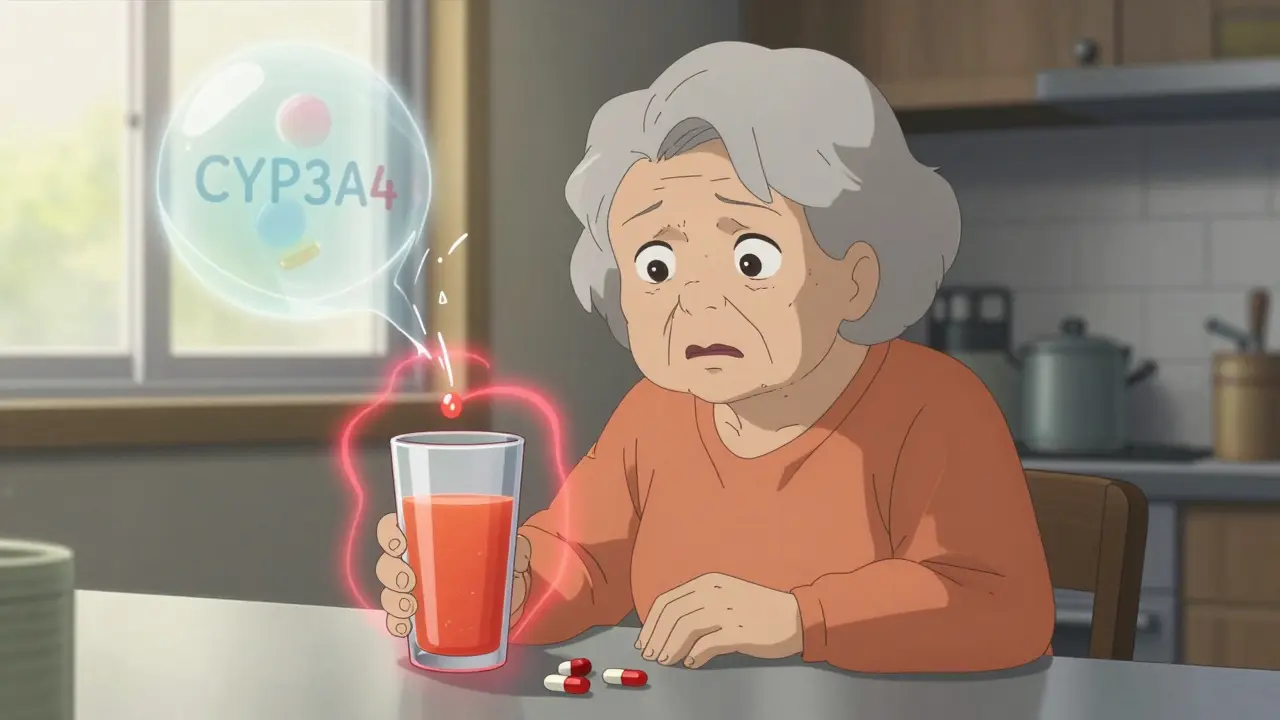
If you're taking a calcium channel blocker for high blood pressure, and you love your morning glass of grapefruit juice, you could be putting yourself at serious risk. This isn't a myth or a vague warning-it's a well-documented, potentially life-threatening interaction that affects millions of people worldwide. The problem isn't just grapefruit. It's about how your body processes medication, and what happens when common citrus fruits interfere with that process.
Why Grapefruit Is the Main Culprit
Not all citrus fruits are created equal when it comes to drug interactions. Grapefruit, Seville oranges, and tangelos contain high levels of chemicals called furanocoumarins, specifically 6',7'-dihydroxybergamottin and bergamottin. These compounds shut down an enzyme in your gut called CYP3A4, which normally breaks down certain medications before they enter your bloodstream. When that enzyme is blocked, your body absorbs way more of the drug than it should.One 200ml glass of grapefruit juice-about one small glass-is enough to disable CYP3A4 for up to 72 hours. That means even if you drink grapefruit juice in the morning and take your blood pressure pill at night, the interaction still happens. The enzyme doesn’t bounce back quickly. It’s permanently inactivated until your body makes new ones, which takes days.
Which Calcium Channel Blockers Are Affected?
Not all calcium channel blockers react the same way. The risk depends on how much the drug relies on CYP3A4 for metabolism. The most dangerous combinations include:- Felodipine: Bioavailability can jump 3 to 5 times higher when taken with grapefruit. A normal dose can become dangerously high.
- Nicardipine and Nimodipine: Both show major increases in blood levels, raising the risk of side effects.
- Amlodipine: While less affected than felodipine, studies still show a measurable increase in drug levels-enough to cause dizziness or low blood pressure in sensitive patients.
Drugs like verapamil and nifedipine may have some interaction, but the evidence is weaker. Still, caution is advised.
The real danger? You won’t feel it coming. A patient might take their usual dose, drink grapefruit juice, and suddenly feel lightheaded, flushed, or experience a pounding headache. In severe cases, blood pressure can drop so low that it causes fainting, falls, or even heart rhythm problems. Elderly patients are especially vulnerable. One nurse practitioner reported a case where an elderly woman couldn’t stand after her morning grapefruit juice and amlodipine-her blood pressure had crashed.
What Happens When You Mix Them?
The pharmacokinetic effects are dramatic. For felodipine, peak blood levels can rise from 2.5 ng/mL to 11.5 ng/mL after grapefruit juice. That’s a 350% increase. But it’s not just about peak levels. Because the enzyme stays blocked for days, the drug builds up in your system over time. By day four, a 60 mg dose might as well be 140 mg. That’s not a typo. That’s what happens when your body can’t clear the drug properly.These aren’t theoretical numbers. They come from clinical studies and real-world cases. The American Journal of Hypertension published a comprehensive review in 2006 showing this interaction is one of the most clinically significant food-drug reactions in cardiovascular medicine. And it’s still happening today-because most people don’t know about it.

Other Citrus Fruits: Are They Safe?
Sweet oranges (like Valencia or Navel) are generally safe. They contain very low levels of furanocoumarins. Orange juice, even from concentrate, doesn’t trigger this interaction. Same with tangerines and clementines.But Seville oranges-used in marmalade-are dangerous. They’re the sour, bitter kind, often sold in jars or used in baking. They contain the same furanocoumarins as grapefruit. So if you’re on a calcium channel blocker, skip the orange marmalade on your toast.
Tangelos, a cross between tangerines and grapefruits, are also risky. They inherit the furanocoumarins from their grapefruit parent. Even if they taste sweet, they’re not safe.
What Should You Do?
The advice is simple: avoid grapefruit and Seville oranges completely if you’re on a calcium channel blocker that interacts with it. Don’t try to time it. Don’t assume a little bit is okay. Don’t think you’re safe because you only drink it once a week. The enzyme inhibition lasts for days.If you’re unsure whether your medication is affected, check the label. Felodipine, nimodipine, and nicardipine all have black box warnings about grapefruit in their prescribing information. If your pill bottle doesn’t say anything, ask your pharmacist. They can look up the interaction using clinical databases.
There are safer alternatives. Amlodipine is often preferred because the interaction is less severe. But even then, some doctors recommend avoiding grapefruit entirely just to be safe. Other blood pressure medications with no known grapefruit interaction include:
- ACE inhibitors like lisinopril
- ARBs like valsartan
- Thiazide diuretics like hydrochlorothiazide
- Some beta blockers like metoprolol
If you’re currently on a high-risk CCB and love citrus, talk to your doctor about switching. It’s not just about convenience-it’s about safety.

Why Is This Still a Problem?
Despite decades of research, this interaction is still widely underappreciated. A 2022 survey found only 37% of primary care doctors routinely ask patients about grapefruit consumption before prescribing calcium channel blockers. And 68% of patients had no idea their morning juice could interfere with their medication.Doctors assume patients know. Patients assume the doctor told them. The result? Around 15,000 emergency room visits in the U.S. each year are linked to grapefruit-drug interactions, mostly involving blood pressure meds. Most of these are preventable.
Even worse, some patients think switching to “diet” grapefruit juice or “grapefruit-flavored” water helps. It doesn’t. Artificial flavors don’t contain furanocoumarins, but actual grapefruit juice-even in small amounts-does. And some “grapefruit-flavored” products still contain real juice. Always read the label.
What’s Being Done About It?
Researchers are working on solutions. Two new extended-release versions of amlodipine are currently in Phase III clinical trials. Early results show they reduce grapefruit interaction by 70%. That’s promising. But these drugs aren’t available yet.Until then, the only proven solution is avoidance. No exceptions. No compromises. No “just a sip.”
If you’re on a calcium channel blocker, your morning routine should look like this: water, then your pill. Skip the grapefruit. Save it for when you’re off the medication-or switch to a safer drug altogether. Your blood pressure, your heart, and your safety depend on it.
brooke wright
January 17, 2026 AT 11:33I knew grapefruit was bad with my meds but I had no idea it lasted 72 hours. I’ve been drinking it every morning for years with amlodipine. Holy crap. I’m switching to orange juice tomorrow. No more risky breakfasts.
Nick Cole
January 19, 2026 AT 08:03This is one of those things doctors assume you know but never actually tell you. My uncle ended up in the ER last year because of this. He thought "a little bit" wouldn’t hurt. It did. Don’t be him.
Nicholas Gabriel
January 20, 2026 AT 23:03Let me be clear: this isn’t just a warning-it’s a lifeline. If you’re on felodipine, nimodipine, or nicardipine, and you love grapefruit, you’re playing Russian roulette with your heart. The enzyme CYP3A4 doesn’t "bounce back" like a rubber band-it’s destroyed. Your body has to rebuild it from scratch. That’s not a myth. That’s biochemistry. And yes, even one glass can do it. And no, "diet" grapefruit juice doesn’t help. If it has real fruit in it, it’s dangerous. Read the label. Ask your pharmacist. Don’t gamble with your health.
Cheryl Griffith
January 22, 2026 AT 06:01I’m a nurse, and I’ve seen this happen too many times. Elderly patients especially-quiet, sweet people who’ve been drinking grapefruit juice for decades. They don’t even realize it’s the juice causing their dizziness. One woman thought she was just getting older. Turns out, her blood pressure dropped to 70/40. She fell and broke her hip. It’s not dramatic. It’s quiet. And that’s why it’s so deadly.
Isabella Reid
January 22, 2026 AT 15:47Just a heads-up: Seville oranges are in a lot of marmalades, especially the fancy British ones. I used to buy that stuff for my toast until I read this. Now I stick to sweet oranges. Also, tangelos? Totally tricked me. They taste like candy but they’re basically grapefruit in disguise. Learned the hard way.
Jody Fahrenkrug
January 24, 2026 AT 11:24So… orange juice is fine? Just not the sour kind? Got it. I’ll stop being paranoid about my OJ. Also, can we please make this a thing on pill bottles? Like a little grapefruit icon? Like the alcohol one?
Kasey Summerer
January 24, 2026 AT 23:57So if I drink grapefruit juice and take my meds… I’m basically doing a drug cocktail with my breakfast? 😏 Guess I’ll be drinking water from now on. Or maybe just… not taking the meds? 😈
Allen Davidson
January 25, 2026 AT 20:48Don’t panic. Just be smart. If you’re on amlodipine, the risk is low but still real. Talk to your doc about switching to an ACE inhibitor or ARB if you really love citrus. There are better options. And if your doctor doesn’t know this? Find a new one. This isn’t rocket science-it’s basic pharmacology. Your life matters more than your morning routine.
john Mccoskey
January 26, 2026 AT 03:06People treat this like a medical mystery when it’s just basic biology. The liver doesn’t care about your preferences. It doesn’t care if you "love" grapefruit. It doesn’t care if you’re "old school" or "traditional." CYP3A4 is an enzyme, not a suggestion. And yet, millions still ignore it because they think they’re special. You’re not. Your body is a chemical factory, not a TikTok trend. If you don’t respect the science, you’ll end up in the ER. Again. And again. And again. And then you’ll blame the system. The system didn’t fail you. You failed the system.
Ryan Hutchison
January 26, 2026 AT 10:34Why are we letting foreigners dictate our health? Grapefruit is a fruit, not a weapon. This is just another overblown FDA scare tactic. Back in my day, we drank grapefruit juice with our pills and lived to 90. You people are too scared to eat anything. Grow a spine.
Samyak Shertok
January 27, 2026 AT 00:00Oh wow, so the West is finally waking up to the fact that citrus is a bioactive compound? In India, we’ve known for centuries that bitter fruits interact with medicine. But no, you need a 2006 American journal to tell you not to mix grapefruit with pills? Pathetic. Also, I drink grapefruit juice with my blood pressure meds. I’m 87. Still walking. Your science is weak.
Stephen Tulloch
January 27, 2026 AT 21:46Look, I get it. Grapefruit is the devil. But honestly? I just take my meds with sparkling water and call it a day. 🥤✨ Also, if you’re on felodipine and still drinking grapefruit juice, you’re not just reckless-you’re a walking liability. Like, come on. You’re not a lab rat. You’re a human. Act like one. 🙄
Melodie Lesesne
January 28, 2026 AT 07:14I switched to oranges after reading this and honestly? I feel better. No more dizziness. Also, my pharmacist gave me a little card with all the risky meds and safe alternatives. I carry it in my wallet now. Small thing, big difference.
Rob Deneke
January 28, 2026 AT 23:28My doc never told me about this. I’m gonna call him tomorrow. Thanks for the heads up. I’ve been drinking grapefruit juice with my amlodipine for 5 years. No idea it was this bad
evelyn wellding
January 30, 2026 AT 02:48OMG I JUST REALIZED I’VE BEEN DOING THIS FOR YEARS 😱 I’M SWITCHING TO APPLE JUICE TODAY 🍎💖 THANK YOU FOR THIS POST!!